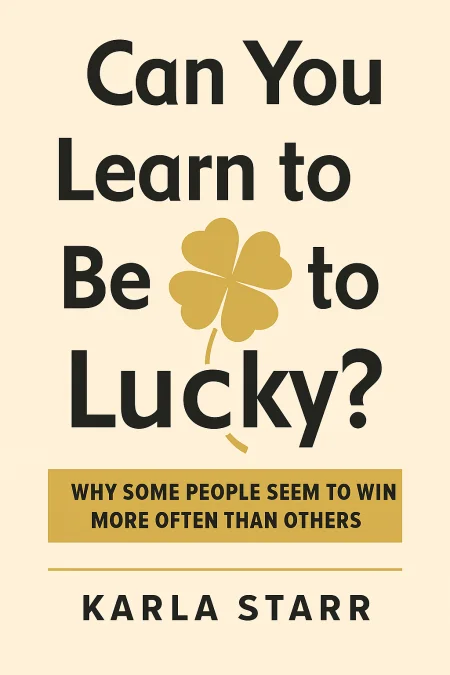
Can You Learn to be Lucky?
Why Some People Seem to Win More Often Than Others
Book Edition Details
Summary
What if fortune's fickle hand isn't as random as it seems? In "Can You Learn to Be Lucky," Karla Starr unveils the hidden architecture of luck, revealing that those seemingly serendipitous moments are often influenced by subconscious biases and cultural cues. Through a journalist's keen eye, Starr deciphers the puzzle of luck, demonstrating how invisible forces mold our destiny and how we can sway them in our favor. Unearth the secrets of motivation's uneven distribution, the silent power of first impressions, and the snap judgments that guide our fate. Starr's insights transform life's unpredictability into a playground of opportunity, where understanding the mechanics of luck empowers you to craft your own destiny with minimal effort.
Introduction
Picture yourself rushing through a crowded airport terminal, stressed about missing your connection, when you accidentally bump into someone carrying coffee. As you both scramble to clean up the mess, laughing at the absurdity of the moment, you discover they work at the exact company you've been dreaming of joining. Three months later, you're walking into your new office, wondering how such a random collision could have changed everything. We've all witnessed these seemingly magical moments where chance encounters transform into life-changing opportunities. Some people appear to stumble into success repeatedly, while others work tirelessly yet struggle to catch a break. The difference isn't just random fortune—it's about understanding the hidden psychological and social forces that create opportunities and learning to position ourselves where serendipity is most likely to strike. Through fascinating research and compelling real-world examples, we can discover that luck follows predictable patterns. While we cannot control every variable in our lives, we can dramatically increase our odds of favorable outcomes by recognizing how timing affects perception, how first impressions shape opportunities, and how our own behaviors create the conditions for positive coincidences. This journey reveals that becoming luckier isn't about wishful thinking or superstition—it's about developing the awareness, skills, and mindset that allow us to dance more skillfully with uncertainty and create the life we truly want.
The Timing Game: When Order and Proximity Create Opportunities
At the Motor City Tattoo Expo, judges faced an overwhelming task: evaluating hundreds of intricate tattoos across multiple categories throughout a long day. As the hours passed, something remarkable happened that had nothing to do with artistic skill. The tattoos displayed later in the competition consistently received higher scores than those shown earlier, regardless of their actual quality. This wasn't conscious favoritism—it was the brain's natural tendency to use recent experiences as reference points, creating what researchers call the "end of sequence effect." This phenomenon extends far beyond tattoo competitions into the most important moments of our lives. Olympic figure skating judges consistently score final performers higher than earlier ones. Parole boards are significantly more likely to grant parole to prisoners whose cases are heard after lunch breaks rather than before, when mental fatigue clouds judgment. Even American Idol contestants benefit from performing later in the show, as judges' standards unconsciously shift throughout the evening. The timing of when we present ourselves matters enormously, but so does where we position ourselves physically and socially. Consider something as simple as choosing where to sit in a college classroom. Students who sit closer to the front don't just pay better attention—they're more likely to form meaningful relationships with both professors and other engaged students. These connections often blossom into research opportunities, recommendation letters, and career guidance that can alter entire life trajectories. Proximity breeds familiarity, and familiarity breeds preference, creating a cascade of opportunities that seem coincidental but follow predictable patterns. Understanding these invisible forces reveals that much of what we call luck actually operates according to discoverable rules. The key is developing awareness of when timing and positioning can work in our favor, then having the courage to place ourselves where positive coincidences are most likely to occur.
First Impressions Matter: The Power of Appearance and Status
Sarah Palin's meteoric rise from small-town Alaska mayor to vice-presidential candidate seemed impossible until you understand the profound advantages that physical presence provides. Her striking appearance and telegenic charisma caught the attention of political operatives who might have overlooked her limited resume. While her qualifications were endlessly debated, her ability to command attention and project confidence was undeniable—illustrating how our brains make lightning-fast judgments that can override more rational considerations. The science behind first impressions reveals uncomfortable truths about human decision-making. Research consistently shows that attractive people earn more money, receive more job offers, and are perceived as more competent, even when their actual abilities are identical to their less attractive counterparts. Teachers unconsciously give higher grades to attractive students. Juries impose lighter sentences on attractive defendants. Voters choose better-looking candidates more often, even when they know nothing else about their policies or experience. These aren't conscious decisions—they're automatic responses rooted deep in our evolutionary psychology. But attractiveness extends far beyond genetics into areas we can all influence. A well-fitted outfit signals competence and attention to detail. Confident posture conveys leadership potential. Maintaining appropriate eye contact dramatically improves how others perceive our trustworthiness and intelligence. Even our vocal tone and speaking pace affect whether others categorize us as credible authorities or dismiss our ideas before we finish expressing them. These visual and auditory cues act as powerful shortcuts that help others quickly decide whether we're worth their time and attention. When we understand how these snap judgments form, we can be more intentional about the signals we send, ensuring our external presentation gives us the best chance to demonstrate our true capabilities before first impressions become lasting opinions.
Building Your Luck Foundation: Self-Control, Talent, and Social Networks
Derek Sivers was a struggling musician trying to sell his own CDs when he built a simple website to help fellow artists reach their fans. What began as a generous favor for friends evolved into CD Baby, the largest seller of independent music online, which he eventually sold for twenty-two million dollars. But Sivers's extraordinary success wasn't just about being in the right place at the right time—it was about having the self-discipline to consistently execute his vision while genuinely caring about others in his industry. The famous Stanford marshmallow experiment revealed something crucial about human potential: four-year-olds who could delay gratification by waiting for a second marshmallow were more successful academically, socially, and professionally decades later. This wasn't because willpower determines destiny, but because self-control enables us to make choices that compound positively over time. When we can resist immediate temptations, we're more likely to practice skills, nurture relationships, and pursue opportunities that create long-term value rather than short-term pleasure. Self-control isn't just about resisting temptation—it's about saying yes to the right things at the right moments. It's about showing up consistently even when motivation wanes, investing in relationships before we need them, and developing capabilities before opportunities arise. The people who appear luckiest often have histories of small, disciplined choices that positioned them to capitalize on chance encounters when they occurred. But discipline alone isn't sufficient. The highest performers in any field combine self-control with genuine talent and passion, finding the sweet spot where their natural abilities intersect with their authentic interests. They practice more because they enjoy the process, persist longer because the activity itself is rewarding, and attract others who want to support their journey. Most importantly, they understand that success is rarely a solo endeavor, cultivating diverse networks through curiosity about others and willingness to help without expecting immediate returns. These relationships become channels through which opportunities flow, creating webs of mutual support that generate apparently serendipitous encounters.
Embracing Uncertainty: The Mindset That Multiplies Fortune
Tony Hsieh's journey from Harvard computer science student to CEO of Zappos illustrates the extraordinary power of remaining open to unexpected paths. He never intended to revolutionize online shoe sales, but when an entrepreneur pitched him the idea for an internet footwear company, Hsieh's curiosity and willingness to explore unfamiliar territory led him to invest, then eventually take over the business. His openness to uncertainty, rather than rigid adherence to predetermined plans, created conditions for building a company worth over a billion dollars. The most consistently fortunate people share a remarkable trait: they approach uncertainty with curiosity rather than fear. While most of us instinctively avoid ambiguous situations, preferring the comfort of predictable routines, those who seem to stumble upon opportunities actively seek out novel experiences. They accept invitations that take them outside comfort zones, engage with people who think differently, and view unexpected changes as potential adventures rather than threats to be avoided. This mindset shift has profound neurological foundations. When we approach new situations with genuine curiosity, our brains release chemicals that enhance learning and memory formation. We become more likely to notice subtle patterns and connections that others miss, developing what researchers call cognitive flexibility—the ability to adapt our thinking when circumstances change. This mental agility allows us to recognize opportunities that others overlook and pivot quickly when new possibilities emerge. Embracing uncertainty doesn't mean being reckless or unprepared. The luckiest people combine openness with competence, developing strong foundational skills that give them confidence to venture into unknown territory. They maintain financial and emotional reserves that allow calculated risks, build support networks that provide guidance during uncertain times, and treat failures as valuable data rather than judgments about their worth. This resilience allows them to persist through inevitable challenges, dramatically increasing their chances of eventually breaking through to extraordinary success.
Summary
The science of getting lucky reveals a profound and empowering truth: what we often attribute to pure chance is frequently the predictable result of positioning, preparation, and perspective. The stories and research throughout this exploration demonstrate that while we cannot control random events, we possess far more influence over our exposure to positive possibilities than we might imagine. The most transformative insight is that luck operates less like a lottery and more like a skill that can be developed through intentional practice. By understanding how timing affects perception, we can choose when and how to present ourselves most effectively. By recognizing the power of first impressions, we can ensure our external presentation reflects our internal capabilities. By building self-control and nurturing authentic relationships, we create foundations for long-term success. By embracing uncertainty with curiosity rather than fear, we multiply our chances of discovering unexpected opportunities that can change everything. Perhaps most encouragingly, these principles are accessible to everyone regardless of background or current circumstances. The person who helps strangers, shows up consistently, maintains genuine curiosity about the world, and approaches challenges with resilience is actively creating conditions for serendipitous encounters. They are not passively waiting for fortune to find them—they are expanding the surface area where positive coincidences can occur. In a world that often feels chaotic and unpredictable, this represents both hope and empowerment: the recognition that while we cannot control everything that happens to us, we have remarkable power to shape the likelihood of favorable outcomes through our choices, attitudes, and actions.
Related Books
Download PDF & EPUB
To save this Black List summary for later, download the free PDF and EPUB. You can print it out, or read offline at your convenience.
By Karla Starr
