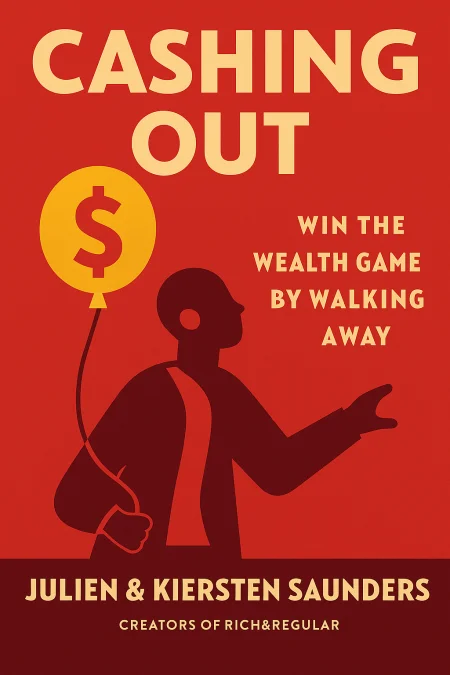
Cashing Out
Win the Wealth Game by Walking Away
byJulien Saunders, Kiersten Saunders
Book Edition Details
Summary
Corporate America isn’t the finish line—it’s just the starting block. Tired of the endless grind that leaves you exhausted and underpaid? "Cashing Out" by Julien and Kiersten Saunders flips the script on traditional financial advice, revealing a dynamic blueprint to reclaim your life and wealth. This isn’t about playing by outdated rules; it’s about redefining success on your own terms. Drawing from their personal triumph of erasing $200,000 in debt and escaping the corporate treadmill, the Saunders offer a refreshingly candid take on building prosperity that celebrates freedom, not stress. Learn to align your financial goals with your life’s true priorities, communicate openly about money without conflict, and create multiple income streams that respect your time and energy. If you’re ready to chart a new course to financial independence, "Cashing Out" is your guide to navigating—and thriving outside—the system.
Introduction
Picture this: you're sitting in your pristine corporate office, checking emails during what should be your honeymoon in South Africa. The sunset paints the horizon in brilliant oranges and purples, yet your eyes are glued to your phone screen, responding to work messages that simply couldn't wait. This was the wake-up call moment for Kiersten and Julien Saunders, a successful Black couple who seemed to have it all but realized they were trapped in a cycle of endless work with no clear exit strategy. Their story begins like many others in corporate America, climbing ladders that seemed to lead nowhere, earning good money but living paycheck to paycheck despite six-figure incomes, and wondering why financial security felt so elusive. What makes their journey extraordinary isn't just that they managed to pay off $200,000 in debt and achieve financial independence before forty, but how they discovered a path that honors both their values and their reality as Black Americans navigating systems that weren't built for their success. This book challenges everything we've been taught about work, money, and the American Dream. It offers a radical yet practical roadmap for anyone tired of sacrificing their present for an uncertain future, anyone ready to take control of their financial destiny, and anyone seeking to build wealth while maintaining their integrity and sense of self. Through honest conversations about race, money, and relationships, you'll discover that financial freedom isn't just about numbers in a bank account, it's about reclaiming your time, your choices, and your life.
From Corporate Dreams to Financial Wake-Up Call
The statistics hit them like a cold slap of reality. In 2017, Kiersten and Julien stumbled upon research predicting that median Black wealth in America was on track to reach zero by 2053. Zero. Not declining, not stagnating, but completely disappearing. As they processed this devastating projection, they looked around at their own circle of highly educated, well-employed friends and family members and saw the harsh truth reflected everywhere. These weren't people lacking ambition or intelligence. They were college graduates with impressive job titles, beautiful homes, and luxury cars. Yet beneath the polished exterior, most were drowning in debt, living paycheck to paycheck despite substantial salaries, and working themselves into exhaustion just to maintain an appearance of success. The math was brutally simple: after student loans, mortgages, car payments, and credit cards, there was nothing left. They were hamsters on a wheel, running faster and faster but getting nowhere. The couple watched as their peers took on additional debt to fund advanced degrees, hoping education would be their ticket to financial freedom. They witnessed brilliant minds trapped in jobs they disliked because they couldn't afford to leave. They saw the quiet desperation behind forced smiles when conversations turned to money, the careful avoidance of certain topics, the shame that came with admitting financial struggle despite outward success. This wasn't just about individual choices or personal responsibility. The authors recognized they were witnessing the compound effect of historical disadvantages, systemic barriers, and cultural pressures that made traditional financial advice feel inadequate. The standard playbook of "work hard, save ten percent, and retire at sixty-five" wasn't working for their community, and pretending otherwise was dangerous. The wake-up call forced them to confront uncomfortable truths about their own situation. Despite their success, they too were caught in the trap of trading time for money with no clear exit strategy. They realized that without dramatic change, they would become another statistic in the wealth gap research, working until they couldn't and hoping someone else would take care of them in their golden years.
Breaking Free: The Fifteen-Year Career Strategy
Most people never seriously consider how long their career should last. They hope for longevity, power through decades of work, and pray retirement will somehow work itself out. But Kiersten and Julien propose something radical: plan for your career to be exactly fifteen years long. Not because everyone can retire at thirty-seven, but because approaching your career with an intentional end date changes everything about how you work, spend, and invest. The fifteen-year framework breaks down into three distinct phases, each with its own focus and objectives. Years one through five center entirely on debt elimination, treating debt like the financial cancer it truly is. This means aggressive frugality, strategic use of methods like debt avalanche or snowball approaches, and viewing every extra dollar as an opportunity to buy back your freedom. The authors share stories of their own debt journey, including the sacrifices that felt impossible at first but became empowering acts of self-determination. Years six through ten shift focus to skill development and income diversification. This is when you discover your professional superpowers and learn to monetize them outside your primary job. Take Kendra Barnes, who transformed her government data analysis skills into a real estate empire that eventually replaced her entire salary. Or consider how corporate skills in negotiation, project management, and strategic thinking translate perfectly to property management, consulting, or online business creation. The final phase, years eleven through fifteen, is about building your escape hatch. This is when all the pieces come together: debt is gone, skills are monetized, and investment accounts are growing exponentially. Some people, like Purple from the blog "A Purple Life," achieve financial independence in just nine years through extreme discipline and strategic job-hopping that increased her income by twenty thousand dollars annually while keeping expenses below twenty thousand per year. The beauty of this approach isn't just the timeline, but the psychological shift it creates. When you know your career has an expiration date, you stop trying to climb every ladder and start building your own. You become strategic about skill development, intentional about spending, and aggressive about creating multiple income streams. Most importantly, you stop defining yourself by your job title and start designing a life that reflects your values rather than your employer's demands.
Building Wealth Through Technology and Community
The digital revolution has fundamentally changed how wealth is created, yet many people still think like it's 1995. While traditional employment faces threats from automation and corporate instability, technology has simultaneously opened unprecedented opportunities for individual wealth creation. The authors discovered this firsthand when they learned that a single Instagram post could earn them twenty-five hundred dollars, or that a simple YouTube video shot on an iPhone could generate thirty-five hundred in revenue. The key insight is understanding that technology has democratized access to global markets. Whether it's creating digital courses, offering freelance services on platforms like Fiverr, or building audiences through content creation, the internet allows individuals to bypass traditional gatekeepers and sell directly to customers worldwide. Jannese Torres-Rodriguez exemplifies this transformation, building a food blog focused on Puerto Rican cuisine that eventually generated over one hundred thousand dollars annually in additional income. But technology is only part of the equation. The authors emphasize that sustainable wealth building requires community, and not necessarily the community you were born into. Traditional friends and family often struggle to support radical financial choices, sometimes viewing frugality as deprivation or investment focus as obsession. The solution is finding your tribe within the Financial Independence Retire Early community, where shared values create understanding and mutual support. This community operates as what experts call a "community of practice" where members learn from each other's successes and failures. Whether through online forums, local meetups, or events like CampFI, connecting with like-minded individuals provides accountability, inspiration, and practical knowledge that can't be found elsewhere. The authors share how their community helped them navigate everything from investment decisions to home purchases, proving that financial independence is easier to achieve with support. The combination of technological leverage and community support creates a powerful multiplier effect. Technology provides the tools to scale income beyond traditional employment limitations, while community provides the knowledge and encouragement necessary to persist through challenges. Together, they form the foundation for building wealth that traditional advice simply cannot match.
Creating Your Rich and Regular Life
The ultimate goal isn't to become extraordinarily wealthy or live an extreme lifestyle, but to achieve what the authors call "rich and regular" status. This means having enough money to make choices based on values rather than financial desperation, while maintaining relationships, health, and personal integrity. It's about being wealthy enough to matter in your community while staying grounded enough to relate to the people you care about. Being rich and regular means understanding that money is a tool for freedom, not a scoreboard for comparison. It's having the confidence to turn down job opportunities that don't align with your values, the resources to help family members in crisis, and the time to pursue interests beyond earning income. The authors discovered this balance during their honeymoon in South Africa, where they glimpsed what life could feel like when work wasn't the center of everything. The path requires rejecting both extreme frugality and mindless consumption in favor of intentional spending aligned with personal values. This might mean living in a smaller house to afford better experiences, choosing used cars to maximize investment contributions, or cooking at home to fund family travel. The key is making conscious trade-offs rather than defaulting to cultural expectations about success markers. Building a rich and regular life also means preparing for setbacks and uncertainty. The 2020 pandemic proved that financial independence provides psychological resilience as much as economic security. While others panicked about job loss or market volatility, financially independent individuals adapted with confidence because their identity wasn't tied to employment and their survival wasn't dependent on a single income source. The authors emphasize that this lifestyle isn't about perfection or extreme sacrifice, but about consistent choices that compound over time. It's about recognizing that happiness isn't found in accumulating possessions or achieving traditional milestones, but in having the freedom to live according to your own values and timeline. Success is measured not by net worth alone, but by the peace of mind that comes with financial security and the joy of living authentically.
Summary
The journey from corporate dependency to financial independence isn't just about money, it's about reclaiming your humanity in a system designed to consume it. Through honest storytelling and practical wisdom, this book reveals how two people transformed from overworked employees into intentional wealth builders who control their own destiny. Their path wasn't perfect or easy, but it was purposeful and ultimately liberating. The most profound insight is that financial freedom begins in your mind, not your bank account. Once you stop believing that hard work alone guarantees security, stop accepting that your career defines your worth, and stop waiting for permission to build the life you want, everything changes. The combination of aggressive debt elimination, strategic skill development, technological leverage, and community support creates a formula that works regardless of your starting point or background. Perhaps most importantly, the book demonstrates that achieving financial independence isn't about becoming someone else, but about becoming more fully yourself. It's about having enough resources to act on your values, enough time to nurture relationships, and enough security to take meaningful risks. The goal isn't to escape life, but to engage with it on your own terms, creating a legacy that extends far beyond your bank balance.
Related Books
Download PDF & EPUB
To save this Black List summary for later, download the free PDF and EPUB. You can print it out, or read offline at your convenience.
By Julien Saunders
