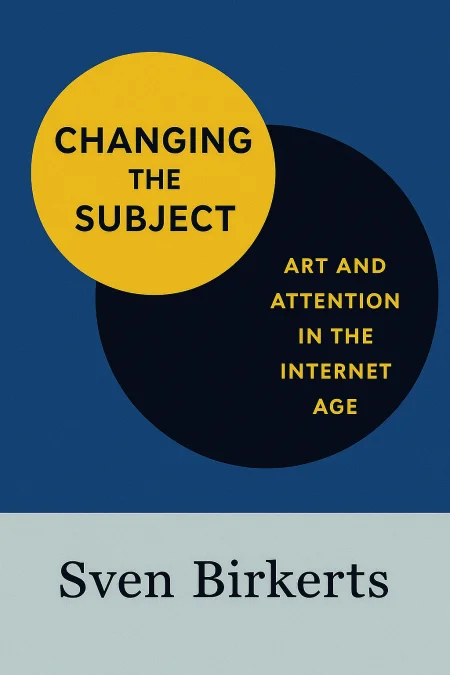
Changing the Subject
Art and Attention in the Internet Age
Book Edition Details
Summary
In a world teetering on the edge of digital saturation, Sven Birkerts' "Changing the Subject" delves into the profound shifts technology inflicts on our lives. This collection of essays, brimming with intellectual fervor, explores how our digital dependency chips away at individuality, creativity, and the serene art of deep reading. Birkerts, a modern-day Cassandra, reflects on his personal journey of cautious tech adoption while lamenting the loss of genuine human connection and undistracted thought. His poignant musings offer a lifeline for those yearning to reclaim their minds from the relentless hum of digital distraction. By juxtaposing the quiet power of literature with the cacophony of screens, Birkerts inspires a return to mindful engagement, urging readers to pause, reflect, and rediscover the rich tapestry of the human experience beyond the digital veil.
Introduction
The digital revolution has fundamentally altered not just how we access information, but how we think, perceive, and relate to the world around us. At the heart of this transformation lies a profound crisis of attention—our capacity for deep, sustained focus is being systematically eroded by the very technologies we've embraced as liberating. This erosion threatens something far more precious than mere productivity: it endangers our ability to engage meaningfully with art, literature, and the contemplative experiences that have long defined human flourishing. The crisis manifests in subtle but pervasive ways. We find ourselves unable to read books as we once did, struggling to maintain focus on complex ideas, and increasingly drawn to the fragmented, hyperlinked nature of digital media. Yet this is not simply a matter of changing habits—it represents a fundamental rewiring of consciousness itself. The argument presented here challenges the prevailing assumption that digital technologies are neutral tools, revealing instead how they actively reshape our neural pathways and cognitive capacities. Through careful analysis of how attention functions, how digital media operates, and what we stand to lose in this exchange, a compelling case emerges for reclaiming our capacity for deep focus. The stakes could not be higher: in losing our ability to attend fully to art and literature, we risk losing touch with the very experiences that make us most fully human.
The Digital Transformation of Human Consciousness and Attention
The unprecedented speed and scope of digital adoption has created a transformation unlike any previous technological shift in human history. Within a single generation, we have moved from a mechanical to a digital paradigm, fundamentally altering the basic conditions of consciousness. This shift operates not merely at the surface level of changed behaviors, but at the deeper level of neural reorganization. Neuroscientific research reveals that our brains possess remarkable plasticity, physically rewiring themselves based on repeated activities. The constant fragmentation demanded by digital media—switching between browser tabs, responding to notifications, processing hyperlinks—literally reshapes our neural pathways. We develop enhanced capacities for rapid task-switching while simultaneously weakening our ability to sustain prolonged focus on singular objects of attention. The implications extend far beyond individual cognition. Digital technologies operate according to a logic of endless connectivity and instant access, creating what can be understood as a new form of environmental pressure. Just as industrial pollution changed the physical atmosphere, digital saturation has created an informational atmosphere that is increasingly difficult to escape. The old boundaries between work and leisure, public and private, presence and absence have dissolved. This transformation operates below the threshold of conscious awareness, making it particularly insidious. We adapt to new capabilities while gradually losing capacities we may not even recognize as valuable until they are gone. The result is a fundamental shift in the structure of human experience, one whose full implications we are only beginning to understand.
Reading, Literature, and the Crisis of Deep Focus
The act of reading—particularly the deep, immersive reading that literature demands—represents one of humanity's most sophisticated cognitive achievements. It requires the ability to sustain attention over extended periods, to construct complex mental models, and to engage imaginatively with hypothetical worlds. These capacities are precisely what digital media systematically undermines. Literary reading operates through what might be called "contemplative duration"—the reader must slow down, inhabit the rhythm of the text, and allow meaning to emerge gradually through sustained engagement. This process cannot be rushed or fragmented without fundamentally altering the experience. When we attempt to read literature with the scanning, hyperlinked attention patterns fostered by digital media, we miss not just details but the deeper resonances that emerge only through unhurried contemplation. The crisis manifests in multiple ways: declining enrollment in humanities courses, the struggle of even dedicated readers to maintain focus on challenging texts, and the broader cultural shift away from the kind of patient, reflective engagement that literature requires. Publishers respond by producing increasingly accessible, fast-paced works that accommodate shortened attention spans, creating a feedback loop that further erodes our capacity for challenging material. Yet literature offers something irreplaceable: the opportunity to inhabit other consciousnesses fully, to experience the world through radically different perspectives, and to encounter the kind of moral complexity that resists easy resolution. These experiences require the very capacities that digital media erodes—patience, empathy, and the ability to tolerate ambiguity and uncertainty while working toward deeper understanding.
Technology, Individuality, and the Hive Mind Challenge
Digital technologies promote a fundamental shift from individual to collective modes of consciousness. The constant connectivity enabled by smartphones, social media, and networked computing creates what can be understood as a "hive mind" dynamic, where individual thoughts and preferences are increasingly shaped by algorithmic mediation and crowd-sourced validation. This shift operates through multiple mechanisms. Search engines and recommendation algorithms determine not just what information we encounter, but how we encounter it, creating filter bubbles that reinforce existing preferences while claiming to expand our horizons. Social media platforms reward content that generates engagement, systematically privileging sensational or divisive material over nuanced reflection. The result is a gradual erosion of independent thought and the capacity for genuine intellectual solitude. The implications for individual consciousness are profound. The development of a distinct, coherent sense of self has historically required periods of solitude and reflection—precisely what digital connectivity makes increasingly difficult to achieve. We are never fully alone with our thoughts, never completely disconnected from the stream of other people's opinions, reactions, and demands for attention. This represents more than a mere change in social habits; it challenges the fundamental premise of liberal democracy, which depends on the existence of independent-thinking individuals capable of making reasoned judgments. If our thoughts and preferences are increasingly shaped by algorithmic manipulation and social pressure, the very foundation of autonomous selfhood comes under threat. The question becomes whether it is possible to maintain genuine individuality within systems designed to promote collective behavior and consumption.
Reclaiming Contemplative Experience in a Fragmented World
Despite the pervasive influence of digital technologies, the human capacity for deep attention and contemplative experience has not disappeared entirely. It remains latent, waiting to be reactivated through conscious effort and deliberate practice. The key lies in understanding attention not as a passive faculty, but as an active power that can be cultivated and strengthened. Art and literature serve as particularly powerful means of attention training. Engaging seriously with challenging works—whether novels, paintings, or musical compositions—requires and simultaneously develops the capacity for sustained focus. This engagement operates as a kind of resistance to the fragmenting forces of digital culture, creating islands of depth within an ocean of distraction. The cultivation of contemplative experience requires deliberate choices about how we structure our daily lives. This might involve creating technology-free zones, establishing regular practices of sustained reading, or simply learning to tolerate the anxiety that arises when we are not constantly connected and stimulated. Such practices are not mere nostalgic gestures but essential acts of self-preservation. The stakes extend beyond individual well-being to the very possibility of maintaining cultural continuity. The great works of art and literature that have shaped human civilization require engaged readers and viewers to remain alive. Without this engagement, they become mere historical artifacts rather than living sources of wisdom and beauty. Reclaiming our capacity for deep attention is thus both a personal and a cultural imperative, essential for preserving what is most valuable in human experience.
Summary
The digital transformation of consciousness represents one of the most significant challenges facing contemporary culture, threatening our capacity for the kind of deep, sustained attention that art and literature require to fulfill their essential functions. Through careful analysis of how digital technologies reshape neural pathways and cognitive habits, a clear picture emerges of what we stand to lose if current trends continue unchecked. Yet this analysis also points toward the possibility of resistance and recovery, suggesting that conscious cultivation of contemplative practices can serve as an antidote to digital fragmentation. The choice we face is not between progress and nostalgia, but between depth and superficiality, between genuine engagement and mere consumption of cultural products.
Related Books
Download PDF & EPUB
To save this Black List summary for later, download the free PDF and EPUB. You can print it out, or read offline at your convenience.
By Sven Birkerts
