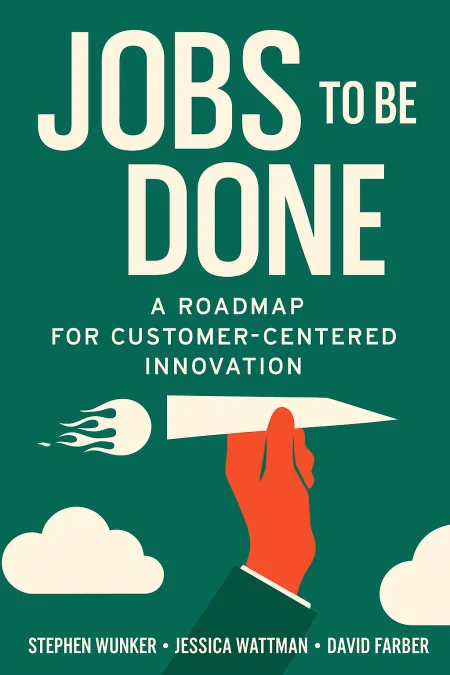
Jobs to Be Done
A Roadmap for Customer-Centered Innovation
byStephen Wunker, Jessica Wattman, David Farber
Book Edition Details
Summary
In the cutthroat dance of the modern market, where agility is king and stagnation spells doom, "Jobs to Be Done" emerges as your guide to mastering the art of innovation. This isn't about tossing ideas into the wind; it's about understanding the secret desires that drive consumer choices. Forget the drill bit; think about the hole it creates. With sharp insights into human behavior, this book reveals how to decipher the emotional and functional needs that compel purchases. Brimming with real-world triumphs, from Snapchat's millennial allure to hidden market opportunities, Stephen Wunker and his team offer a transformative blueprint. Harness the power of the Jobs method to uncover unmet needs, craft solutions that resonate, and sidestep the pitfalls of conventional product development. This isn't just a strategy—it's a revelation that could redefine your business landscape, turning hidden wants into tangible success.
Introduction
Why do customers choose one product over another? Traditional market research often provides misleading answers, focusing on what people buy rather than why they buy it. This fundamental misunderstanding leads to a staggering failure rate where more than 50 percent of newly launched products fall short of expectations, and only one in 300 new products significantly impacts customer behavior or company growth. The Jobs to Be Done framework revolutionizes how we understand customer motivation by shifting focus from product features to underlying customer needs. This approach recognizes that customers don't simply purchase products—they "hire" solutions to get specific jobs done in their lives. When we understand what jobs customers are trying to accomplish, both functional and emotional, we can design offerings that customers will eagerly adopt because they address real, pressing needs. This framework transforms innovation from a creative free-for-all into a systematic, repeatable process. By deeply understanding customer jobs, the contextual factors that drive prioritization, current workarounds and pain points, success criteria, obstacles to adoption, value creation mechanisms, and competitive dynamics, organizations can consistently develop breakthrough solutions. The methodology provides a structured roadmap that bridges the gap between customer insights and strategic action, enabling companies to innovate with confidence and achieve sustainable growth through genuine customer-centricity.
Understanding Jobs to Be Done Framework
The Jobs to Be Done framework fundamentally reframes how we conceptualize markets and customer behavior. Rather than viewing customers as demographic segments who purchase products within defined categories, this approach recognizes that people hire solutions to accomplish specific jobs in their lives. A job represents the progress a customer seeks to make in a particular circumstance, encompassing both functional tasks and emotional needs that drive decision-making. The framework operates on three interconnected levels that work together to create comprehensive customer understanding. Jobs themselves represent what customers are fundamentally trying to accomplish, ranging from functional objectives like "get from point A to point B" to emotional desires such as "feel confident in social situations." Job drivers encompass the contextual factors—attitudes, background, and circumstances—that make certain jobs more or less important for different customer segments. Current approaches and pain points reveal how customers currently attempt to satisfy their jobs and where existing solutions fall short, creating opportunities for innovation. The power of this framework becomes evident when examining successful companies like Uber, which didn't simply create a cheaper taxi service but addressed multiple customer jobs: ensuring predictable arrival times, eliminating payment friction, providing route transparency, and offering emotional reassurance through real-time tracking. By understanding the complete ecosystem of customer needs rather than focusing solely on transportation, Uber created a solution that customers couldn't wait to adopt. This systematic approach to understanding customer motivation enables organizations to consistently identify breakthrough opportunities that competitors miss, transforming innovation from lucky accidents into predictable competitive advantage.
Building the Jobs Atlas for Market Insights
The Jobs Atlas serves as a comprehensive mapping tool that systematically captures all relevant customer insights across eight interconnected dimensions. This structured approach ensures that innovation teams develop a complete understanding of the opportunity landscape before jumping to solutions, preventing the common pitfall of falling in love with ideas before understanding the market reality. The atlas begins with foundational elements that establish where customers currently stand. Success criteria define how customers measure whether a job has been accomplished, providing specific, measurable parameters that guide product development decisions. Obstacles identify barriers that prevent customers from adopting new solutions or continuing to use them after initial purchase, revealing critical factors that determine market success or failure. These elements work together to create a detailed picture of customer requirements and constraints. The framework then expands to address business viability through value and competition analysis. Value assessment determines how much customers will pay for solutions and what business models can sustainably capture that value, while competitive analysis reveals not just direct competitors but all alternatives customers might choose to satisfy their jobs. This broader competitive view often uncovers unexpected threats and opportunities that traditional industry analysis misses. Consider how Netflix understood that their competition wasn't just other video rental companies but anything that satisfied the job of "entertaining myself tonight," including video games, books, and social activities. This comprehensive market understanding enabled Netflix to position itself advantageously and anticipate industry evolution, demonstrating how the Jobs Atlas creates strategic clarity that drives superior business outcomes.
Transforming Customer Insights into Breakthrough Solutions
Converting Jobs Atlas insights into successful innovations requires a systematic process that moves beyond traditional brainstorming to create targeted, customer-centric solutions. The transformation begins with establishing clear strategic objectives that align innovation efforts with business goals, ensuring that creative energy focuses on opportunities that matter most to organizational success. The ideation process leverages Jobs Atlas insights through structured techniques that generate diverse, relevant solutions. Rather than asking generic questions like "what should we build," effective sessions probe specific challenges revealed in the atlas: "How might we eliminate the pain point of unpredictable wait times while satisfying the emotional job of feeling in control?" This targeted approach produces ideas that directly address customer needs while maintaining creative ambition. Teams then systematically vet concepts against atlas criteria, asking whether proposed solutions satisfy key jobs, address relevant pain points, overcome adoption obstacles, and create sustainable value. The final transformation phase involves rapid experimentation and iteration to validate assumptions and refine solutions. Smart experiments test the biggest risks early and inexpensively, using techniques like concept testing, prototype feedback, and behavioral observation to gather real customer responses. This evidence-based approach prevents costly mistakes while ensuring that final solutions truly resonate with target customers. Companies like Fitbit exemplify this process, starting with deep customer research about casual exercisers' jobs around easy fitness improvement, then systematically testing and refining their approach to create a simple yet compelling solution. The result was a focused product that dominated its market by delivering precisely what customers needed rather than trying to be everything to everyone. This disciplined approach to insight transformation enables organizations to consistently turn customer understanding into market-winning innovations.
Summary
The Jobs to Be Done framework fundamentally shifts innovation from guesswork to systematic customer understanding, enabling organizations to consistently create solutions that customers eagerly adopt because they address real, pressing needs rather than imagined problems. This methodology's enduring significance lies in its ability to make innovation repeatable and predictable, transforming it from an art dependent on creative lightning strikes into a disciplined competency that organizations can build and scale. By focusing on the progress customers seek rather than the products they currently buy, companies can anticipate market evolution, identify breakthrough opportunities, and create sustainable competitive advantages. For readers, embracing this framework means developing a fundamentally different way of seeing markets—one that reveals hidden opportunities, prevents costly missteps, and consistently generates innovations that truly matter to the people they're designed to serve.
Related Books
Download PDF & EPUB
To save this Black List summary for later, download the free PDF and EPUB. You can print it out, or read offline at your convenience.
By Stephen Wunker
