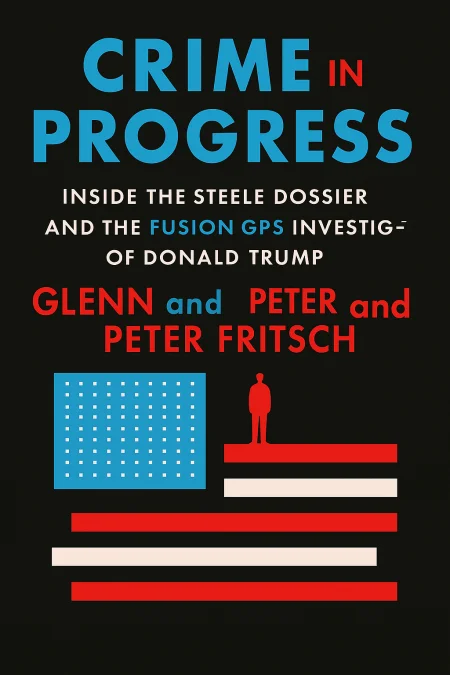
Crime in Progress
Inside the Steele Dossier and the Fusion GPS Investigation of Donald Trump
byGlenn Simpson, Peter Fritsch
Book Edition Details
Summary
In the shadowy corridors of political intrigue, two former journalists abandon their press badges to expose secrets that could shatter presidencies. Glenn Simpson and Peter Fritsch, co-founders of Fusion GPS, wield their investigative prowess to uncover the tangled web linking Donald Trump to Russian operatives. "Crime in Progress" unveils their harrowing four-year journey, from poring over a labyrinth of financial mysteries to the explosive creation of the Steele dossier. This dossier, a ticking time bomb of allegations, catapults these sleuths into the epicenter of international scandal, triggering the Mueller investigation and a media firestorm. An unyielding narrative of relentless pursuit, this account peels back the layers of power and deception, daring readers to question the very fabric of truth in modern politics.
Introduction
In the summer of 2015, a routine opposition research assignment would evolve into one of the most consequential investigations in American political history. What began as standard campaign research on Donald Trump's business dealings gradually unveiled a sophisticated foreign operation targeting the heart of American democracy. This investigation exposed how a hostile power could penetrate the highest levels of American politics, revealing vulnerabilities that many believed impossible in the world's oldest democracy. The story illuminates three critical questions that continue to shape our understanding of modern democratic governance. How do authoritarian regimes exploit the openness of democratic societies to advance their strategic interests? What happens when partisan loyalty overrides national security concerns among elected officials? And perhaps most urgently, how do democratic institutions respond when faced with unprecedented threats that blur the lines between foreign espionage and domestic politics? This account offers essential insights for citizens, policymakers, and anyone seeking to understand how democracies can protect themselves in an era of sophisticated information warfare and foreign interference.
Origins of Concern: Early Trump-Russia Connections (2015-2016)
The investigation that would eventually convulse American politics began with a simple email in September 2015 about Donald Trump's presidential candidacy. What started as routine opposition research quickly revealed a troubling pattern of financial entanglements stretching back decades. Researchers discovered that Trump's business empire had been repeatedly rescued by mysterious infusions of Russian capital, particularly after his casino bankruptcies in the 1990s left him unable to secure traditional American financing. The early findings painted a picture of a businessman whose public persona masked a more complex reality. Court documents revealed extensive dealings with Felix Sater, a Russian-born businessman with organized crime connections who had worked closely with the Trump Organization despite his criminal background. Even more concerning was the discovery that Trump's real estate projects had attracted unusual numbers of Russian buyers, often paying in cash at prices well above market value. These financial relationships took on new significance when viewed alongside Trump's consistently pro-Russian foreign policy positions, which stood in stark contrast to traditional Republican orthodoxy. His praise for Vladimir Putin and calls for improved U.S.-Russia relations seemed inexplicable given Russia's increasingly aggressive international behavior. The pattern suggested either remarkable naivety about geopolitical realities or something more troubling. The investigation's scope expanded dramatically with Paul Manafort's arrival as Trump's campaign chairman in March 2016. Manafort brought a history of working for pro-Russian politicians in Ukraine and owing millions to Russian oligarch Oleg Deripaska. This development transformed what had been a business investigation into a potential national security concern, raising questions about whether foreign interests were gaining influence over a major presidential campaign at the most critical moment in the electoral process.
The Dossier Emerges: Intelligence Gathering and FBI Contact (2016)
By May 2016, the accumulating evidence of Trump's Russian connections prompted investigators to engage Christopher Steele, a former British intelligence officer with extensive experience in Russian affairs. Steele's task was straightforward: use his network of sources within Russia to understand the nature of Trump's relationships there. What he discovered exceeded all expectations and would fundamentally alter the trajectory of American politics for years to come. Steele's sources reported that the Russian government had been cultivating Trump for at least five years, viewing him as a potential asset who could be influenced to advance Russian interests. The intelligence suggested that Russian operatives possessed compromising material on Trump, including recordings from his 2013 visit to Moscow. More significantly, the reports indicated that Russia was actively working to help Trump win the presidency through a coordinated campaign of electoral interference. The gravity of these findings compelled Steele to take an unprecedented step: he contacted the FBI to report what he believed was a national security emergency. This decision reflected his professional judgment that the information was too important to remain within the confines of private research. The implications were staggering, suggesting that a hostile foreign power had potentially compromised a major party's presidential nominee. The FBI's initial response was cautious but serious. Agents met with Steele and found his information credible enough to warrant further investigation. However, the Bureau faced an impossible dilemma: how to investigate such explosive allegations during the height of a presidential campaign without appearing to interfere in the democratic process. This tension between national security imperatives and electoral integrity would plague the investigation throughout its duration, ultimately contributing to decisions that may have altered the course of American history.
Election Interference Unfolds: From Hacking to Political Chaos (2016)
The summer of 2016 witnessed an escalation of Russian interference that transformed theoretical concerns into active operations against American democracy. The hacking of Democratic National Committee emails, followed by their strategic release through WikiLeaks, demonstrated the sophistication of Russia's information warfare capabilities. These attacks were not random acts of cyber vandalism but carefully orchestrated operations designed to maximize political damage at crucial campaign moments. The timing of these releases revealed the strategic nature of the Russian operation. When the Access Hollywood tape threatened to derail Trump's candidacy in October, WikiLeaks immediately released a new batch of stolen emails to divert media attention. This coordination suggested a level of planning and real-time responsiveness that indicated direct communication between Russian operatives and their American allies. The pattern was too consistent to be coincidental. Meanwhile, Trump campaign officials maintained suspicious contacts with Russian representatives throughout this period. Carter Page's mysterious trip to Moscow, where he allegedly met with sanctioned Russian officials, exemplified the campaign's willingness to engage with hostile foreign actors. These meetings occurred against the backdrop of the campaign's successful effort to weaken the Republican Party platform's support for Ukraine, the only policy position the Trump team sought to change. The convergence of these activities created a perfect storm of foreign interference and domestic vulnerability. Russian operatives had identified and exploited weaknesses in American electoral systems while simultaneously cultivating relationships with individuals who could influence policy outcomes. The operation's success lay not just in its technical sophistication but in its understanding of American political psychology and media dynamics. By the time authorities fully grasped the scope of the interference, the damage to democratic norms and institutions was already severe.
Post-Election Reckoning: Truth versus Political Warfare (2017-2019)
Trump's unexpected victory transformed the investigation from a campaign issue into a constitutional crisis. The prospect that a potentially compromised candidate had won the presidency created unprecedented challenges for American institutions. Intelligence agencies faced the daunting task of investigating a sitting president while maintaining political neutrality, a balance that proved nearly impossible to achieve in the hyperpartisan environment that followed. The post-election period revealed the full extent of Russian success in sowing discord within American society. Rather than uniting against foreign interference, political leaders divided along partisan lines, with some viewing the investigation as a threat to their electoral gains rather than a defense of democratic principles. This reaction demonstrated how foreign adversaries could exploit American political polarization to protect their operations from scrutiny and accountability. Robert Mueller's appointment as special counsel in May 2017 represented both a victory for the rule of law and a new phase in the political battle. Mueller's investigation ultimately validated many concerns raised in the original research, securing convictions of Trump's campaign chairman, personal lawyer, and national security advisor. The probe revealed extensive contacts between Trump associates and Russian operatives, though Mueller concluded these contacts did not rise to the level of a prosecutable conspiracy. The ultimate lesson of this period was that foreign interference succeeds not just through technical capabilities but by exploiting existing divisions within democratic societies. Russia's greatest achievement was not the hacking of emails or spreading of disinformation, but the creation of lasting doubt about the integrity of American democratic institutions. The investigation revealed that protecting democracy requires not just technical defenses but a shared commitment to placing national interests above partisan advantage, a commitment that proved tragically elusive during this critical period.
Summary
The Trump-Russia investigation exposed a fundamental vulnerability in American democracy: the susceptibility of political systems to foreign manipulation when domestic actors prioritize personal or partisan interests over national security. The central tension throughout this saga was between the imperative to protect democratic processes from foreign interference and the political incentives that made such protection inconvenient for those who benefited from that interference. This historical episode offers crucial lessons for safeguarding democratic institutions in an era of sophisticated foreign threats. First, electoral systems must be protected by robust, non-partisan institutions capable of responding to foreign interference regardless of which party benefits. The integrity of intelligence and law enforcement agencies must be preserved as democracy's early warning system against hostile foreign operations. Second, political leaders must be held accountable for maintaining relationships with hostile foreign actors, with clear consequences for those who compromise national security for personal gain. Finally, citizens must develop greater awareness of how foreign adversaries exploit domestic political divisions, making democratic societies more resilient to manipulation attempts. The stakes of these lessons extend far beyond any single election, as the techniques pioneered in this case continue to threaten democratic societies worldwide, requiring constant vigilance and adaptation to preserve the foundations of self-governance.
Related Books
Download PDF & EPUB
To save this Black List summary for later, download the free PDF and EPUB. You can print it out, or read offline at your convenience.
By Glenn Simpson
