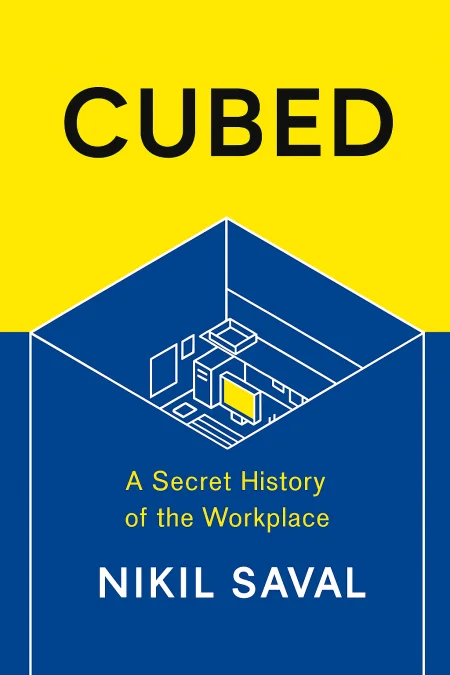
Cubed
A Secret History of the Workplace
Book Edition Details
Summary
Once upon a time, the humble office was merely a shadowy lair for clerks—dandified number-crunchers tucked away in cramped, gloomy corners. Fast forward to today, and our workspaces have transformed into bustling arenas of productivity and innovation. "Cubed" peels back the layers of this dramatic metamorphosis, tracing the evolution from the dreary counting-houses of yesteryear to the towering skyscrapers and ubiquitous cubicles we recognize now. This riveting chronicle reveals the unsung heroes of the white-collar world and the seismic shifts in societal roles, particularly as women stormed the professional battleground. Through the lenses of literature, film, and comic strips, the book illuminates the quirks and quandaries of office life with wit and insight, all while pondering the future of workspaces in an ever-changing world. A tapestry of history and humor, "Cubed" is a must-read for anyone who’s ever wondered why they toil in those monotonous beige boxes.
Introduction
Imagine walking through a bustling Manhattan street in 1850, peering into a dimly lit counting house where a young clerk hunches over a ledger, his fingers stained with ink as he carefully records transactions by candlelight. Now fast-forward to today's gleaming corporate towers, where thousands of workers sit in identical cubicles, their every keystroke monitored by sophisticated software. This dramatic transformation represents one of the most profound yet overlooked revolutions in how Americans work and live. The modern office didn't emerge through natural evolution or inevitable technological progress. Instead, it developed through a series of deliberate choices, power struggles, and unintended consequences that fundamentally reshaped American society. This hidden history reveals how spaces designed to liberate workers often ended up constraining them, how promises of middle-class prosperity masked new forms of surveillance and control, and how the pursuit of efficiency sometimes came at the cost of human dignity. Understanding this evolution illuminates why today's workplace feels simultaneously empowering and suffocating, why the promise of meaningful work often seems just out of reach, and what lessons we can draw as we navigate the future of work in an age of remote offices and artificial intelligence. This story speaks to anyone who has ever wondered how we ended up spending our days in the environments we do, offering crucial insights for workers, managers, and anyone seeking to understand the forces that continue to shape our professional lives.
Birth of the Modern Office: Clerks to Corporate Machines (1850s-1920s)
The American office began as an intimate affair in the mid-nineteenth century, housed in small counting houses where merchants conducted business alongside a handful of trusted clerks. These early workplaces resembled someone's study more than a modern office, with workers perched on high stools at standing desks, surrounded by leather-bound ledgers and the tools of manual record-keeping. The relationship between employer and employee was personal and paternalistic, with clerks harboring genuine hopes of eventual partnership or independent business ownership. This cozy world shattered in the decades following the Civil War, as American business underwent a revolutionary transformation. The explosive growth of railroads, the advent of telegraph communication, and the rise of massive industrial corporations created an unprecedented demand for information processing and administrative coordination. Companies that once operated with three or four clerks suddenly required hundreds of workers to manage correspondence, track inventory, and coordinate operations across vast geographical distances. The intimate counting house could no longer contain the expanding machinery of American capitalism. The response was the birth of the modern office as we know it: vast floors filled with identical desks where armies of clerks performed specialized, repetitive tasks under the watchful eyes of supervisors. This transformation was accelerated by the introduction of new technologies, particularly the typewriter, which brought thousands of young women into office work for the first time. These "typewriter girls" represented both progress and constraint, gaining access to respectable employment while being systematically paid less than their male counterparts and confined to subordinate roles. The period also witnessed the rise of scientific management principles, as efficiency experts began applying factory-style optimization to clerical work. Frederick Winslow Taylor's obsession with measuring and standardizing every aspect of human labor found fertile ground in the expanding world of office work. The result was the transformation of white-collar work from a craft requiring judgment and discretion into a series of mechanized processes that could be performed by interchangeable workers. This laid the foundation for the modern corporate hierarchy while establishing the fundamental tension between efficiency and humanity that would define office work for generations to come.
Scientific Management and the Skyscraper Revolution (1920s-1950s)
The 1920s brought the marriage of scientific management principles with revolutionary architectural innovations, creating the modern office building as both workplace and symbol of corporate power. Soaring skyscrapers like the Woolworth Building and later the Empire State Building housed thousands of workers in standardized "cells," as architect Louis Sullivan called them, stacked floor upon floor in gleaming monuments to administrative capitalism. These towers represented not just engineering marvels, but the triumph of white-collar work over manual labor in the American economy. Inside these buildings, the principles of Taylorism reached their full flowering in office environments. Efficiency experts armed with stopwatches invaded clerical departments, timing envelope stuffing, analyzing filing motions, and reorganizing workspaces to eliminate "waste movements." Vast typing pools emerged where hundreds of women worked in synchronized rows, their productivity measured by keystrokes per minute. The office had become a factory for processing information, complete with assembly-line methods and industrial-style supervision. Yet this period also saw the emergence of more sophisticated thinking about workplace psychology and human relations. The famous Hawthorne Studies conducted at Western Electric revealed that worker productivity was influenced not just by physical conditions but by psychological factors like attention, social dynamics, and sense of purpose. This discovery introduced the revolutionary idea that happy workers might actually be more productive workers, laying the groundwork for decades of workplace reform efforts. The architectural response reflected these evolving ideas about work and human nature. Frank Lloyd Wright's Larkin Administration Building pioneered the concept of the purpose-built office space, with its soaring central atrium creating a cathedral-like atmosphere that elevated clerical work to something approaching the sacred. Innovations like air conditioning, built-in furniture, and carefully planned lighting systems established standards that would define office design for decades. However, the same buildings that proclaimed the dignity of white-collar work often reduced their occupants to interchangeable components in an increasingly complex bureaucratic machine, embodying the persistent contradiction between humanistic ideals and organizational efficiency that would continue to plague the American workplace.
Organization Men and the Glass Box Era (1950s-1970s)
The post-war economic boom created what appeared to be a white-collar paradise, as major corporations moved to pastoral suburban campuses and offered employees comprehensive benefits packages that promised security from cradle to grave. Companies like IBM and Connecticut General built modernist headquarters surrounded by manicured lawns, complete with subsidized cafeterias, recreational facilities, and company-sponsored social activities. This was the era of the "organization man," those gray-suited middle managers who traded entrepreneurial independence for the promise of lifetime employment and steady advancement up the corporate ladder. The architectural expression of this corporate benevolence reached its peak in the glass-walled office buildings that came to define the 1950s and 1960s. Structures like Lever House and the Seagram Building proclaimed a new corporate transparency and rationality through their pristine curtain walls and climate-controlled environments. These buildings were machines for working, perfected through the marriage of technology and modernist design principles. Air conditioning allowed deeper floor plates, fluorescent lighting eliminated dependence on natural light, and modular furniture systems promised infinite flexibility in organizing work spaces. Yet beneath the surface of this apparent corporate enlightenment lay new forms of control and surveillance. The glass walls that seemed to democratize the workplace also enabled unprecedented monitoring of employee behavior, making every worker visible to supervisors at all times. Companies increasingly deployed personality tests and psychological assessments that promised to match individuals to appropriate roles, but actually functioned as elaborate screening mechanisms for conformity and loyalty. The organization man was free to be himself, as long as himself fit neatly into predetermined corporate categories. This period also witnessed significant changes in the composition of the office workforce, as women entered white-collar jobs in growing numbers while remaining largely confined to supporting roles. The cultural archetype of the "office wife" emerged, the secretary who managed her boss's professional life with intimate attention to detail while being systematically excluded from advancement opportunities. The glass ceiling proved as real and impermeable as the glass walls, creating new possibilities for women's economic participation while simultaneously constraining them within narrow roles that served male career ambitions. These contradictions would fuel the workplace upheavals of the following decades, as the promise of corporate paternalism began to clash with changing social expectations and economic realities.
The Cubicle Crisis and Digital Transformation (1970s-Present)
The 1970s shattered the postwar corporate consensus as economic stagnation and increased global competition forced companies to abandon their paternalistic policies in favor of cost-cutting and efficiency measures. The cubicle, originally conceived by designer Robert Propst as a tool for liberating knowledge workers from rigid hierarchies, became instead a symbol of corporate penny-pinching as companies used modular furniture systems to cram more employees into less space. Propst's vision of flexible, adaptable workspaces was cheapened into the fabric-covered boxes that would become synonymous with white-collar drudgery and alienation. The personal computer revolution of the 1980s and 1990s promised to transform office work once again, creating the long-anticipated "paperless office" and enabling new forms of flexible work arrangements. Silicon Valley companies pioneered informal workplace cultures that seemed to blur the boundaries between work and play, offering employees everything from foosball tables to free gourmet meals. Yet these innovations often masked longer working hours and increased job insecurity, as the boom-and-bust cycles of the technology industry created new forms of workplace volatility that made the old corporate paternalism seem quaint by comparison. The rise of the knowledge economy brought with it sophisticated new forms of surveillance and control that made earlier efficiency experts look positively benevolent. Computer systems could monitor every keystroke and mouse click, while performance metrics reduced complex human activities to simple numerical targets. Email and mobile devices extended the reach of work into every corner of employees' lives, creating an always-on culture that eroded the boundaries between professional and personal time. The promise of autonomy and creativity that had driven workplace reform efforts for decades seemed to recede further into the distance, replaced by digital forms of Taylorism that were more pervasive and subtle than anything the original scientific managers had imagined. Recent experiments with open offices, activity-based working, and co-working spaces represent the latest attempts to solve the persistent problems of office life, while the COVID-19 pandemic has accelerated the shift toward remote and hybrid work arrangements. Companies continue to promise liberation through design and technology, creating elaborate campus environments and sophisticated collaboration tools. Yet fundamental questions about power, autonomy, and the meaning of work remain unresolved, suggesting that the evolution of the American office reflects deeper tensions in our economic system that cannot be solved through architectural or technological fixes alone.
Summary
The hidden history of American office work reveals a persistent cycle of reform and reaction, where each generation's solution to workplace problems creates new forms of alienation and control for the next. From the intimate counting houses of the nineteenth century to today's digital workspaces, the promise of meaningful, autonomous work has consistently collided with organizational demands for efficiency, predictability, and control. This pattern suggests that the fundamental tensions between human needs and institutional imperatives cannot be resolved through design innovations or management theories alone, but require ongoing attention to questions of power, dignity, and purpose in work life. This historical perspective offers crucial insights for navigating contemporary workplace challenges and designing more humane work environments. First, technological solutions must be evaluated not just for their efficiency gains but for their human consequences, as tools designed to liberate workers often end up constraining them in unexpected ways. Second, the most successful workplace innovations have emerged from listening to workers themselves rather than imposing top-down solutions based on abstract theories about productivity or human nature. Finally, creating truly fulfilling work environments requires addressing fundamental questions about economic inequality, democratic participation, and the distribution of power within organizations, not just optimizing physical spaces or digital tools. As we face new disruptions from artificial intelligence, remote work, and changing generational expectations, the lessons of this hidden history become more relevant than ever. The future of work remains unwritten, and understanding how we arrived at our current predicament can help us write that future more thoughtfully, avoiding the recurring mistakes of the past while building on the genuine insights that each era has contributed to our understanding of human flourishing in the workplace.
Related Books
Download PDF & EPUB
To save this Black List summary for later, download the free PDF and EPUB. You can print it out, or read offline at your convenience.
By Nikil Saval
