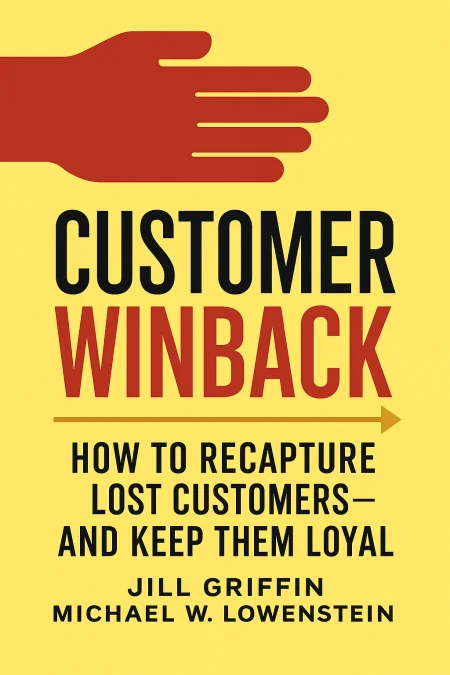
Customer WinBack
How to Recapture Lost Customers – And Keep Them Loyal
byJill Griffin, Michael W. Lowenstein
Book Edition Details
Summary
In a business landscape where lost customers often seem like echoes of the past, Jill Griffin and Michael Lowenstein redefine possibilities with their revolutionary guide, "Customer WinBack." This isn't just a roadmap for recovery—it's a manifesto for transformation. Dive into strategies that rescue clients on the brink of departure and seal the loyalty of those you've already won back. The book unravels the mystery of identifying which former patrons hold the highest potential, turning them into enduring allies. With insights drawn from trailblazing companies, this guide equips businesses of all sizes—whether retail giants or boutique firms—with the tools to reclaim their customer base. In a world where every client counts, "Customer WinBack" offers the keys to revitalizing your approach and securing the loyalty that fuels growth and innovation.
Introduction
Every day, businesses across the globe face a silent crisis that threatens their very survival. While executives celebrate new customer acquisitions and analyze market expansion strategies, a devastating exodus occurs right under their noses. The harsh reality is that most companies lose between 20 to 40 percent of their customers annually, yet they possess no systematic approach to reclaim these valuable relationships. This isn't merely about recovering lost revenue; it's about recognizing that departed customers represent your most accessible growth opportunity. Unlike cold prospects who know nothing about your business, former customers already understand your value proposition, have experienced your services, and often harbor feelings that can be transformed from disappointment into fierce loyalty. The mathematics are compelling: winning back a lost customer costs five times less than acquiring a new one, and recovered customers frequently become more devoted than they were before their departure. The question isn't whether you can afford to pursue win-back strategies, but whether you can afford to ignore the goldmine of opportunity that exists within your lost customer database.
Transform Customer Defection Into Growth Opportunity
Customer defection represents one of business's most misunderstood phenomena, often viewed as inevitable failure rather than valuable intelligence about market dynamics and operational weaknesses. The true cost of losing customers extends far beyond immediate revenue loss, encompassing recruitment expenses, negative word-of-mouth impact, and the opportunity cost of resources diverted from growth to replacement activities. Bill McCausland, an executive at GTE Telecommunications, discovered this hidden crisis during what seemed like a routine performance review. Despite aggressive marketing campaigns that successfully attracted new customers, the company's overall customer base remained frustratingly stagnant. The revelation struck him like lightning: GTE was operating what he termed a "leaky bucket" business model, pouring enormous resources into filling the top while massive holes at the bottom drained away existing customers at nearly the same rate. McCausland's investigation revealed that many defections were entirely preventable, stemming from service issues that could have been resolved with proper attention and systematic intervention. By shifting focus from pure acquisition to understanding departure patterns, GTE not only recovered significant numbers of lost customers but also identified systemic operational problems that were driving the exodus. The win-back process became a diagnostic tool that strengthened the entire customer experience infrastructure. To transform defection into opportunity, begin by calculating your true customer loss costs, including recruitment expenses, training investments, and morale impact on your team. Establish early warning systems that identify at-risk customers through behavioral changes rather than waiting for complaints. Create formal win-back processes that treat former customers as warm prospects rather than write-offs. Remember that every departed customer carries valuable intelligence about your competitive positioning and service delivery that cannot be obtained through any other channel.
Master the Strategic Win-Back Process
Successful customer recovery demands a sophisticated approach that transcends generic "we miss you" campaigns and discount-driven incentives. The most effective win-back strategies are built on deep understanding of departure motivations, personalized messaging that addresses specific concerns, and demonstrated evidence of meaningful operational improvements. Fernando Roman, director of customer recovery at Cellular One, inherited a win-back program that epitomized everything wrong with traditional approaches. Mass mailings with generic offers generated minimal response rates, while frustrated customers felt bombarded rather than valued. Roman revolutionized the process by implementing a research-driven methodology that began with comprehensive analysis of departure reasons and customer segment characteristics. The breakthrough came when Roman's team recognized that different customer segments required completely different recovery approaches. Price-sensitive customers needed compelling value demonstrations, while service-disappointed customers demanded proof of operational improvements. Quality-seeking customers required evidence of enhanced product offerings and superior support systems. By creating customized campaigns for each segment, with messaging and offers specifically tailored to address their departure triggers, recovery rates increased dramatically. To master your win-back process, categorize lost customers based on departure motivations rather than just demographic profiles or spending levels. Develop segment-specific messaging that demonstrates how you've addressed their concerns rather than simply attempting to buy back their business. Create multi-touchpoint timelines that allow for patient relationship rebuilding, as effective win-back often requires persistence and trust restoration. Most importantly, ensure that your recovery promises are supported by genuine operational changes, because returning customers will scrutinize your performance more intensely than they did originally.
Build a Defection-Proof Organization Culture
Creating a defection-resistant organization requires proactive cultural transformation that anticipates customer needs, identifies risk factors before they become problems, and continuously strengthens relationships through genuine value creation. This involves developing systems, processes, and mindsets that make customer retention a natural organizational outcome rather than a constant uphill battle. Bruce Woolpert, co-CEO of Granite Rock Company, exemplified this approach through his revolutionary "customer listening tours" that went far beyond traditional feedback mechanisms. Recognizing that conventional satisfaction surveys and complaint systems weren't revealing the real issues driving customer defection, Woolpert personally visited customers to engage in deliberately uncomfortable conversations about his company's shortcomings and failures. These weren't pleasant courtesy calls designed to maintain relationships. Woolpert would sit quietly through awkward silences, waiting patiently until customers felt safe enough to share their honest frustrations and disappointments. The insights from these intensive sessions transformed Granite Rock's entire operational philosophy. Customers revealed that while they appreciated product quality, they were frustrated by inflexibility around special requests and delivery timing constraints. This feedback led to implementation of their "Yes we will" policy, accommodating any customer request that wasn't illegal or immoral. To build your defection-proof culture, establish systematic processes for gathering brutally honest customer feedback that goes beyond traditional survey methods. Train your team to initiate difficult conversations about organizational shortcomings and create safe environments where customers feel comfortable expressing genuine frustration. Implement behavioral early warning systems that identify at-risk customers based on usage patterns and engagement changes rather than waiting for formal complaints. Most importantly, ensure that customer insights drive real operational transformations rather than superficial policy adjustments, because defection-proofing requires continuous organizational evolution based on customer needs rather than internal assumptions.
Summary
The journey from customer loss to competitive advantage begins with a fundamental perspective shift: viewing departed customers not as failures to forget, but as opportunities to learn, improve, and build deeper relationships than ever before. As the evidence demonstrates throughout these strategies, the companies that master customer recovery don't just survive in competitive markets; they thrive by transforming their greatest challenges into sustainable advantages. The path forward requires honest assessment of your current defection patterns, implementation of systematic recovery processes, and cultivation of organizational cultures that anticipate and address customer needs before problems arise. Start today by reaching out to your most valuable lost customers with genuine curiosity about their experience and authentic commitment to addressing their concerns. Your next conversation with a former customer might reveal the key insight that transforms your entire approach to customer loyalty and business growth.
Related Books
Download PDF & EPUB
To save this Black List summary for later, download the free PDF and EPUB. You can print it out, or read offline at your convenience.
By Jill Griffin
