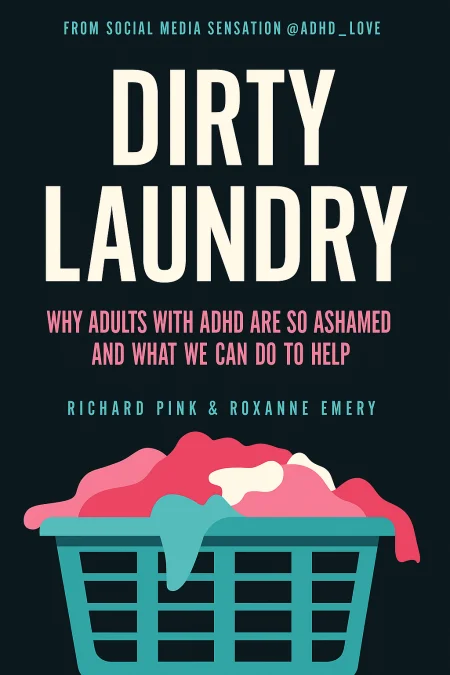
DIRTY LAUNDRY
Why adults with ADHD are so ashamed and what we can do to help
Book Edition Details
Summary
In the whirlwind of life with ADHD, where chaos dances hand-in-hand with creativity, Rich Pink and Rox Emery become your candid allies in "Dirty Laundry." With humor and heart, this vibrant duo dismantles the heavy cloak of shame that often shadows the ADHD experience. Each chapter unfurls with an ADHD symptom, weaving personal tales that spotlight their journey through impulsivity, financial chaos, and more. Rox champions self-love, while Rich offers a masterclass in empathy, urging readers to embrace understanding over judgment. For partners, parents, friends, and those who live with ADHD, this book is a beacon of hope and clarity. Dive into these relatable stories and practical insights, and discover how to navigate the beautiful mess that is ADHD with compassion and laughter.
Introduction
Picture this: You're standing in your living room at 11:55 PM, about to drift off to sleep, when suddenly your partner sits bolt upright with that unmistakable glint in their eye. Within minutes, you're both creating a social media account about the most intimate details of your relationship, convinced this spontaneous idea will change everything. This wasn't just any ordinary night for Rich and Rox—it was the moment their journey into understanding ADHD truly began. What started as a late-night conversation about tampons became a viral sensation that connected millions of people who had spent their entire lives feeling broken, misunderstood, and deeply ashamed of behaviors they couldn't control. The tears that flowed when strangers approached them on the street weren't tears of sadness, but of profound relief—the kind that comes when you finally discover you're not alone in your struggles. This is a story about the hidden battles that rage behind closed doors, where simple tasks feel impossible and love requires navigation through uncharted territories of neurodivergence. It's about the shame that accumulates over decades of being labeled as lazy, careless, or broken, and the transformational power of understanding that your brain simply works differently. Through raw honesty and gentle wisdom, we'll explore how acceptance, compassion, and the right support can turn what feels like chaos into something beautifully manageable—and even magical.
The Hidden Struggles: When Simple Tasks Feel Impossible
The basement flat was pitch black, electricity cut off for unpaid bills, when the loud knocking began. Rox found herself crawling under the bed, heart racing, as men with chainsaws replaced her electricity meter with a pay-as-you-go system. This wasn't a scene from a horror film—this was the reality of living with undiagnosed ADHD, where unopened letters pile up like mountains of shame and the simplest adult tasks feel insurmountable. At university, Rox had been given the nicest room with a beautiful view, only to watch it descend into chaos within weeks. While her roommates effortlessly adapted to adult life—doing laundry, paying bills, maintaining basic hygiene—she felt like she was drowning in a world that required a manual she'd never received. The fly infestation in her room became a badge of dishonor she wore with dark humor, masking the deep shame with alcohol and self-deprecation. Years later, the pattern continued across different apartments and cities. Clean starts would inevitably spiral into squalor, not from laziness but from an inability to see the path through overwhelming tasks. Making a bed, doing dishes, opening mail—each represented a mountain that neurotypical brains could scale effortlessly but felt impossible to her ADHD mind. The shame compounded daily, creating a narrative of personal failure that nearly led to the ultimate escape. What looks like simple carelessness to the outside world often represents a complex neurological difference in how the brain processes and prioritizes tasks. The gap between wanting to function normally and actually managing to do so creates a special kind of suffering—one that can only be healed through understanding, support, and the radical acceptance that different doesn't mean broken.
Love in the Time of ADHD: Relationships and Understanding
Rich thought he was dating someone who simply didn't care enough to reply to texts. Hours would pass after his loving messages, leaving him spiraling through catastrophic thoughts—had she been hurt, had she fallen out of love, had she met someone else? Meanwhile, Rox sat at her desk, having read his message with genuine affection, only to have it slip completely from her consciousness the moment her attention shifted elsewhere. This dance of misunderstanding played out daily in their early relationship. Rich's brain, wired for consistent communication, interpreted silence as rejection or indifference. Rox's brain, operating on an "out of sight, out of mind" principle, simply couldn't hold people in her awareness once they left her immediate environment. Neither was wrong, but both were suffering from the collision of different neurological realities. The breakthrough came when Rox could finally name her experience as "object constancy" struggles rather than character defects. She wasn't selfish or uncaring—her brain literally worked differently when it came to maintaining connections across time and space. With this understanding, Rich stopped taking the communication gaps personally, and Rox stopped drowning in shame about her inability to meet neurotypical expectations. They developed new rhythms that honored both their needs: face-to-face time that felt deeply connecting for Rox, and clear communication about important matters for Rich. The pressure lifted, and paradoxically, Rox found herself reaching out more naturally when the expectation was removed. Love, they discovered, isn't about forcing someone to communicate in your preferred style—it's about creating space where both people can be authentically themselves while still feeling cared for and understood.
Finding Your Superpower: The Gifts Within the Chaos
At eleven years old, Rox could recite obscure facts about ancient Egypt with encyclopedia-like precision, build working models of shadoofs from clay, and deliver PowerPoint presentations that amazed adults. Teachers called her gifted, parents beamed with pride, and she was fast-tracked into advanced programs. But no one thought to teach her how to make her bed, manage her emotions, or structure her daily life—skills that would prove far more essential than memorizing historical irrigation devices. This pattern of intense fascination followed by complete absorption became both her greatest strength and her deepest challenge. When hyperfocus struck, she could research hotels for five hours straight, becoming an expert on everything from luxury suites to budget options, ultimately finding hidden gems others would never discover. The same brain that couldn't remember to open mail could spend an entire night learning economics principles and teach them with infectious enthusiasm to struggling classmates. Years later, when Rox found songwriting, she finally discovered how her unique brain could become an asset rather than a liability. Each day brought new collaborations, fresh creative challenges, and the dopamine hits her brain craved. The variety and novelty that made traditional jobs impossible became the perfect ingredients for a creative career where hyperfocus could be channeled into artistic expression rather than fighting against bureaucratic structures. The transformation from "broken" to "differently gifted" required more than just finding the right career—it demanded a complete reframing of what productivity and success could look like. When we stop trying to force square pegs into round holes and instead create environments where unique strengths can flourish, the very traits that once felt like curses begin to reveal themselves as superpowers waiting for the right stage on which to shine.
Summary
What begins as a story about tampons and late-night social media inspiration ultimately reveals itself as a profound exploration of what it means to live, love, and thrive with a brain that works magnificently differently from the norm. The shame that accumulates over years of feeling broken can be transformed into understanding, acceptance, and even celebration of neurodivergent gifts when met with the right combination of knowledge, support, and radical self-compassion. The journey from hiding under beds in darkened apartments to building communities of millions demonstrates that our greatest struggles often contain the seeds of our most meaningful contributions. When we stop fighting our brains and start working with them—creating systems that support rather than oppose our natural rhythms, finding partners who offer curiosity rather than judgment, and reframing our stories from failure to difference—transformation becomes not just possible but inevitable. The very traits that once felt like insurmountable obstacles can become the foundations for lives of extraordinary creativity, connection, and purpose, proving that sometimes the most beautiful flowers grow from the most unlikely soil.
Related Books
Download PDF & EPUB
To save this Black List summary for later, download the free PDF and EPUB. You can print it out, or read offline at your convenience.
By Richard Pink
