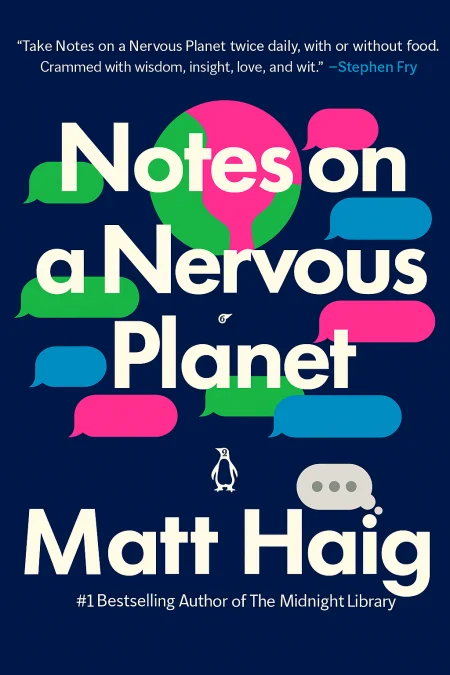
Notes on a Nervous Planet
Build your very own twenty-first-century survival kit
Book Edition Details
Summary
In a whirlwind of modern chaos, Matt Haig crafts a lifeline for the overwhelmed soul with "Notes on a Nervous Planet." This thought-provoking sequel to his acclaimed memoir digs deep into the fabric of contemporary living, unmasking the hidden traps of our tech-driven world. Haig, having battled the shadows of anxiety and depression, offers a candid exploration of how society's "advancements" might be unraveling our peace. From the relentless pull of social media to the relentless pace of news, he dissects the silent culprits behind our collective unease. With wisdom born from personal trials, Haig charts a course toward mental resilience, offering readers not just survival strategies, but a heartfelt guide to thriving amidst the noise.
Introduction
Modern existence presents a fundamental paradox: while technological advancement has solved countless historical problems, rates of anxiety, depression, and mental distress continue to climb across developed nations. This phenomenon suggests that progress itself may be creating new psychological challenges that our ancient brains struggle to process. The constant connectivity, information overload, and artificial stimulation of contemporary life activate stress responses that evolved for entirely different threats. Through careful examination of how digital culture, consumer society, and accelerated living impact human psychology, a clearer understanding emerges of why mental health crises proliferate alongside material prosperity. The exploration reveals that awareness itself becomes the primary tool for navigating these challenges—not through wholesale rejection of modernity, but through conscious choices about how we engage with technological and social systems that often prioritize engagement over wellbeing.
The Nervous Planet: How Technology and Modern Society Fuel Mental Distress
The metaphor of Earth as a nervous system reveals the unprecedented psychological pressures of interconnected existence. Global communication networks mirror neural pathways, transmitting emotional states and reactions across vast distances instantaneously. When distressing events occur anywhere in the world, they trigger cascading responses through social media platforms, news cycles, and digital communities, creating collective anxiety that transcends geographic boundaries. This constant stimulation overwhelms cognitive systems evolved for much simpler information processing. The acceleration of technological change compounds these effects. Moore's Law demonstrates that processing power doubles exponentially, but human adaptation remains linear. While our ancestors faced perhaps dozens of significant choices daily, contemporary life presents thousands of micro-decisions across digital platforms, consumer options, and social interactions. This cognitive overload manifests as decision fatigue, attention fragmentation, and persistent background stress that rarely allows for genuine psychological rest. Historical perspective illuminates the unprecedented nature of current conditions. Traditional communities provided stable social structures, clear role definitions, and predictable daily rhythms that supported mental equilibrium. Modern existence eliminates many of these stabilizing factors, replacing them with fluid identities, constant comparison opportunities, and artificial urgency that keeps stress hormones chronically elevated. The mismatch between evolutionary psychology and technological reality creates friction that manifests as widespread anxiety disorders. The solution involves recognizing these systemic pressures without abandoning beneficial aspects of modern life. Awareness of how external systems influence internal states enables conscious boundary-setting and intentional engagement with technology rather than passive consumption of whatever algorithms deliver.
The Invisible Triggers: Social Media, News, and Consumer Culture as Anxiety Amplifiers
Digital platforms exploit psychological vulnerabilities through sophisticated behavioral modification techniques. Social media companies employ intermittent reinforcement schedules—the same mechanisms that make gambling addictive—to maximize user engagement. Each notification, like, or comment provides a small dopamine reward, creating compulsive checking behaviors that interrupt focus and elevate baseline anxiety levels. The unpredictability of these rewards makes them more powerful than consistent positive feedback. News consumption has transformed from discrete daily updates to continuous streams of crisis information. Breaking news alerts, push notifications, and 24-hour coverage create artificial urgency around events that rarely require immediate attention. This constant exposure to negative information—amplified because bad news attracts more engagement than positive developments—skews perception of reality and maintains heightened stress states. The brain's negativity bias, useful for avoiding ancient dangers, becomes counterproductive when applied to global information consumption. Consumer culture systematically generates dissatisfaction to maintain economic activity. Marketing psychology identifies personal insecurities and amplifies them, suggesting that happiness lies just one purchase away. This creates perpetual wanting—a psychological state incompatible with contentment. The hedonic treadmill ensures that satisfaction from acquisitions fades quickly, requiring ever-greater consumption to maintain previous levels of temporary pleasure. These invisible triggers operate below conscious awareness, making them particularly insidious. Recognition of their existence and mechanics provides the first line of defense against their influence, enabling more intentional relationships with digital media and consumer messaging.
Reclaiming Human Balance: Strategies for Mental Wellness in a Digital Age
Effective mental health protection requires active curation of environmental inputs rather than passive consumption of whatever systems deliver. Digital minimalism involves conscious choices about which technologies serve authentic human needs versus those that exploit psychological vulnerabilities for profit. This might include disabling notifications, scheduling specific times for social media engagement, or choosing entertainment that genuinely enriches rather than merely distracts. Physical practices anchor psychological wellbeing in embodied experience. Regular exercise, adequate sleep, and time in natural environments provide neurochemical benefits that counteract stress responses triggered by artificial stimulation. Sleep hygiene becomes particularly crucial as artificial light and screen exposure disrupt circadian rhythms evolved over millennia. Creating technology-free spaces and times allows nervous systems to restore natural equilibrium. Attention training through meditation, reading, or focused activities rebuilds capacity for sustained concentration that fragmented digital consumption erodes. These practices strengthen prefrontal cortex function, improving emotional regulation and reducing reactivity to external stressors. Even brief daily practices can significantly impact mental resilience over time. Social connection requires intentional cultivation beyond digital interactions. Face-to-face relationships provide hormonal and psychological benefits that virtual communication cannot replicate. Prioritizing in-person community involvement, whether through family time, friendship maintenance, or civic engagement, creates supportive networks that buffer against individual psychological distress.
Finding Peace Within Chaos: Acceptance and Awareness as Antidotes to Modern Anxiety
The paradox of control reveals itself most clearly in attempts to manage unmanageable circumstances. Anxiety often intensifies when focused on changing external conditions beyond individual influence. Acceptance practices redirect energy toward aspects of experience that can be influenced—primarily internal responses to external conditions. This shift from trying to control outcomes to managing reactions reduces psychological friction and creates space for more effective action. Awareness functions as both diagnostic tool and therapeutic intervention. Mindful observation of emotional states, thought patterns, and bodily sensations provides data about which environmental factors contribute to distress versus those that promote wellbeing. This self-knowledge enables more precise adjustments to lifestyle, relationships, and daily practices. Awareness also creates psychological distance from automatic reactions, introducing choice points where different responses become possible. Present-moment focus counteracts the future-oriented worry and past-focused rumination that characterize anxiety disorders. Most psychological distress involves mental time travel—imagining catastrophic futures or rehashing painful memories. Grounding techniques that anchor attention in immediate sensory experience interrupt these cycles and access inherent stability available in each moment. The goal involves sustainable engagement with modern life rather than wholesale retreat from contemporary society. This requires ongoing experimentation with boundaries, practices, and perspectives that maintain psychological health while participating meaningfully in current cultural and economic systems. Individual mental wellness contributes to collective sanity by modeling alternatives to unsustainable patterns of living.
Summary
The fundamental insight emerging from this analysis concerns the profound mismatch between human psychological architecture and the environments we have created through technological advancement. Mental distress often signals not individual pathology but reasonable responses to unreasonable conditions. Recognizing the systematic nature of contemporary psychological pressures enables more compassionate and effective approaches to mental health that address root causes rather than merely managing symptoms. The path forward involves neither wholesale rejection of modernity nor passive acceptance of its harmful aspects, but conscious cultivation of practices and perspectives that preserve essential humanity while engaging skillfully with the opportunities and challenges of current circumstances. This approach validates the difficulty of maintaining psychological equilibrium in unprecedented conditions while empowering individuals to make choices that support both personal wellbeing and broader cultural sanity.
Related Books
Download PDF & EPUB
To save this Black List summary for later, download the free PDF and EPUB. You can print it out, or read offline at your convenience.
By Matt Haig
