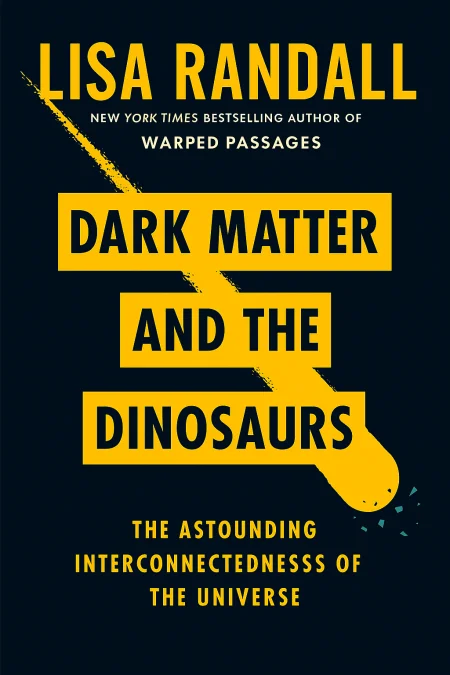
Dark Matter and the Dinosaurs
The Astounding Interconnectedness of the Universe
Book Edition Details
Summary
In the vast tapestry of the cosmos, where shadows of the unseen wield power, Lisa Randall unravels a mystery as old as the stars. "Dark Matter and the Dinosaurs" dances on the edge of science and speculation, inviting readers to ponder the cosmic forces that shaped our planet's destiny. A cataclysmic collision erased the dinosaurs—was it merely an errant comet, or did dark matter's invisible hand play a role? Randall, a luminary in theoretical physics, embarks on a bold exploration, connecting the celestial with the terrestrial. Her narrative is a kaleidoscope of science, history, and culture, revealing how the enigmatic dark matter might have scripted Earth's past and possibly its future. This book doesn't just offer knowledge; it transforms your gaze upon the heavens and Earth, forever altering your understanding of our cosmic heritage.
Introduction
Sixty-six million years ago, a massive asteroid streaked through Earth's atmosphere and slammed into what is now Mexico's Yucatan Peninsula with the force of billions of nuclear weapons. In that single moment, the age of dinosaurs ended and the age of mammals began. But what if this catastrophic event wasn't simply cosmic bad luck? What if it was part of a vast, invisible cycle that has been shaping life on Earth for hundreds of millions of years? This remarkable journey through space and time reveals how the universe's hidden architecture influences the fate of species in ways we're only beginning to understand. From the mysterious dark matter that sculpted cosmic structure to the periodic bombardments that have repeatedly reset evolution's course, we discover that Earth's biological history is intimately connected to forces operating on galactic scales. The story weaves together cutting-edge physics, paleontology, and astronomy to show how the invisible scaffolding of the cosmos may have determined which creatures survived and which perished throughout deep time. Whether you're fascinated by the mysteries of dark matter, curious about the dramatic events that shaped life's trajectory, or simply wonder how cosmic forces reach down to influence our planet, this exploration offers profound insights into the hidden connections between the largest structures in the universe and the smallest details of evolutionary history.
The Invisible Scaffolding: Dark Matter Shapes Cosmic Architecture
In the 1930s, astronomer Fritz Zwicky made a startling discovery while studying distant galaxy clusters. The galaxies were moving far too fast to remain gravitationally bound by the matter he could see, yet somehow they stayed together in vast cosmic structures. Zwicky realized that some invisible form of matter must be providing the additional gravitational glue, coining the term "dark matter" for this mysterious component that would prove to dominate the universe. Today we know that dark matter outweighs ordinary matter by a factor of five to one, forming an invisible scaffolding upon which all cosmic structure depends. This elusive substance doesn't interact with light, making it nearly impossible to detect directly, yet its gravitational influence shapes everything from the smallest galaxies to the largest structures in the observable universe. Computer simulations reveal that without dark matter's head start in the early universe, there wouldn't have been enough time for galaxies to form, stars to ignite, and the heavy elements essential for life to be forged in stellar cores. The cosmic web that emerged from dark matter's gravitational embrace reveals a universe of stunning complexity and beauty. Vast filaments of matter stretch across hundreds of millions of light-years, intersecting at nodes where galaxy clusters formed, separated by enormous voids containing almost nothing. Our own Milky Way galaxy sits within this grand architecture, its spiral structure and stellar populations shaped by the invisible halo of dark matter that extends far beyond what we can see. This hidden framework didn't just create the stage for cosmic evolution—it may continue to influence the drama of life on Earth. As our solar system journeys through the galaxy, it encounters varying densities of dark matter that could trigger the very catastrophes that have punctuated our planet's biological history, connecting the invisible universe to the visible story of extinction and survival.
Solar System Bombardment: Asteroids, Comets and Planetary Evolution
Our solar system formed 4.6 billion years ago from a swirling disk of gas and dust, a violent process that left behind countless rocky and icy fragments scattered throughout space. The asteroid belt between Mars and Jupiter contains millions of these remnants, while the distant Kuiper Belt and hypothetical Oort Cloud harbor trillions of comets in the frozen outer reaches of our cosmic neighborhood. Far from being mere debris, these objects represent both the building blocks of planets and an ongoing threat to life on Earth. During the solar system's chaotic youth, migrating giant planets scattered asteroids and comets throughout the inner regions, creating what scientists call the Late Heavy Bombardment around four billion years ago. The Moon's cratered surface preserves evidence of this cosmic shooting gallery, while Earth's geological activity has erased most traces of ancient impacts. Yet this bombardment wasn't entirely destructive—it delivered the water that fills our oceans and the organic compounds that provided raw materials for life's emergence. The Oort Cloud, extending perhaps 100,000 times farther from the Sun than Earth, represents a vast reservoir of potential catastrophe. These icy bodies orbit so far from the Sun that they're barely bound by its gravity, making them exquisitely sensitive to external disturbances. A passing star, the tidal force of the galaxy, or other cosmic perturbations can nudge these objects from their distant homes, sending them careening toward the inner solar system as long-period comets. Modern surveys have catalogued most kilometer-sized near-Earth asteroids, finding that none pose immediate threats. However, the ongoing dance of gravitational forces ensures that our planet's bombardment history is far from over. The same cosmic processes that delivered life's ingredients continue to operate, occasionally sending visitors from the outer darkness that can reshape our world in ways both creative and destructive.
The Great Dying: Mass Extinctions and the K-Pg Impact Event
The fossil record tells a story of life repeatedly rising and falling in dramatic cycles, with five major mass extinctions punctuating the history of complex organisms. Each event eliminated between fifty and ninety percent of existing species, fundamentally reshaping the trajectory of evolution and opening new ecological opportunities for surviving lineages. The most famous of these catastrophes occurred sixty-six million years ago, marking the boundary between the Cretaceous and Paleogene periods and ending the reign of non-avian dinosaurs. For decades, scientists debated whether this extinction resulted from gradual climate change or sudden catastrophe. The answer came from an unlikely source—a thin layer of clay found worldwide at the extinction boundary, enriched with iridium, an element rare on Earth's surface but common in asteroids. This chemical signature, combined with shocked quartz crystals and tiny glass spheres that form only under extreme impact conditions, pointed to a cosmic culprit of unprecedented scale. The smoking gun emerged with the discovery of the Chicxulub crater, buried beneath Mexico's Yucatan Peninsula. This 180-kilometer-wide scar provided definitive proof that an asteroid at least ten kilometers across had struck Earth with devastating consequences. The impact vaporized rock, triggered global wildfires, and hurled debris into the atmosphere that blocked sunlight for months. Photosynthesis ceased, food chains collapsed, and the planet entered a prolonged winter that eliminated three-quarters of all species. Yet this cosmic catastrophe also created unprecedented opportunities. With large dinosaurs eliminated, small mammals diversified rapidly into ecological niches that had been closed to them for over 160 million years. The lineages that emerged from this evolutionary bottleneck would eventually give rise to primates, and ultimately to humans. The asteroid that ended the age of dinosaurs didn't just destroy—it cleared the path for our own existence, demonstrating how cosmic catastrophes can redirect the entire course of life's history.
Galactic Cycles: Dark Disk Theory and Periodic Catastrophes
The discovery that asteroid impacts could trigger mass extinctions raised a tantalizing question: could these catastrophic events follow a predictable pattern? Analysis of crater records and extinction data suggests that major impacts may occur in cycles roughly thirty million years apart, a periodicity too regular to be explained by random cosmic accidents. If real, this pattern would point to some underlying astronomical cycle that periodically disturbs the Oort Cloud, sending waves of comets toward the inner solar system. The key insight comes from understanding our solar system's motion through the Milky Way galaxy. As the Sun orbits the galactic center, it also oscillates up and down through the galactic disk, crossing the dense midplane approximately every thirty million years. Traditional models suggested this motion might trigger comet showers by increasing gravitational disturbances, but the predicted effects were too weak to explain the observed impact rates. Recent theoretical work proposes a revolutionary solution: a thin disk of dark matter embedded within the galaxy's ordinary matter disk. This hypothetical "dark disk" would be much denser than previously assumed, creating powerful tidal forces as our solar system passes through it. When the Sun crosses this dark matter concentration, the enhanced gravitational field would violently disturb the distant Oort Cloud, launching barrages of comets toward Earth and the other planets. This dark disk model represents a profound connection between fundamental physics and the history of life, linking the invisible architecture of our galaxy to the visible record of extinction and survival preserved in Earth's rocks. If confirmed, it would suggest that the rise and fall of species—including the extinction of dinosaurs and the subsequent diversification of mammals—may be governed by our solar system's journey through realms of dark matter we are only beginning to understand.
Summary
The cosmic history revealed through this investigation demonstrates that Earth's biological story cannot be understood in isolation from the vast forces that shape our galactic environment. The central theme connecting dark matter to dinosaurs is the profound relationship between invisible architecture and visible consequences—how the universe's hidden scaffolding not only creates the conditions for life but may also orchestrate the periodic catastrophes that drive evolutionary change across deep time. This perspective offers crucial insights for our modern world and future survival. First, it reminds us that Earth exists within a dynamic cosmic environment where long-term cycles operate on timescales that dwarf human civilization, encouraging us to think beyond immediate concerns when planning for humanity's future. The recognition that cosmic forces have repeatedly reset life's trajectory suggests we should develop technologies and strategies capable of detecting and potentially deflecting future impact threats. Second, it demonstrates how seemingly unrelated fields of science can illuminate each other in unexpected ways, showing that our greatest breakthroughs may come from embracing interdisciplinary thinking rather than narrow specialization. Perhaps most importantly, this cosmic detective story teaches us both humility and empowerment about our place in the universe. We are products of forces we cannot see, survivors of catastrophes we barely comprehend, yet through careful observation and creative thinking, we can decode the hidden connections that link our existence to the deepest structures of reality. In recognizing these connections, we gain not only scientific knowledge but also a profound appreciation for the remarkable chain of cosmic events that made our brief moment of consciousness possible.
Related Books
Download PDF & EPUB
To save this Black List summary for later, download the free PDF and EPUB. You can print it out, or read offline at your convenience.
By Lisa Randall
