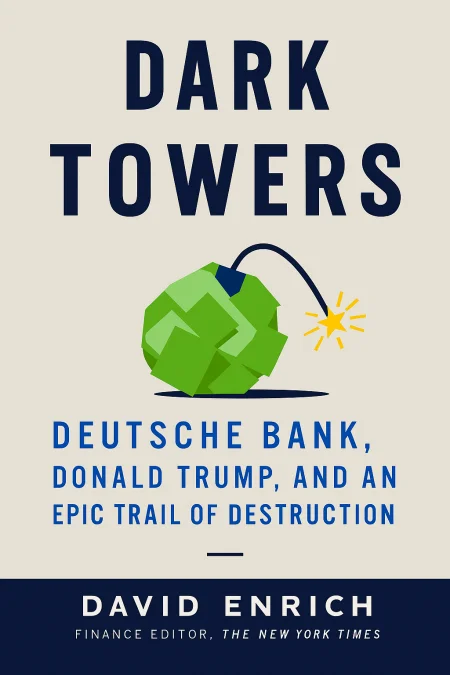
Dark Towers
Deutsche Bank, Donald Trump, and an Epic Trail of Destruction
Book Edition Details
Summary
In the shadowy corridors of global finance, Deutsche Bank emerges not merely as a bank, but as an ominous force shaping the world's darkest dealings. "Dark Towers" by David Enrich peels back the layers of a century-old financial giant entwined with historical infamy and modern scandal. From its sinister support of the Nazi regime to its entanglements with Russian oligarchs and its audacious ties with Donald Trump, Deutsche Bank's saga is a chilling tale of ambition and moral decay. At its heart is Bill Broeksmit, a man who held the keys to its most damning secrets, until fear and betrayal led him to a tragic end. This riveting exposé invites readers into a world where power corrupts absolutely, and where one man's secrets could unravel an empire.
Introduction
In the heart of Frankfurt's financial district, a towering institution once stood as the embodiment of German banking excellence, its influence stretching across continents and shaping the flow of global capital. Yet behind the polished facade of respectability lay a darker story of institutional transformation, where traditional banking values gradually gave way to reckless ambition and moral compromise. This narrative reveals how a venerable financial institution can lose its way in pursuit of profits, ultimately becoming entangled with some of the most controversial figures and transactions of our era. The story illuminates three profound questions that extend far beyond banking: How do established institutions abandon their founding principles in pursuit of growth? What happens when the culture of an organization becomes corrupted by unchecked ambition? And how do personal relationships and individual decisions shape the destiny of entire financial empires? Through this lens, we witness the broader transformation of global finance, where Old World prudence collided with New World risk-taking, often with devastating consequences. This tale will particularly resonate with business leaders seeking to understand institutional culture, policy makers grappling with financial regulation, and anyone curious about how power operates behind the scenes of major political and economic events. It offers crucial insights into the human cost of corporate failure and the far-reaching consequences when financial institutions prioritize short-term gains over long-term integrity.
Wall Street Transformation: Building a Financial Empire (1995-2008)
The metamorphosis of Deutsche Bank from a conservative German lender into a global financial powerhouse began with a pivotal decision in the mid-1990s. Faced with the limitations of traditional European banking, the institution's leadership embarked on an ambitious journey to conquer the lucrative world of American investment banking. This wasn't merely a business expansion; it represented a fundamental reimagining of what the bank could become in an increasingly interconnected financial world. The architect of this transformation was Edson Mitchell, a charismatic American banker who arrived with a $2 billion war chest and an evangelical belief in the power of complex financial instruments. Mitchell brought with him a cadre of Wall Street veterans, including Bill Broeksmit, a brilliant risk manager who would serve as both enabler and conscience of the bank's expansion. Together, they introduced Deutsche Bank to the world of derivatives trading, structured products, and high-stakes financial engineering that had made American investment banks extraordinarily profitable. The cultural collision was immediate and profound. Mitchell's team operated with an aggressive, profit-first mentality that clashed dramatically with Deutsche's traditional approach to banking. They spoke English in German boardrooms, commanded astronomical bonuses, and treated risk-taking as a virtue rather than a necessary evil. Within months, they had hired thousands of employees and begun transforming Deutsche into what would become, by 2007, the world's largest bank by assets. This period of explosive growth established patterns that would prove catastrophic in later years. The bank's leadership became intoxicated with quarterly profits, viewing each successful deal as validation of their strategy. They accumulated trillions of dollars in derivatives, created complex financial products with little regard for long-term consequences, and built a culture where questioning authority was discouraged. The seeds of future scandals were planted during these boom years, when success masked the fundamental instability of the empire they were constructing.
Crisis and Deception: Survival Through Fraud (2008-2014)
The 2008 financial crisis should have been Deutsche Bank's moment of reckoning, but instead it became a masterclass in institutional survival through deception and regulatory manipulation. While other major banks collapsed or required massive government bailouts, Deutsche managed to present itself as a success story, claiming superior management and strategic foresight had enabled it to navigate the crisis. The reality behind this facade was far more troubling and would eventually unravel in spectacular fashion. Behind closed doors, Deutsche was engaged in systematic fraud, manipulating the values of its derivatives portfolios to hide billions in losses from investors and regulators. Traders were rigging fundamental interest rates, while other divisions laundered money for sanctioned regimes and helped wealthy clients evade taxes on an industrial scale. The bank's survival depended not on sound business practices but on its ability to deceive everyone about its true financial condition and the extent of its misconduct. The human cost of this institutional deception became tragically apparent in the wave of despair that swept through the banking industry. Bill Broeksmit, who had spent years trying to impose discipline on Deutsche's risk-taking culture, found himself increasingly isolated as the bank's problems mounted and his warnings went unheeded. His death in January 2014 marked not just a personal tragedy but a symbolic end to the era when voices of caution could still be heard within the institution's walls. This period revealed the mechanics of regulatory capture in stark detail. Deutsche Bank employed former government officials, funded lobbying organizations, and exploited jurisdictional rivalries between different countries' regulators to avoid meaningful oversight. When investigations did occur, the bank's response was to delay, obfuscate, and minimize rather than genuinely reform its practices. The pattern established during these years would define Deutsche's relationship with law enforcement for the remainder of the decade, creating a cycle of scandal and settlement that would ultimately threaten the bank's very existence.
Political Entanglement: The Trump Connection and Institutional Collapse (2011-2020)
Perhaps no relationship better illustrates Deutsche Bank's willingness to prioritize profits over prudence than its decision to become Donald Trump's primary lender during a period when virtually every other major financial institution had blacklisted him. This partnership, which deepened significantly around 2011, would ultimately entangle the bank in American presidential politics in ways that its executives never anticipated, creating conflicts of interest that would haunt the institution for years to come. The relationship was cultivated by Rosemary Vrablic, a skilled private banker who specialized in managing difficult and high-maintenance clients. When Trump approached Deutsche for financing after defaulting on previous loans and burning bridges with other lenders, Vrablic saw opportunity where others saw insurmountable risk. She structured deals that allowed Trump to refinance existing debts, purchase new properties, and maintain his lavish lifestyle even as his business empire teetered on the edge of bankruptcy. What made this relationship particularly extraordinary was its persistence despite repeated red flags and warning signs. Trump had a well-documented history of defaulting on loans, grossly inflating his net worth in financial statements, and using litigation as a primary negotiating tactic. Internal Deutsche documents revealed that bank analysts had to reduce Trump's claimed asset values by as much as 70 percent to arrive at realistic assessments of his wealth. Yet the loans continued to flow, totaling hundreds of millions of dollars over the course of their relationship. The deeper significance of this partnership became clear as Trump's political ambitions grew and eventually led him to the presidency. Deutsche Bank was not simply lending money to a controversial real estate developer; it was providing crucial financial support to a future president of the United States. By the time investigations began in earnest, Deutsche found itself in the unprecedented position of being the primary creditor to the leader of the free world, creating conflicts of interest and political vulnerabilities that would define the bank's final chapter as a global financial powerhouse.
Summary
The story of Deutsche Bank reveals a fundamental truth about modern institutional failure: organizations don't collapse overnight but through a series of small compromises that gradually erode their foundational principles and moral compass. The bank's transformation from a respected German institution to a global scandal factory illustrates how the relentless pursuit of short-term profits can ultimately destroy long-term value, institutional integrity, and human lives in the process. The central tension running through this narrative is the eternal conflict between growth and governance, between ambition and ethics, between individual enrichment and institutional responsibility. Time and again, Deutsche Bank's leaders chose immediate gains over sustainable practices, personal advancement over collective welfare, and regulatory arbitrage over genuine compliance. This pattern, repeated across decades and continents, demonstrates how financial institutions can become captured by their own success, losing the ability to assess risk rationally or act in their own long-term interests. The lessons for our current moment are both sobering and actionable. First, we must recognize that financial institutions of Deutsche Bank's size and complexity cannot be effectively regulated by existing frameworks; they require new approaches that acknowledge their systemic importance and political influence. Second, institutional culture matters more than individual talent or market opportunities, and organizations that abandon their core values in pursuit of growth inevitably create conditions for their own destruction. Finally, the interconnected nature of global finance means that the moral failures of one institution can have far-reaching consequences for entire economies and political systems, making the stakes of financial reform higher than ever before.
Related Books
Download PDF & EPUB
To save this Black List summary for later, download the free PDF and EPUB. You can print it out, or read offline at your convenience.
By David Enrich
