
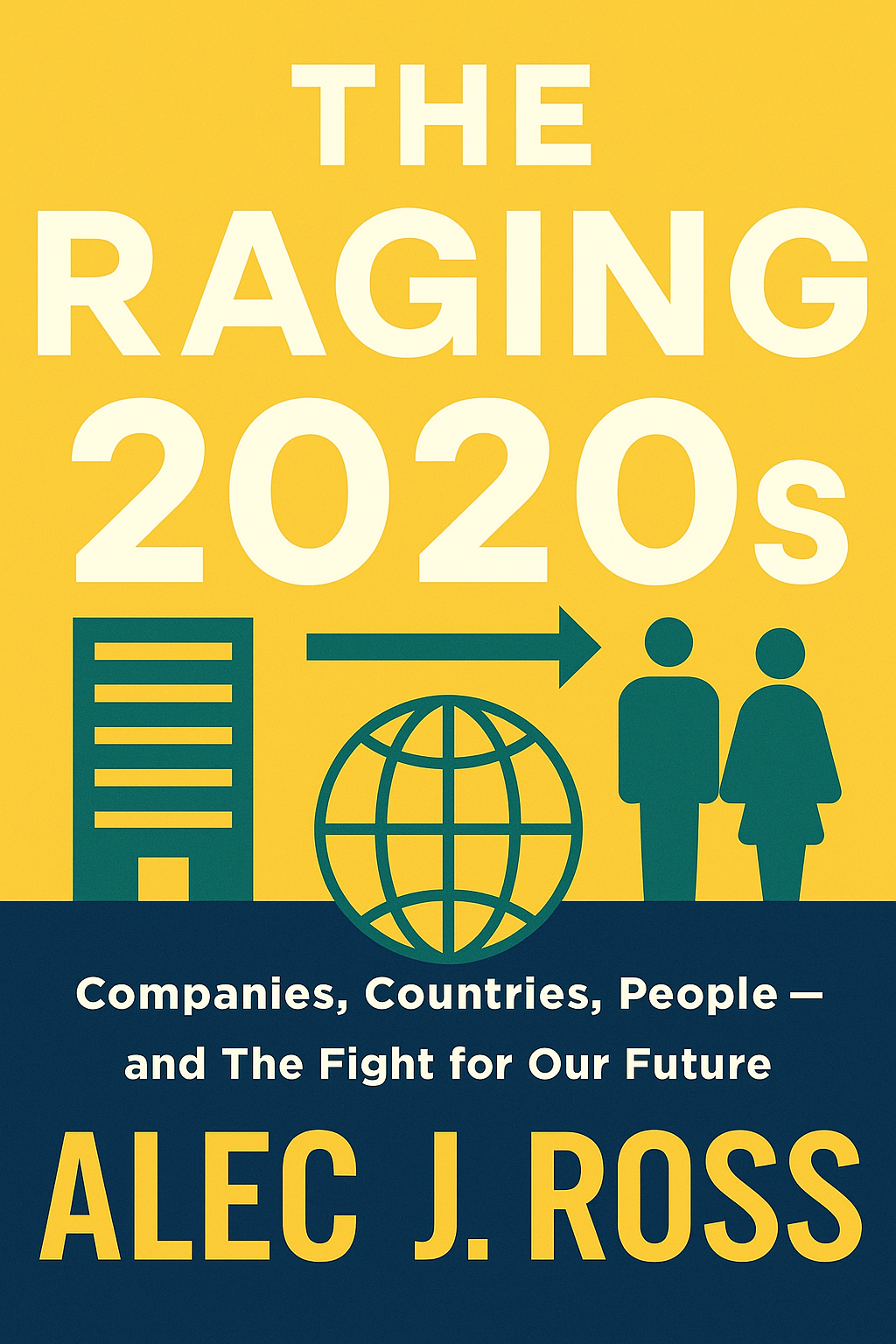
The Raging 2020s
Companies, Countries, People – and the Fight for Our Future
Book Edition Details
Summary
In an era where corporate giants cast shadows over nation-states, "The Raging 2020s" by Alec Ross emerges as a clarion call for transformation. This provocative narrative dissects the fragile social contract, unraveling how corporations have eclipsed governments in influence, dictating terms in privacy, sustainability, and social equity. As pandemics rage and climate crises loom, Ross, a seasoned voice in global policy, challenges us to reimagine our collective future. Through poignant interviews and gripping tales of corporate defiance and governmental faltering, he charts a course toward equilibrium. Are we destined for a dystopian reality, or can we forge a new pact for the modern age? This book is a crucial roadmap, offering insights and inspiration to reshape the landscape of power.
Introduction
The social contract that once balanced corporate interests, governmental authority, and citizen welfare has fundamentally collapsed, creating unprecedented concentrations of power that threaten democratic governance itself. This transformation represents more than economic inequality or political dysfunction; it signals the emergence of a new form of capitalism where multinational corporations operate as quasi-sovereign entities, capable of choosing their regulatory environments, avoiding fiscal obligations, and influencing policy outcomes while remaining largely unaccountable to democratic institutions. The evidence manifests across multiple domains simultaneously. Pharmaceutical companies extract enormous profits from medications discovered decades ago while patients ration life-saving treatments. Technology giants accumulate surveillance capabilities that rival nation-states while operating with minimal oversight. Workers find themselves trapped in precarious employment arrangements that offer neither security nor representation, even as corporate profits reach historic highs. Meanwhile, democratic governments struggle with institutional capture, declining revenues, and an inability to address challenges that transcend national borders. This analysis employs a systems-thinking approach to examine how corporate power has evolved to fill vacuums left by weakened democratic institutions, creating new forms of governance that operate beyond traditional accountability mechanisms. The investigation reveals how tax avoidance, labor exploitation, technological dominance, and regulatory capture interconnect to undermine the social contracts that once ensured shared prosperity. Understanding these dynamics becomes essential for comprehending why democratic societies face such profound instability and what structural changes might restore equilibrium between corporate efficiency and democratic legitimacy.
Corporate Capture: How Shareholder Primacy Undermined Democratic Institutions
Corporate capitalism has undergone a fundamental transformation that prioritizes short-term shareholder returns over broader social responsibilities, creating systematic incentives for behaviors that undermine democratic governance. This shift, crystallized in Milton Friedman's doctrine that businesses exist solely to maximize profits, has produced a system where corporate decisions routinely ignore their impacts on workers, communities, and democratic institutions. The pharmaceutical industry exemplifies this dysfunction, where companies controlling insulin production have increased prices by over 1,000% since the 1990s, forcing diabetic patients to ration life-saving medication while generating enormous profits for shareholders. The shareholder primacy model encourages destructive behaviors that socialize risks while privatizing gains. Stock buybacks, illegal until 1982, now consume trillions of dollars that could otherwise fund research, worker compensation, or infrastructure investment. Airlines spent $49 billion on buybacks before requesting taxpayer bailouts during the COVID-19 pandemic, revealing how this system forces governments and citizens to bear the costs of corporate short-termism while shareholders capture the benefits during profitable periods. Market concentration has accelerated under this model, creating oligopolies that exploit both consumers and democratic processes. Four companies control 80% of beef production, while similar consolidation affects industries from airlines to telecommunications. This concentration enables price manipulation, reduces competitive pressure for innovation, and creates corporate entities large enough to capture regulatory agencies and influence legislative processes. The result is an economy where corporate power grows unchecked while democratic institutions struggle to provide effective oversight. Democratic capture operates through multiple channels that systematically advantage corporate interests over public preferences. Corporate lobbying expenditures have grown exponentially, with businesses now spending $34 for every dollar invested by public interest groups in influencing policy. This disparity has produced a system where corporate interests routinely override public preferences, even when polling shows overwhelming popular support for policies like higher minimum wages or stricter environmental regulations. The revolving door between government agencies and the industries they regulate ensures that corporate perspectives dominate policy formation and implementation.
The Tax Avoidance System: Multinational Power Beyond National Accountability
Multinational corporations have constructed a parallel governance structure through sophisticated tax avoidance schemes that operate beyond democratic accountability, fundamentally challenging the fiscal foundations of democratic societies. Google's "Double Irish with a Dutch Sandwich" structure enabled the company to pay effective tax rates below 1% on international profits, routing billions through shell companies in tax havens while utilizing infrastructure and educated workforces funded by taxpayers. This system allows corporations to benefit from public investments while avoiding the fiscal responsibilities that sustain democratic institutions. The offshore financial system has evolved into a comprehensive mechanism for wealth extraction that undermines democratic sovereignty. Approximately $7.6 trillion in private wealth remains hidden in tax havens, while corporations shift an estimated $600 billion annually away from national tax authorities. These flows represent more than accounting maneuvers; they constitute a fundamental challenge to democratic governance, as elected governments lose the resources necessary to provide public services, invest in infrastructure, or respond effectively to citizen demands. Government agencies tasked with oversight have been systematically weakened through budget cuts and regulatory capture, creating an asymmetric power relationship that favors corporate interests. The Internal Revenue Service has lost 22% of its workforce since 2010, while audit rates for wealthy individuals and large corporations have plummeted. Meanwhile, corporate lawyers and accountants develop increasingly sophisticated strategies to exploit regulatory gaps and jurisdictional arbitrage. This dynamic ensures that democratic institutions cannot effectively monitor or constrain corporate behavior. The race to the bottom in corporate taxation has created a global system where countries compete to attract multinational investment by offering increasingly generous tax incentives, ultimately undermining their own fiscal capacity. Average global corporate tax rates have fallen from over 40% in 1980 to just over 24% today, while the complexity of international tax structures has made enforcement increasingly difficult for national authorities. This system enables the largest and most profitable corporations to contribute proportionally less to public goods while smaller, domestically-focused businesses bear the full burden of taxation.
Labor's Decline and Nordic Alternatives: Rebuilding Economic Democracy
The systematic weakening of organized labor represents a fundamental shift in economic power that has eliminated a crucial counterweight to corporate dominance while undermining democratic participation more broadly. Union membership in the United States has fallen from 35% of the workforce in the 1950s to just 10% today, correlating directly with stagnating wages, reduced worker protections, and the growth of precarious employment arrangements that offer neither security nor benefits. This decline has removed institutional mechanisms that once translated worker interests into political power. Traditional collective bargaining has proven inadequate for addressing the challenges of the modern economy, where gig work, contractor relationships, and global supply chains fragment worker solidarity. Uber employs 3.9 million drivers worldwide while maintaining they are independent contractors rather than employees, thereby avoiding obligations for benefits, job security, or collective bargaining rights. This model has spread across industries, creating a workforce that bears economic risks individually while corporations capture the benefits of their labor through algorithmic management and platform control. Nordic countries demonstrate alternative approaches to labor organization that maintain worker power while adapting to economic change, offering concrete models for reconstructing economic democracy. Sweden achieves 70% union membership through sectoral bargaining that covers entire industries rather than individual workplaces, creating coordination mechanisms that prevent a race to the bottom in wages and working conditions. Danish "flexicurity" combines easy hiring and firing with robust unemployment benefits and retraining programs, enabling economic adaptation while protecting worker welfare through collective institutions. Worker representation on corporate boards offers another mechanism for balancing stakeholder interests within capitalist structures, demonstrating how democratic principles can be embedded in corporate governance. German codetermination requires large companies to include employee representatives on supervisory boards, creating institutional channels for worker input into strategic decisions. Research indicates that companies with worker board representation invest more in research and development, maintain more stable employment, and achieve better long-term performance than those governed solely by shareholder representatives, suggesting that economic democracy can enhance rather than undermine corporate effectiveness.
Technology and Surveillance: The New Battleground for Democratic Values
The development of artificial intelligence and surveillance technologies has created new forms of power that operate beyond traditional democratic controls, fundamentally altering the relationship between corporate capabilities and governmental authority. Chinese companies like SenseTime have constructed surveillance systems capable of tracking individual citizens throughout their daily lives, feeding data to government authorities who use it to suppress political dissent and control social behavior. This technology represents a convergence of corporate innovation and authoritarian governance that threatens democratic societies worldwide. American technology companies face different pressures but similar challenges in balancing innovation with democratic values, often making decisions that override traditional governmental prerogatives. Google's withdrawal from Project Maven, a Pentagon artificial intelligence initiative, illustrates how corporate decisions about technology development can supersede national security considerations. Meanwhile, companies like Palantir have embraced defense and intelligence contracts, creating a new military-industrial complex built around data analytics and algorithmic decision-making rather than traditional weapons systems. The global competition for technological dominance has created a "Code War" between democratic and authoritarian models of development, with profound implications for the future of democratic governance. China's state-directed approach enables rapid deployment of new technologies but subordinates individual privacy and political freedom to collective goals defined by party leadership. Western democracies struggle to match this coordination while maintaining competitive markets and protecting civil liberties, creating potential advantages for authoritarian systems in developing and deploying powerful technologies. Regulating artificial intelligence and surveillance technologies requires international cooperation among democratic nations, but existing institutions prove inadequate for addressing challenges that transcend national borders and traditional regulatory categories. The European Union's General Data Protection Regulation represents one attempt to establish democratic control over technology development, but American companies often comply minimally while authoritarian governments ignore such restrictions entirely. Creating effective governance for emerging technologies demands new forms of international cooperation that can match the global scale of technology companies while preserving democratic accountability and individual rights.
Summary
The convergence of corporate power concentration, governmental institutional weakness, and technological transformation has created a systemic crisis that threatens the foundational assumptions of democratic capitalism. Multinational corporations now operate as quasi-sovereign entities capable of choosing among regulatory jurisdictions, avoiding tax obligations, and influencing policy outcomes in ways that systematically undermine democratic governance. This system produces enormous wealth for shareholders and corporate executives while imposing costs on workers, communities, and democratic institutions that lack effective means of response. The resulting inequality and institutional dysfunction fuel political polarization and authoritarian movements that further weaken democratic capacity. However, alternative models from Nordic countries and emerging stakeholder capitalism frameworks demonstrate that market economies can operate within democratic constraints when supported by appropriate institutional designs. The fundamental challenge lies not in choosing between capitalism and democracy, but in reconstructing the social contracts and institutional arrangements that can harness corporate efficiency while maintaining democratic accountability and ensuring that economic growth serves broadly shared prosperity rather than concentrated wealth accumulation.
Related Books
Download PDF & EPUB
To save this Black List summary for later, download the free PDF and EPUB. You can print it out, or read offline at your convenience.
By Alec J. Ross
