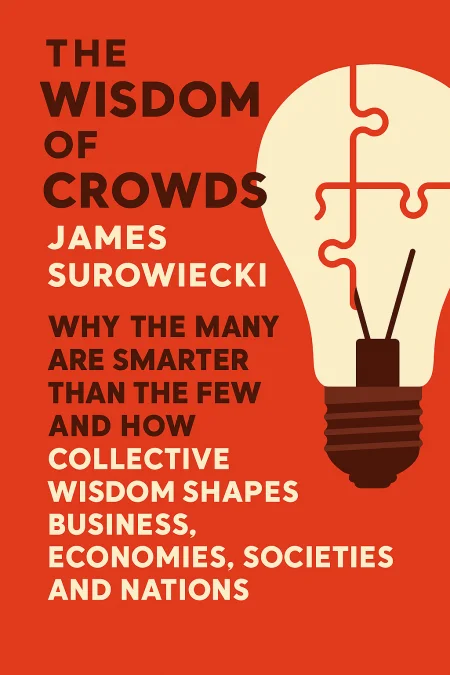
The Wisdom of Crowds
Why the Many Are Smarter Than the Few
Book Edition Details
Summary
In a world teeming with complexities, what if the collective wisdom of everyday folks outshines the genius of a select few? In "The Wisdom of Crowds," James Surowiecki challenges the notion that brilliance is the exclusive domain of elites. Instead, he unravels how ordinary groups can tackle problems, spur innovation, and even forecast the future with uncanny accuracy. Through a mosaic of disciplines, from the quirks of pop culture to the intricacies of ant colonies, Surowiecki illustrates the profound implications of this idea on everything from business strategies to societal organization. He peppers his narrative with engaging real-world scenarios—why does your checkout line always seem the slowest? How do global standards bring screws and bolts into harmony? This book is a vivid exploration of collective intelligence, reshaping how we approach decision-making, leadership, and the essence of human collaboration.
Introduction
Why do individual experts often fail while groups of ordinary people succeed? This paradox challenges our fundamental assumptions about intelligence, expertise, and decision-making. When Francis Galton observed a crowd at a county fair accurately guess the weight of an ox, he stumbled upon a profound truth that would reshape our understanding of collective intelligence. The phenomenon reveals that under the right conditions, groups consistently outperform even their smartest members, producing remarkably accurate judgments and innovative solutions. This collective wisdom emerges not from the brilliance of any single individual, but from the aggregation of diverse, independent perspectives working within decentralized systems. The theory illuminates how markets price securities, how democracies function, how scientific breakthroughs occur, and how organizations can harness the distributed knowledge of their members. Understanding collective intelligence offers a framework for reimagining everything from corporate strategy to public policy, revealing that the answer to complex problems often lies not in finding the right expert, but in asking the right crowd.
Foundations of Collective Intelligence
Collective intelligence represents the counterintuitive principle that groups of diverse individuals can make better decisions than isolated experts, even when most group members possess limited knowledge about the problem at hand. This phenomenon occurs when four critical conditions align: diversity of opinion ensures that people bring different pieces of information and perspectives to the problem; independence prevents individuals from being unduly influenced by others' judgments; decentralization allows people to specialize and draw on local knowledge; and aggregation provides a mechanism for turning private judgments into collective decisions. The mathematical foundation rests on the law of large numbers and error cancellation. When individuals make estimates, each guess contains both information and error. In a properly functioning crowd, the errors are random and tend to cancel each other out, while the information accumulates. This creates what statisticians call the wisdom of crowds effect, where the group's average estimate approaches the true answer with remarkable precision. The phenomenon explains why prediction markets often outperform expert forecasts, why Wikipedia rivals traditional encyclopedias in accuracy, and why Google's PageRank algorithm successfully identifies relevant web pages by aggregating millions of individual linking decisions. Consider the Iowa Electronic Markets, where ordinary people trade contracts based on election outcomes. These markets consistently outperform professional pollsters, not because traders are political experts, but because they aggregate diverse information and opinions into price signals that reflect collective judgment. The power lies not in individual brilliance but in the emergent intelligence that arises when diverse perspectives combine through proper aggregation mechanisms.
Markets and Coordination Mechanisms
Markets represent sophisticated information processing systems that coordinate the decisions of millions of participants without central planning or control. The theoretical elegance lies in how price mechanisms automatically aggregate dispersed knowledge, preferences, and expectations into signals that guide resource allocation across entire economies. Each market transaction represents a small piece of information about value, scarcity, and demand that becomes part of a larger collective judgment about optimal resource distribution. The coordination mechanism operates through interconnected feedback loops where individual participants make decisions based on their local knowledge and personal circumstances. These individual choices create patterns of supply and demand that generate price signals, which in turn influence the decisions of other participants. The system creates dynamic information flows that allow rapid adaptation to changing conditions without requiring any central authority to collect and process all relevant data. Real-world examples demonstrate this principle across various scales and contexts. When natural disasters disrupt supply chains, prices automatically adjust to reflect new scarcities, encouraging conservation and attracting alternative suppliers without government intervention. Traffic patterns emerge from similar collective intelligence, as drivers make individual route choices that collectively optimize flow patterns across road networks. Dating apps use comparable mechanisms, allowing millions of individual preferences to create matching systems more sophisticated than any algorithm designed by experts. The power of these coordination mechanisms lies not in their perfection, but in their ability to harness distributed knowledge and adapt continuously to changing circumstances, creating order from apparent chaos through the invisible hand of collective decision-making.
Organizational Decision-Making and Leadership
Traditional organizational hierarchies often suppress collective intelligence by concentrating decision-making power in the hands of a few leaders, regardless of where relevant knowledge actually resides within the organization. The theoretical challenge lies in designing structures that can harness the distributed expertise of all organizational members while maintaining coordination and accountability. Effective organizational intelligence requires creating channels for information to flow upward, sideways, and across traditional boundaries, rather than simply flowing down from executive suites. The most successful organizational models combine hierarchical coordination with decentralized intelligence gathering and processing. This involves establishing clear decision-making processes that actively seek diverse perspectives, create psychological safety for dissenting views, and implement mechanisms for aggregating insights from across the organization. Leaders in such systems function less as omniscient decision-makers and more as architects of collective intelligence, designing processes that can tap into the knowledge and creativity of their entire workforce. Companies like Toyota revolutionized manufacturing by empowering front-line workers to identify problems and suggest improvements, recognizing that those closest to the work often possess the most valuable insights about operational efficiency. Successful technology companies create internal prediction markets where employees can bet on project outcomes, product launches, and market trends, often producing more accurate forecasts than executive committees. The military concept of commander's intent exemplifies this approach, providing clear objectives while allowing field personnel to adapt tactics based on local conditions and real-time information. These examples demonstrate that organizational intelligence flourishes when leadership focuses on creating conditions for collective wisdom rather than trying to centralize all important decisions, resulting in organizations that respond more quickly to changing conditions and make better use of their human capital.
Democracy and Social Cooperation
Democratic systems represent humanity's most ambitious attempt to harness collective intelligence for governance, based on the premise that aggregating the political preferences and judgments of entire populations produces better outcomes than rule by elites or experts. The theoretical foundation rests on the idea that while individual citizens may have limited knowledge about specific policies, their collective judgment about broad directions and values reflects a wisdom that transcends individual limitations. This creates a feedback mechanism where political leaders must remain responsive to public sentiment while citizens learn from the consequences of their electoral choices. The architecture of democratic collective intelligence operates through multiple interconnected mechanisms. Electoral systems aggregate individual preferences into collective choices about leadership and policy direction. Public discourse and media create information-sharing networks that help citizens learn from each other's experiences and perspectives. Civil society organizations provide channels for specialized knowledge and interests to contribute to public debate. Federalism and local governance allow for experimentation and adaptation based on local conditions, creating laboratories for testing different approaches to common problems. The effectiveness of democratic collective intelligence depends critically on maintaining the conditions that make group wisdom possible. This requires protecting the independence of information sources, ensuring diverse voices can participate in public discourse, and creating institutions that can aggregate preferences fairly while protecting minority rights. When these conditions break down through polarization, misinformation, or institutional capture, democratic systems can produce outcomes that reflect mob psychology rather than collective wisdom. However, when functioning properly, democratic systems demonstrate remarkable resilience and adaptability, allowing societies to navigate complex challenges, adapt to changing circumstances, and maintain legitimacy across diverse populations while continuing to evolve mechanisms for collective decision-making at scale.
Summary
The wisdom of crowds emerges not from the intelligence of any individual, but from the systematic aggregation of diverse perspectives under conditions that preserve independence and enable effective coordination. This fundamental insight transforms our understanding of intelligence itself, revealing it as a distributed property that can be cultivated and harnessed rather than simply concentrated in experts or leaders. The implications extend across every domain of human activity, from markets and organizations to science and governance, offering a framework for designing better decision-making systems in an increasingly complex world. By understanding and applying these principles, we can create institutions and processes that tap into humanity's collective intelligence, enabling us to solve problems and make decisions that exceed the capabilities of even our most brilliant individuals.
Related Books
Download PDF & EPUB
To save this Black List summary for later, download the free PDF and EPUB. You can print it out, or read offline at your convenience.
By James Surowiecki
