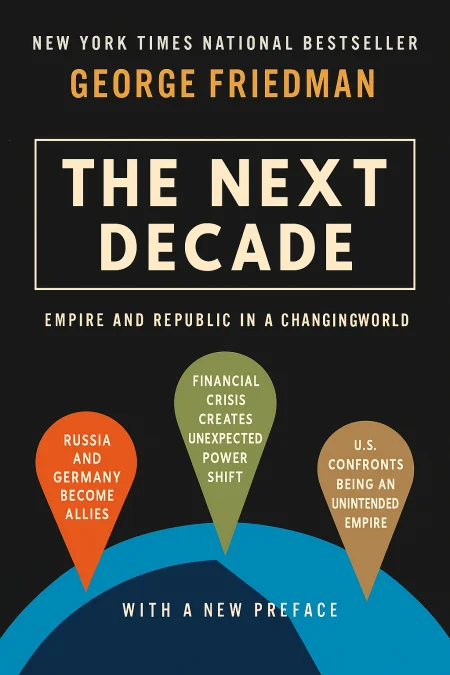
The Next Decade
Empire and Republic in a Changing World
Book Edition Details
Summary
In a world poised on the edge of transformation, George Friedman takes you on a thrilling exploration of the next decade's geopolitical landscape. As the winds of change sweep through America’s corridors of power and ripple across the globe, the spotlight falls on those pivotal figures whose decisions will shape our collective destiny. Friedman, with his incisive foresight, dissects the intricate dance of diplomacy, revealing potential upheavals in U.S. relations with Iran and Israel, a looming crisis in China, and the waning of conflict in the Islamic world. He foresees a future where energy breakthroughs and labor challenges eclipse financial woes, all under the watchful eye of an American president who must possess unparalleled acumen to navigate this era of uncertainty. "The Next Decade" is not just a forecast—it's a gripping narrative that challenges our understanding of leadership and destiny in an ever-shifting global theater.
Introduction
In the corridors of power in Washington, a profound transformation has been quietly taking place. What began as a republic founded in opposition to empire has itself become the world's dominant imperial force, wielding unprecedented influence across every continent. This metamorphosis occurred not through grand design, but through the inexorable forces of history, leaving American leaders to grapple with an empire they never intended to create. The story of America's unintended empire reveals three critical insights that reshape our understanding of modern geopolitics. First, how economic dominance inevitably creates imperial responsibilities, as America's massive economy draws nations into its orbit whether by choice or necessity. Second, the delicate balance between maintaining republican values at home while exercising imperial power abroad presents challenges that even the founders could not have foreseen. Third, the art of managing global power requires a sophisticated understanding of regional balances, where success depends not on direct control but on preventing any single power from dominating its neighbors. This exploration appeals to anyone seeking to understand the hidden mechanics of international relations, the true nature of American influence in the world, and the timeless principles that govern the rise and fall of great powers. For students of history, practitioners of statecraft, and citizens curious about their nation's role in the world, these pages offer a masterclass in the realities of power in the modern age.
The Unintended Empire: America's Global Dominance After the Cold War
The collapse of the Soviet Union in 1991 left the United States in an unprecedented position. Unlike previous great powers that deliberately built empires through conquest and colonization, America found itself the sole global hegemon almost by accident. The economic statistics tell the story most clearly: with just over four percent of the world's population, the United States produces nearly a quarter of global economic output, wielding influence that touches every corner of the planet. This new reality manifested itself in ways both subtle and profound. When Americans develop an appetite for shrimp, fish farmers in the Mekong Delta adjust their production accordingly. When the U.S. Federal Reserve changes interest rates, financial markets from London to Tokyo respond within hours. The very size of the American economy creates a gravitational pull that draws other nations into dependency relationships they never consciously chose. The military dimension reinforces this economic dominance. American forces maintain a presence in dozens of countries, not primarily to fight wars but to prevent potential challengers from emerging. This forward deployment strategy represents a fundamental shift from traditional defensive thinking to a system of preemptive power projection that keeps potential rivals off balance before they can threaten American interests. What makes this empire particularly complex is its informal nature. Unlike the British Empire with its clear administrative structures and the Roman Empire with its legal frameworks, American dominance operates through economic integration, security guarantees, and cultural influence. Nations align with the United States not because they are conquered territories, but because the alternatives are economically and strategically untenable. This informal empire proves both more flexible and more durable than its historical predecessors, but it also creates new challenges for American leaders who must manage global responsibilities without the traditional tools of imperial governance.
Strategic Imbalances: From 9/11 to the 2008 Financial Crisis
The first decade of the twenty-first century exposed critical flaws in America's approach to managing its global dominance. The September 11 attacks revealed that even the world's most powerful nation remained vulnerable to asymmetric threats, while the 2008 financial crisis demonstrated how deeply American economic decisions affected the entire global system. These twin shocks forced a reckoning with the true scope and responsibility of American power. The response to terrorism illustrated the dangers of allowing tactical concerns to override strategic thinking. Instead of maintaining the balanced approach that had served America well during the Cold War, policymakers became fixated on eliminating terrorist threats at the expense of broader geopolitical considerations. This narrow focus led to prolonged military commitments in Afghanistan and Iraq that drained resources and attention from other critical regions, particularly the emerging challenge from a resurgent Russia. The financial crisis of 2008 revealed another dimension of imperial responsibility. What began as a housing bubble in American suburbs spread across the globe, devastating economies from Iceland to Hungary. Eastern European families who had taken mortgages denominated in foreign currencies found themselves bankrupted when their local currencies collapsed. The crisis demonstrated that American domestic policies had become, in effect, global policies, with consequences that reached far beyond U.S. borders. These events highlighted a fundamental imbalance in American strategy. The country possessed overwhelming military and economic power but lacked the institutional frameworks and strategic vision necessary to manage that power effectively. The ad hoc responses to each crisis, while understandable given the immediate pressures, created new vulnerabilities and commitments that would shape the following decade. The lesson was clear: great power brings great responsibility, and the failure to accept that responsibility creates chaos that ultimately returns to threaten the homeland itself.
Regional Realignments: Middle East, Russia, and Global Power Shifts
The strategic mistakes of the early 2000s created opportunities for regional powers to challenge American dominance in their respective spheres. In the Middle East, the destruction of Iraq as a counterweight to Iran fundamentally altered the regional balance, leaving Tehran as the dominant indigenous power in the Persian Gulf. This shift threatened not only American interests but also the stability of the entire global energy system. Russia's resurgence under Vladimir Putin exemplified how quickly geopolitical realities can change when a great power is distracted. While American forces remained bogged down in Iraq and Afghanistan, Moscow systematically rebuilt its influence in the former Soviet space. The 2008 war in Georgia served as a stark reminder that Russia retained both the capability and the will to use force in defense of its perceived interests, while the American response proved diplomatically weak and strategically ineffective. Perhaps most significantly, these regional shifts revealed the inadequacy of America's post-Cold War alliance system. NATO, designed to counter a Soviet threat that no longer existed, proved ill-suited to managing the complex challenges of a multipolar world. European allies showed little enthusiasm for American adventures in the Middle East, while America's focus on counterterrorism left little bandwidth for addressing the root causes of instability in other regions. The emergence of new regional balances required a fundamental rethinking of American strategy. Rather than trying to maintain direct control over every region simultaneously, America needed to return to the classical imperial approach of managing regional balances of power. This meant sometimes working with distasteful partners, accepting imperfect outcomes, and recognizing that the perfect could become the enemy of the good. The decade ahead would test whether American leaders possessed the strategic wisdom and political courage to make such difficult adjustments.
The Machiavellian Presidency: Managing Empire While Preserving the Republic
The greatest challenge facing American leaders in the coming decade lies not in any external threat but in reconciling the requirements of imperial management with the preservation of republican institutions. History offers sobering examples of republics that were destroyed by the very empires they created, as the responsibilities of global dominance corrupted domestic governance and democratic values. The solution requires what can only be called Machiavellian leadership: presidents who combine moral vision with ruthless pragmatism in pursuit of long-term strategic goals. Abraham Lincoln preserved the Union and ended slavery through means that violated both the Constitution and conventional morality. Franklin Roosevelt allied with Stalin's Soviet Union while systematically deceiving Congress and the American people about his intentions. Ronald Reagan pursued the destruction of the Soviet Union through covert operations that circumvented legal restrictions on executive power. Each of these presidents understood that conventional virtue in a leader often produces disastrous results for the nation. The international system operates according to power dynamics that reward cunning and punish naive idealism. A president who refuses to lie, manipulate, or betray promises when circumstances require it will find himself unable to protect the very values he claims to champion. Yet this Machiavellian approach must always serve larger moral purposes. The test of presidential greatness lies not in the methods employed but in the ultimate outcomes achieved. Lincoln's deceptions served the cause of human freedom. Roosevelt's manipulations preserved democracy against totalitarian threats. Reagan's covert operations helped end the Cold War without nuclear conflict. The challenge for future presidents will be maintaining this delicate balance between means and ends while managing an empire that dwarfs anything their predecessors faced. Success will require not only political skill but also the wisdom to know when the survival of the republic itself justifies actions that would otherwise be unthinkable.
Summary
The central paradox of American power in the twenty-first century emerges from the tension between democratic ideals and imperial necessities. A nation founded in opposition to empire must now manage the largest empire in human history, wielding influence that extends to every corner of the globe while somehow preserving the republican institutions that define its national character. This historical moment offers three profound lessons for understanding power in the modern world. First, empires emerge not from grand designs but from the accumulation of incremental decisions and the inexorable logic of security and economic interests. Second, the informal nature of modern empire, based on economic integration and security dependence rather than direct political control, creates both greater flexibility and greater complexity in management. Third, the survival of democratic institutions within an imperial framework requires leaders who can master the art of necessary deception while never losing sight of ultimate moral purposes. For contemporary leaders and citizens, this analysis demands a fundamental reassessment of America's role in the world and the prices that role requires. The fantasy of returning to a simpler time when America could avoid international entanglements must give way to mature acceptance of imperial responsibilities. This means developing the institutional capabilities and strategic wisdom necessary to manage global power effectively while creating safeguards to prevent that power from corrupting domestic governance. Most importantly, it requires a citizenry sophisticated enough to understand that their nation's security and prosperity depend on the skillful management of an empire they never consciously chose to create but cannot now afford to abandon.
Related Books
Download PDF & EPUB
To save this Black List summary for later, download the free PDF and EPUB. You can print it out, or read offline at your convenience.
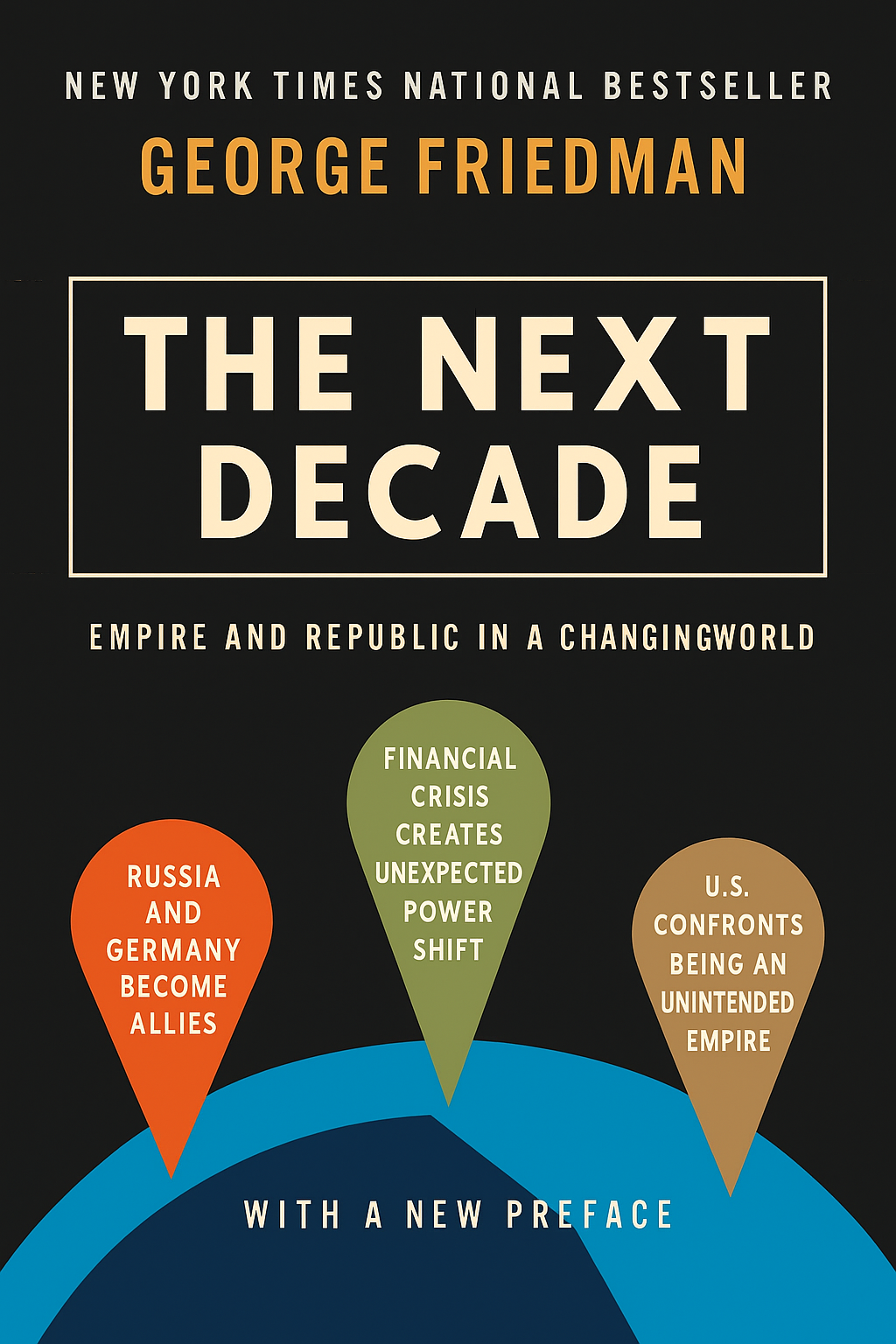
By George Friedman
