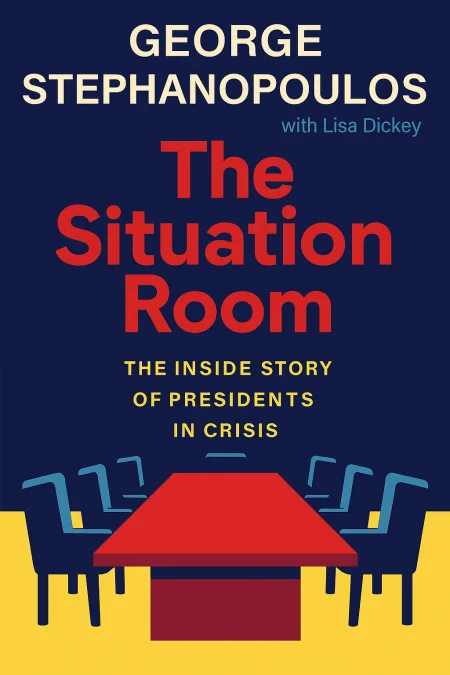
The Situation Room
The Inside Story of Presidents in Crisis
byGeorge Stephanopoulos, Lisa Dickey
Book Edition Details
Summary
In a shadowy chamber where America's most pivotal decisions unfold, "The Situation Room" offers an unprecedented glimpse behind the locked doors of the White House's nerve center. George Stephanopoulos, an eyewitness to history, unravels the clandestine tales of power and peril that have defined a nation. From crises that nearly spiraled into catastrophe to the narrow escapes that rewrote destiny, this gripping narrative unveils the raw tension of twelve presidencies. Each page pulses with the urgency of split-second choices, revealing the unsung heroes and titans of statecraft who have shaped global events. Here, the pulse of American influence beats strongest—where history isn’t just observed, but made.
Introduction
Picture this: It's 3:47 AM on May 2, 2011, and in a cramped basement room beneath the White House, the most powerful people in America sit transfixed by grainy video footage streaming live from half a world away. President Obama leans forward in his chair, Secretary of State Hillary Clinton covers her mouth in tension, and CIA Director Leon Panetta coordinates the most daring military operation in decades. They're watching Navy SEALs storm a compound in Pakistan where Osama bin Laden, the world's most wanted terrorist, has been hiding for years. This is the Situation Room at its most dramatic, the nerve center where history unfolds in real time. For over six decades, this unremarkable basement complex has been the hidden stage for America's most consequential decisions. From the Cuban Missile Crisis that brought the world to the brink of nuclear war to the chaotic final days of Vietnam, from the fall of the Berlin Wall to the response to 9/11, the defining moments of the modern presidency have played out within these secure walls. Yet the real story of what happens there has remained largely classified, known only to those with the highest security clearances. This hidden history reveals not just the mechanics of presidential power, but the human drama behind it. We see presidents at their best and worst, advisers who rose to greatness and others who failed catastrophically, and the dedicated professionals who kept America running even when their leaders stumbled. For anyone fascinated by American history, presidential leadership, or how the world's most powerful nation actually makes its most critical decisions, this story illuminates the intersection of technology, personality, and power that shapes our world. It's essential reading for understanding how democracy works under pressure and what happens when the stakes couldn't be higher.
Origins of Crisis Management: From Bay of Pigs to Cold War Command (1961-1974)
The Situation Room was born from catastrophic failure. When President Kennedy's Bay of Pigs invasion collapsed in April 1961, the young president was furious not just at the outcome, but at the chaotic process that led to it. Critical intelligence never reached him, communications broke down at crucial moments, and decisions affecting ships and planes were being relayed over unsecured phone lines. Within weeks, Kennedy ordered the creation of something no previous president had possessed: a centralized command center with secure communications, staffed around the clock, where he could receive unfiltered information and coordinate responses to global crises. Built in a converted White House bowling alley, the original Situation Room was remarkably modest. Kennedy himself called it cramped and poorly ventilated, but what it lacked in comfort, it made up for in function. The room's true test came during the Cuban Missile Crisis in October 1962, when Soviet nuclear weapons in Cuba brought the world closer to nuclear war than ever before or since. While Kennedy held his crucial meetings upstairs, the Situation Room proved its worth by monitoring Soviet communications and rushing critical intelligence to decision-makers. When Nikita Khrushchev announced his decision to remove the missiles on Radio Moscow, it was Situation Room staff who caught the broadcast and delivered the breakthrough news that helped end the crisis. Under Lyndon Johnson, the room evolved from an information center into something approaching a command post. LBJ practically lived there during the Vietnam War, obsessing over casualty reports and bombing assessments, calling duty officers at all hours to demand updates. He even installed a detailed terrain model of the Khe Sanh battlefield, earning criticism for micromanaging the war from his "sandbox." Johnson's immersion in the room reflected both his desperate desire to control events and his growing anguish over a conflict that would ultimately destroy his presidency. The technology that promised to give presidents better control over distant events also trapped them in the minutiae of tactical decisions. The Nixon years brought a paradox: a president who almost never entered the room that bore his administration's most dramatic moments. Nixon believed Johnson had suffered from "Situation Room syndrome," becoming so mesmerized by real-time information that he lost sight of strategy. This avoidance proved nearly catastrophic during the October 1973 Yom Kippur War, when Nixon's Watergate troubles left him incapacitated at the moment of maximum danger. As Soviet submarines moved closer to American shores, Secretary of State Henry Kissinger found himself managing a nuclear crisis with a president too drunk to take calls from foreign leaders. In an unprecedented move, Kissinger and other advisers raised America's military alert to DEFCON 3 without Nixon's knowledge, a gambit that worked but exposed the terrifying vulnerability of a system dependent on presidential leadership.
Institutional Evolution: Presidential Struggles and Technological Revolution (1975-1989)
Gerald Ford inherited a presidency weakened by Watergate and a Situation Room that had become the de facto command center for American foreign policy. Ford's brief tenure was marked by the chaotic final collapse of South Vietnam and the Mayaguez incident, where the room coordinated a rescue mission that succeeded tactically but raised troubling questions about proportional response. The incident highlighted a new dilemma created by modern communications: when an Air Force pilot could radio Washington for instructions about whether to sink a Cambodian boat, presidents found themselves micromanaging tactical decisions from thousands of miles away. Jimmy Carter brought an engineer's precision to the Situation Room, demanding comprehensive briefings and immersing himself in operational details. His presidency culminated in the Iran hostage crisis, which consumed his final year in office and transformed the room into a 444-day vigil. Carter often slept in the Oval Office, monitoring developments through the night, while Situation Room staff coordinated with diplomats, intelligence agencies, and military planners searching for ways to free the American captives. The failed Desert One rescue mission in April 1980 became a defining moment, showing how even perfect intelligence and meticulous planning could be undone by mechanical failures and the unpredictable friction of war. The Reagan era brought Hollywood glamour to the presidency but also dangerous confusion to crisis management. The March 1981 assassination attempt revealed shocking gaps in the system, with Secretary of State Alexander Haig's infamous declaration that he was "in control" stemming from genuine uncertainty about who was actually running the country while Reagan underwent surgery. Audio recordings from that day capture the chaos as officials struggled to maintain command authority during the ultimate test of constitutional continuity. Reagan's hands-off management style created space for the Iran-Contra scandal, where National Security Council staff used the Situation Room complex to run unauthorized operations. Oliver North and his colleagues essentially created a shadow foreign policy apparatus, selling weapons to Iran and funneling profits to Nicaraguan rebels in direct violation of congressional prohibitions. The scandal revealed how the room's capabilities could be corrupted when proper oversight broke down, leading to significant reforms in how the space was managed and monitored. Meanwhile, the technological revolution of the 1980s brought computers, email, and video conferencing to the room, transforming how America processed information and communicated with allies, setting the stage for the post-Cold War era.
Post-Cold War Adaptation: New Threats and Global Leadership (1989-2016)
George H.W. Bush inherited a world in revolutionary flux, and the Situation Room became the nerve center for managing the peaceful end of the Cold War. As the Berlin Wall fell and Soviet satellite states threw off Communist rule, Bush's team worked with remarkable discipline and restraint. The president's decision to practice what he called "the art of doing nothing" during these dramatic events reflected both wisdom and strategic patience, allowing history to unfold without American interference that might have provoked a violent Soviet backlash. The room's new video conferencing capabilities proved crucial during the Gulf War, allowing key officials to participate in meetings from their own command centers rather than rushing to the White House. The Clinton years brought the Situation Room into the information age, though technological upgrades often lagged behind the broader digital revolution. The Bosnia crisis tested the room's ability to manage complex humanitarian interventions, with Secretary of State Madeleine Albright using the space to advocate for military action against Serbian forces. Her famous confrontation with General Colin Powell, demanding to know what good America's superb military was if it couldn't be used, exemplified the robust debates that made the room most effective. The eventual intervention, triggered by the Srebrenica massacre, demonstrated how personal tragedy could galvanize political will and overcome institutional inertia. September 11, 2001, transformed the Situation Room from a crisis management center into a wartime command post. As hijacked planes struck the World Trade Center and Pentagon, duty officers refused evacuation orders, understanding that their communications capabilities were essential for coordinating the government's response. Their courage under fire, literally signing what they called a "dead list" of who would be found in the rubble if the White House was destroyed, embodied the dedication of career professionals who serve the institution regardless of personal risk. The Bush 43 administration used the post-9/11 crisis to completely renovate the Situation Room, creating the high-tech facility that more closely resembled its Hollywood portrayals. The Obama administration's most dramatic moment came with the raid that killed Osama bin Laden, captured in the famous photograph of the president and his team watching the operation unfold in real-time. The image became iconic of twenty-first-century leadership, though it also raised questions about the appropriate level of presidential involvement in tactical operations. The successful mission demonstrated both the room's evolution into a true global command center and the enduring importance of human judgment in an age of technological sophistication.
Modern Challenges: Democracy Under Stress and Institutional Resilience (2017-Present)
The Trump administration brought unprecedented chaos to the Situation Room, testing the resilience of institutions and processes that had evolved over six decades. Trump's disdain for traditional intelligence briefings, his preference for information from television over professional analysts, and his habit of making policy announcements via Twitter fundamentally disrupted the room's traditional role. Career staff found themselves producing books of television screenshots rather than strategic analysis, while senior officials struggled to maintain coherent policy processes in an environment where presidential tweets could instantly reverse months of careful diplomacy. The COVID-19 pandemic created new challenges as the Coronavirus Task Force met daily in the room, often without masks despite obvious health risks. The disconnect between public health guidance and White House practice illustrated the broader dysfunction of this period, when political considerations routinely overrode expert advice. The January 6, 2021 insurrection represented the nadir, with Situation Room staff watching in horror as the democratic process they served came under direct attack from the president himself. The peaceful transfer of power that followed demonstrated the resilience of American institutions, but also revealed how quickly democratic norms could erode when leaders abandoned established processes. The Biden administration has worked to restore traditional processes and respect for expertise, drawing on decades of institutional memory to manage crises from the chaotic Afghanistan withdrawal to the Russian invasion of Ukraine. The creation of specialized planning teams represents an evolution of the room's capabilities, using lessons learned from past failures to improve crisis preparation. The ability to coordinate instantly with allies through secure video links has proven crucial in maintaining Western unity against Russian aggression, while the room's staff has adapted to new challenges including cyber warfare, climate change, and the ongoing struggle to maintain democratic governance in an increasingly polarized nation. Throughout these modern trials, the Situation Room has demonstrated remarkable institutional resilience. Career professionals have maintained their commitment to serving the presidency regardless of who occupies the Oval Office, while the physical space continues to evolve with new technologies and changing security requirements. Recent renovations have created a more flexible, technologically advanced facility that can adapt to future challenges while maintaining the human connections that remain essential to effective decision-making. The room's survival through the Trump years and its continued effectiveness under Biden suggest that American democratic institutions, while fragile, possess an underlying strength that can withstand even severe stress.
Summary
The hidden history of the Situation Room reveals a fundamental tension at the heart of American democracy: the need for centralized, efficient decision-making in crisis versus the deliberation and checks that characterize democratic governance. Over six decades, this modest basement room has evolved from a hastily constructed communications center into the nerve center of global American power, adapting to technological revolutions while maintaining its core mission of supporting presidential decision-making under the most extreme pressure. The room's story teaches us that effective crisis management requires three essential elements: accurate information, clear processes, and trusted relationships between leaders and advisers. When these elements align, as during the Cuban Missile Crisis or the bin Laden raid, the system works brilliantly, enabling decisive action that protects American interests and values. When they break down, as during Iran-Contra or the Trump years, the consequences can be severe, threatening both effective governance and democratic accountability. The career professionals who staff the room represent the institutional memory and expertise that provide continuity across administrations, serving as both enablers of presidential power and crucial checks on its abuse. For citizens seeking to understand how their government really works, the Situation Room offers both reassurance and warning. It demonstrates the dedication and competence of the professionals who serve regardless of political winds, but also reveals how quickly established norms can erode when leaders abandon proven processes. The room's future effectiveness will depend on maintaining the delicate balance between technological capability and human judgment, between centralized authority and democratic accountability, that has made it both powerful and ultimately answerable to the American people. As new challenges emerge, from cyber warfare to climate change to threats to democracy itself, the lessons learned in this basement room over six decades remain more relevant than ever.
Related Books
Download PDF & EPUB
To save this Black List summary for later, download the free PDF and EPUB. You can print it out, or read offline at your convenience.
By George Stephanopoulos
