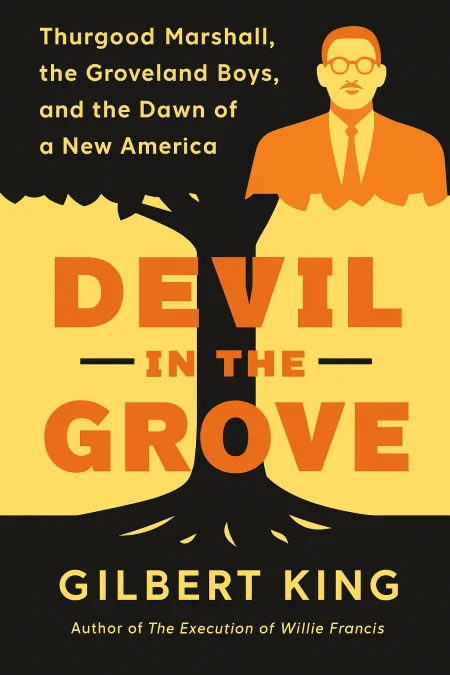
Devil in the Grove
Thurgood Marshall, the Groveland Boys, and the Dawn of a New America
Book Edition Details
Summary
In the crucible of 1949 Florida, where the scent of oranges mingles with the stench of injustice, Thurgood Marshall finds himself ensnared in a perilous battle for truth. "Devil in the Grove" chronicles the harrowing tale of the Groveland Boys, four Black men caught in the deadly gears of a racially charged false accusation. As violence and vitriol erupt in a town gripped by fear, Marshall, the indefatigable champion of civil rights, steps into the fire, risking everything to dismantle the sinister machinations of a deeply flawed justice system. With an unyielding spirit and an unwavering moral compass, Marshall confronts not only the wrath of a corrupt sheriff and a raging Klan but also the very soul of America. This Pulitzer Prize-winning narrative is a searing portrait of courage in the face of chaos, a testament to one man's relentless pursuit of justice against the odds.
Introduction
In the sweltering heat of a Florida courtroom in 1949, a tall, dignified lawyer in a crisp suit stood before an all-white jury, defending three young black men accused of rape. The odds were stacked impossibly against him—hostile judges, coerced confessions, and the ever-present threat of violence from the Ku Klux Klan. Yet Thurgood Marshall never wavered, driven by an unwavering belief that the Constitution belonged to all Americans, regardless of color. This was the man who would become known as "Mr. Civil Rights," transforming the American legal landscape one case at a time. Marshall's journey from the segregated streets of Baltimore to the marble halls of the Supreme Court represents one of the most remarkable legal careers in American history. Through his strategic brilliance and moral courage, he dismantled the legal foundations of Jim Crow, paving the way for the civil rights movement that would follow. His story reveals the power of legal advocacy to create social change, the importance of strategic thinking in the face of overwhelming opposition, and the profound impact one person can have on the course of justice. From his early battles in hostile Southern courtrooms to his historic victory in Brown v. Board of Education, Marshall's life offers timeless lessons about perseverance, principle, and the relentless pursuit of equality under law.
From Baltimore to Harlem: Forging a Legal Mind
Thurgood Marshall's transformation from a mischievous Baltimore schoolboy to America's foremost civil rights attorney began with a punishment that would shape his destiny. As a student at Colored High School, young Thurgood was frequently sent to the basement to memorize passages from the Constitution as discipline for his disruptive behavior. Little did his teachers know they were creating a legal mind that would one day use that very document to revolutionize American society. Born in 1908 to William Marshall, a railroad porter, and Norma Williams Marshall, a teacher, Thurgood grew up in a household that valued education and debate. His father, Willie, would take him to the local courthouse to watch trials, instilling in the boy a fascination with the law and the art of argument. These early experiences planted the seeds of Marshall's future career, though his path to legal greatness was far from predetermined. After graduating from Lincoln University, Marshall set his sights on law school, but financial constraints forced him to attend Howard University rather than his preferred University of Maryland, which didn't admit black students. This apparent setback proved fortuitous, as Howard was home to Charles Hamilton Houston, the brilliant legal scholar who would become Marshall's mentor and shape his understanding of law as a tool for social change. Under Houston's guidance, Marshall learned that "a lawyer's either a social engineer or he's a parasite on society." The young lawyer's early career was marked by financial struggle and professional challenges. Opening his own practice in Depression-era Baltimore, Marshall often worked for little or no pay, representing clients who couldn't afford legal fees. Yet these lean years taught him invaluable lessons about the real-world impact of legal discrimination and the urgent need for systematic change. When Houston invited him to join the NAACP's legal team in New York, Marshall was ready to take his fight for justice to the national stage.
Confronting Jim Crow: The Groveland Case and Southern Justice
The summer of 1949 brought Marshall face-to-face with one of the most dangerous and challenging cases of his career when four young black men in Groveland, Florida, were accused of raping a white woman. The case had all the hallmarks of a legal lynching: flimsy evidence, coerced confessions extracted through torture, and a community seething with racial hatred. When Marshall arrived in Lake County, he found a situation that seemed hopeless—three of the defendants had been brutally beaten in custody, and one had been shot dead while allegedly "resisting arrest." Sheriff Willis McCall ruled Lake County like a feudal lord, his authority backed by the Ku Klux Klan and sustained by a culture of terror that kept the black population in line. The investigation bore no resemblance to actual police work; instead, it was a carefully orchestrated performance designed to produce the predetermined outcome of black guilt and white vindication. The defendants were subjected to beatings so severe that blood was still matted in their hair weeks later, their confessions extracted through medieval torture methods. Despite the overwhelming odds and constant death threats, Marshall assembled a defense team and fought the case with characteristic determination. The trial itself was a study in Southern "justice," with an all-white jury, a hostile judge, and a courtroom packed with armed segregationists. Marshall's strategy was both brilliant and dangerous—knowing that the local jury would never acquit his clients, he focused on creating a record that would support an appeal to higher courts where constitutional principles might prevail over racial prejudice. The Groveland case nearly cost Marshall his life. After the trial, Klansmen attempted to ambush his car, and only the quick thinking of his local co-counsel saved him from what would likely have been a lynching. Yet Marshall's courage in taking on such dangerous cases sent a powerful message throughout the South: black Americans finally had a champion who would risk everything to defend their rights. When the Supreme Court eventually overturned the convictions, it vindicated Marshall's strategy and proved that the Constitution's protections could be enforced even in the heart of Jim Crow territory.
Supreme Court Victories: Dismantling Segregation Through Law
Marshall's approach to civil rights litigation was revolutionary in its methodical precision. Rather than simply fighting individual cases of injustice, he developed a comprehensive legal strategy aimed at undermining the entire edifice of segregation. His plan was to chip away at the "separate but equal" doctrine by proving that separate was inherently unequal, building precedent case by case until the Supreme Court would have no choice but to overturn Plessy v. Ferguson. The breakthrough came in higher education cases like Sweatt v. Painter and McLaurin v. Oklahoma State Regents, where Marshall successfully demonstrated that separate facilities could never be truly equal. In the Sweatt case, he showed that the hastily created black law school in Texas could never match the resources, prestige, and networking opportunities available at the University of Texas Law School. These victories established crucial precedents and gave Marshall the confidence to take on the ultimate prize: public school segregation. The culmination of Marshall's legal career came with Brown v. Board of Education, the landmark 1954 case that declared segregated schools unconstitutional. Marshall had spent years preparing for this moment, assembling a team of brilliant lawyers and social scientists who could demonstrate the psychological and educational harm caused by segregation. His argument before the Supreme Court was both legally sophisticated and morally compelling, combining constitutional analysis with social science research to show that separate could never be equal. When Chief Justice Earl Warren announced the Court's unanimous decision, Marshall had achieved what many thought impossible: the legal dismantling of Jim Crow segregation. The victory was more than legal; it was a moral revolution that transformed American society. Marshall had successfully argued that segregation inflicted psychological harm on black children and violated the fundamental principle of equal protection under law. The decision sparked massive resistance in the South but also energized the civil rights movement, providing the legal foundation for the protests and activism that would follow.
Legacy of Constitutional Revolution: Transforming American Justice
Marshall's appointment to the Supreme Court in 1967 marked the pinnacle of his career and a historic moment for American justice. As the first black Supreme Court justice, he brought a unique perspective to the nation's highest court, one shaped by decades of fighting for the rights of the powerless and marginalized. His judicial philosophy was grounded in the belief that the Constitution was a living document that must evolve to protect the rights of all Americans. Throughout his twenty-four years on the Court, Marshall remained the conscience of American jurisprudence, consistently advocating for the underdog and challenging his colleagues to live up to the Constitution's highest ideals. He understood that law was not merely an intellectual exercise but a tool for social transformation, and he never forgot the lessons learned in those dangerous Southern courtrooms where he had risked his life for justice. Marshall's influence extended far beyond his judicial opinions. Through his work with the NAACP Legal Defense Fund, he had trained a generation of civil rights lawyers who carried on his mission long after he left the bench. His strategic approach to litigation—building precedent case by case, using the media to educate the public, and combining legal arguments with moral appeals—became a model for social reform movements around the world. The personal costs of Marshall's crusade were enormous. He faced constant death threats, endured the humiliations of Jim Crow travel, and watched as some of his clients were murdered before justice could be served. Yet he never wavered in his commitment to justice, understanding that his individual sacrifices were small compared to the suffering of millions of Americans denied their basic rights. His legacy created the legal framework that made the modern civil rights movement possible and established precedents that continue to protect minority rights today.
Summary
Thurgood Marshall's life stands as a testament to the transformative power of law when wielded by someone with both brilliant legal mind and unshakeable moral courage. His greatest achievement was not merely winning cases, but fundamentally altering America's understanding of justice and equality under law. Through decades of patient legal strategy, he dismantled the legal foundations of segregation and created the constitutional framework that made the modern civil rights movement possible. Marshall proved that one person, armed with courage, intelligence, and an unwavering commitment to principle, could indeed change the world. His approach offers timeless lessons for anyone seeking to create meaningful change: that progress requires strategic thinking combined with moral conviction, that systematic injustice demands systematic resistance, and that lasting transformation comes not from dramatic gestures but from the persistent, often unglamorous work of challenging unjust systems through their own mechanisms. For anyone interested in law, civil rights, or the mechanics of social change, Marshall's story provides both inspiration and a practical roadmap for turning ideals into reality.
Related Books
Download PDF & EPUB
To save this Black List summary for later, download the free PDF and EPUB. You can print it out, or read offline at your convenience.
By Gilbert King
