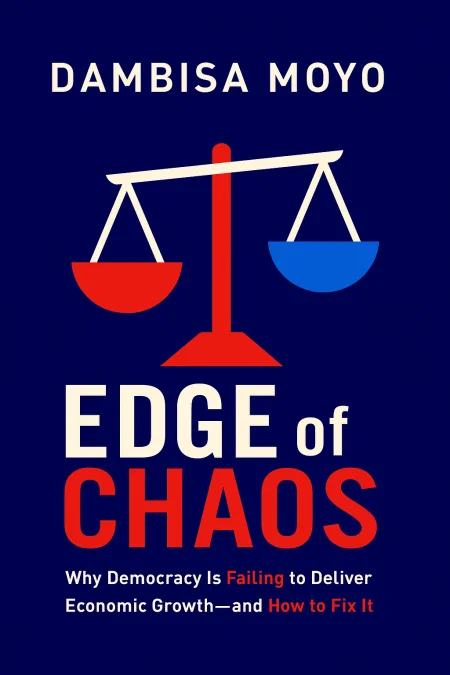
Edge of Chaos
Why Democracy is Failing to Deliver Economic Growth – and How to Fix It
Book Edition Details
Summary
As the pulse of global prosperity falters, Dambisa Moyo’s "Edge of Chaos" ignites a bold conversation about the future of liberal democracy. Moyo, a visionary economist, confronts the unsettling truth: our beloved democracies, once thriving growth engines, are now sputtering under the weight of short-sighted policies and rising inequalities. With societies teetering on the brink of nationalism and protectionism, she argues for a profound transformation—a daring reimagining of democratic governance that prioritizes long-term economic vigor. This book is not just a critique; it is a clarion call to action, challenging readers to envision a reinvigorated democratic landscape that secures prosperity and stability for the next century.
Introduction
The world stands at a precipice. Despite decades of apparent prosperity and democratic expansion, economic stagnation now grips both developed and developing nations. Growth rates that once lifted millions from poverty have slowed to a crawl, while political systems designed for simpler times struggle to address complex, interconnected challenges. The very foundations of liberal democracy and market capitalism - long considered the pinnacle of human political and economic evolution - face unprecedented skepticism from their own citizens. This crisis runs deeper than cyclical economic downturns or temporary political upheavals. The fundamental structures of democratic governance, with their emphasis on short electoral cycles and immediate voter gratification, have become systematically misaligned with the long-term thinking required to address today's economic headwinds. While politicians focus on the next election, critical issues like infrastructure decay, educational decline, demographic shifts, and technological disruption compound into existential threats to prosperity itself. The analysis that follows employs a rigorous examination of both democratic political processes and economic performance across nations, revealing how the very mechanisms intended to ensure accountability and representation have instead created perverse incentives for short-term thinking. Through careful study of successful and failed states, historical precedents, and contemporary challenges, a clear pattern emerges: the countries that thrive economically are those whose political systems can maintain long-term focus, while those trapped in cycles of democratic myopia find themselves increasingly unable to compete or provide for their citizens' fundamental needs.
The Growth Imperative and Democratic Failures
Economic growth represents far more than abstract statistical measures or theoretical economic models. It constitutes the fundamental prerequisite for human progress, social stability, and political legitimacy. When economies expand, societies can address their most pressing challenges - poverty, inequality, infrastructure needs, and social mobility - through the creation of new wealth rather than zero-sum redistribution. Growth provides governments with the resources necessary to invest in education, healthcare, and public goods while maintaining social cohesion and democratic stability. The absence of growth, conversely, creates a cascade of social and political problems that democratic systems struggle to address effectively. Stagnant wages, declining social mobility, and mounting public debts force painful trade-offs that pit different constituencies against one another. Democratic politicians, facing regular electoral accountability, find themselves trapped between the immediate demands of voters and the long-term investments required for sustained prosperity. This dynamic creates a vicious cycle where short-term political pressures prevent the very policies needed to restore growth, further eroding confidence in democratic governance. Contemporary examples illustrate this pattern with stark clarity. Countries experiencing prolonged economic stagnation - from Greece's devastating austerity to Japan's decades-long malaise - witness rising political instability, social unrest, and declining faith in democratic institutions. Citizens facing economic hardship become increasingly receptive to populist promises and authoritarian alternatives that claim to offer immediate solutions to complex structural problems. The correlation between economic performance and democratic stability suggests that sustainable growth represents not merely an economic imperative but an existential requirement for liberal democracy itself. The measurement of economic success, while imperfect, provides crucial insights into societal wellbeing and progress. Gross Domestic Product, despite its limitations in capturing income distribution or environmental costs, remains the most reliable indicator of a nation's capacity to provide for its citizens' material needs. Alternative metrics like happiness indices or social progress measures consistently demonstrate strong correlations with economic performance, confirming that material prosperity, while not sufficient for human flourishing, remains necessary for it.
Hurricane Headwinds: Structural Challenges to Growth
The global economy faces unprecedented structural challenges that traditional policy responses cannot adequately address. These headwinds operate across the three fundamental drivers of economic growth - capital, labor, and productivity - creating compound effects that threaten sustained prosperity worldwide. Unlike cyclical recessions that respond to monetary and fiscal interventions, these challenges require long-term structural reforms that democratic systems find politically difficult to implement. Capital formation faces severe constraints from multiple directions simultaneously. Global debt levels have reached unsustainable proportions, with public and private obligations creating drag effects on future growth through increased servicing costs and reduced fiscal flexibility. Natural resource scarcity compounds these pressures as growing populations compete for finite supplies of arable land, fresh water, and energy resources. Climate change further amplifies resource constraints while requiring massive infrastructure investments that strain already overburdened public finances. Labor markets confront equally daunting demographic shifts that fundamentally alter the economics of social welfare systems. Aging populations in developed countries create unsustainable dependency ratios, with fewer active workers supporting growing numbers of retirees requiring healthcare and pensions. Simultaneously, educational systems fail to prepare younger workers for an economy increasingly dominated by technology and automation. The result is a labor force characterized by skills mismatches, technological displacement, and declining productivity relative to historical norms. Technological advancement, traditionally a source of productivity growth, now presents paradoxical effects that democratic systems struggle to manage. While innovation continues to improve efficiency and create new possibilities, the pace of technological change increasingly destroys jobs faster than it creates them. Automation threatens entire categories of employment, from manufacturing to professional services, potentially creating permanent unemployment for large segments of the population. Income inequality widens as the benefits of technological progress accrue primarily to capital owners while workers face stagnant wages and job insecurity. These structural challenges interact synergistically, creating feedback loops that compound their individual effects. Technological unemployment reduces consumer demand, which depresses business investment and further limits job creation. Aging populations require increased public spending precisely when shrinking workforces reduce tax revenues. Resource scarcity drives up costs and reduces competitiveness just as demographic pressures limit fiscal capacity for necessary infrastructure investments. Democratic political systems, designed for shorter time horizons and immediate responsiveness to voter concerns, prove systematically incapable of addressing challenges that require sustained commitment across multiple electoral cycles.
The False Promise of Protectionist Solutions
Facing economic stagnation and popular discontent, democratic leaders increasingly embrace protectionist policies that promise immediate relief but ultimately exacerbate underlying problems. Trade restrictions, capital controls, and immigration limitations appeal to voters seeking scapegoats for their economic difficulties, yet historical evidence demonstrates that such measures consistently reduce overall prosperity while failing to address root causes of economic decline. The retreat from globalization represents a fundamental misdiagnosis of contemporary economic challenges. While international integration has indeed created winners and losers within national economies, the solution lies not in reversing globalization but in managing its effects more effectively through domestic policy reforms. Protectionist measures artificially increase prices for consumers, reduce competitive pressures that drive innovation, and limit access to international markets and capital flows that enable growth. Countries that embrace isolation find themselves falling further behind more open economies that benefit from specialization and comparative advantage. Trade wars and currency manipulations create beggar-thy-neighbor dynamics that reduce global prosperity without providing sustainable advantages to any participant. When multiple countries simultaneously pursue protectionist policies, the result is a downward spiral of retaliation and economic fragmentation that reduces efficiency and increases costs for everyone. Historical precedents, from the Smoot-Hawley Tariff to various regional trade conflicts, demonstrate that protectionism deepens recessions rather than providing escape routes from them. Immigration restrictions similarly reflect political opportunism rather than economic logic. Demographic pressures in developed countries create labor shortages that immigration could help address, while restrictions prevent optimal allocation of human resources across national boundaries. Countries that maintain relatively open immigration policies benefit from expanded labor forces, entrepreneurial energy, and cultural diversity that enhances innovation and economic dynamism. Conversely, nations that restrict immigration face accelerating demographic decline and reduced economic competitiveness. The appeal of protectionist policies reflects deeper failures of democratic political systems to educate citizens about complex economic relationships and trade-offs. Short electoral cycles encourage politicians to promise simple solutions to complex problems, while voters facing immediate economic pressures find it difficult to appreciate abstract arguments about long-term benefits from international integration. This creates a systematic bias toward policies that provide short-term political benefits while imposing long-term economic costs that become apparent only after electoral accountability has passed to successors.
Blueprint for Democratic Reform and Growth Revival
Addressing contemporary economic challenges requires fundamental reforms to democratic political systems that align electoral incentives with long-term economic necessities. These reforms must target both the institutional structures that govern political decision-making and the processes through which citizens participate in democratic governance. The goal is creating political systems capable of sustained focus on growth-enhancing policies while maintaining democratic accountability and legitimacy. Electoral reforms should extend political terms to better match the time horizons required for effective economic policy implementation. Longer terms reduce the frequency of electoral pressures that distract politicians from long-term planning while providing sufficient time for complex policies to demonstrate results. Term limits prevent the complacency and special interest capture that characterize career politicians while ensuring regular infusion of new perspectives and energy into political systems. Voter education and participation reforms can enhance the quality of democratic decision-making by ensuring that electoral choices reflect informed understanding of policy trade-offs rather than immediate emotional reactions. Mandatory voting increases participation and reduces the influence of narrow interest groups, while basic competency requirements for voting ensure that citizens possess sufficient knowledge to make informed choices about complex policy alternatives. Campaign finance restrictions limit the distorting effects of concentrated wealth on political processes while creating more level playing fields for candidates with diverse backgrounds and perspectives. Public financing of campaigns can reduce the time politicians spend fundraising and increase their focus on governance, while restrictions on private contributions reduce the influence of special interests that often oppose long-term structural reforms. Professional qualifications for political office can improve the quality of policy-making by ensuring that elected officials possess relevant experience and competencies for addressing complex economic challenges. Requirements for non-political work experience prevent the emergence of insular political classes that lack understanding of private sector dynamics, while educational or professional standards ensure basic competency in areas relevant to governance. These reforms work synergistically to create political systems better equipped to address long-term economic challenges while maintaining democratic legitimacy and accountability. By extending time horizons, improving voter quality, and enhancing politician competency, reformed democratic systems can pursue the sustained, coherent policies necessary for restoring economic growth and social progress.
Summary
The fundamental challenge facing contemporary societies is the misalignment between democratic political systems designed for simpler times and the complex, long-term economic challenges of the modern world. Democratic myopia - the systematic tendency toward short-term thinking imposed by electoral cycles and immediate voter pressures - prevents the sustained policy focus necessary for addressing structural economic problems and restoring growth. Reform of democratic institutions represents not an attack on democratic values but their essential preservation through adaptation to contemporary realities. Only by creating political systems capable of long-term thinking while maintaining popular accountability can societies hope to address the economic stagnation that threatens both prosperity and democratic legitimacy itself.
Related Books
Download PDF & EPUB
To save this Black List summary for later, download the free PDF and EPUB. You can print it out, or read offline at your convenience.
By Dambisa Moyo
