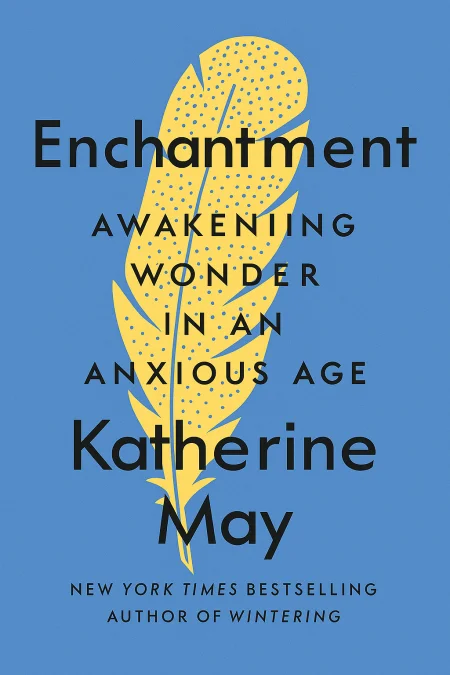
Enchantment
Re-awakening Wonder in an Anxious Age
Book Edition Details
Summary
In a world that never seems to pause, Katherine May invites us to linger in the quiet corners of existence with "Enchantment." As life spins in a dizzying dance of constant updates and endless noise, May finds herself yearning for something more—a return to the soft whispers of wonder that often go unheard. Through her personal tales of navigating family dynamics, professional pressures, and the disorienting aftermath of a pandemic, she discovers solace in nature's embrace. May's narrative, woven with sincerity and humor, beckons readers to peel back the layers of the everyday and uncover the extraordinary hidden within the ordinary. With each page, she gently guides us to embrace the earth's elements—earth, water, fire, and air—and to savor the simple rituals that restore our spirits. "Enchantment" is a lyrical call to rediscover the magic that lies just beyond the surface, urging us to reconnect with both the world and ourselves in profoundly nourishing ways.
Introduction
On a quiet evening, a woman steps outside her home and notices something extraordinary: her own shadow cast by moonlight, stretching across the ground with startling clarity. For months, she had been unable to read, unable to concentrate, feeling disconnected from the world around her. The pandemic had left her feeling empty, discombobulated, running on fumes. Yet here, under the brilliant moon, she rediscovers a sense of wonder she thought she had lost forever. This moment captures the heart of our modern predicament. We live in an age of constant anxiety, our attention scattered across endless screens, our spirits dulled by the relentless pace of contemporary life. Many of us feel like we're sleepwalking through our days, cut off from the natural rhythms and simple pleasures that once nourished human souls. We sense something fundamental is missing, but we can't quite name what it is. The answer lies not in grand gestures or dramatic life changes, but in rekindling our capacity for enchantment. Through intimate stories of seeking magic in everyday moments, we can learn to soften our analytical minds and open ourselves to wonder. This journey teaches us that the sacred isn't found in distant places or ancient traditions, but in our willingness to pay attention to the world that surrounds us every day. When we learn to see with fresh eyes, we discover that enchantment has been waiting for us all along.
Earth and Stone: Finding Sacred Ground
Standing barefoot on newly erected stones, a woman searches for meaning in a modern stone circle built on a hilltop overlooking her seaside town. These aren't ancient megaliths steeped in millennia of ritual, but contemporary boulders placed just months ago, still rough from the quarry. She approaches skeptically, expecting nothing from these artificial monuments. Yet as she sits among them, removing her shoes to feel grass between her toes, something shifts. The stones seem to listen, patient and attentive, offering not answers but presence. The hesitation she feels mirrors our collective loss of connection to sacred spaces. We've inherited a world where meaning feels manufactured rather than discovered, where the old certainties have crumbled but new ones haven't yet taken root. In our disenchanted age, we must learn to create our own hierophanies, transforming ordinary places into vessels for the sacred through our deliberate attention and care. Later, she visits the Black Prince Well, a medieval healing spring hidden behind a thorny rose. Stepping down into the stone-lined pool, she tastes the mineral water and presses it to her forehead, unsure what ritual she's performing but compelled to try. Other pilgrims have been there recently, leaving shells and glass gems as offerings. The well holds centuries of human longing, and her tentative gestures become part of an unbroken chain of seeking. These experiences reveal that sacred ground isn't something we inherit but something we create through reverence and attention. Whether ancient or modern, stones and springs become meaningful when we approach them with openness, bringing our whole selves to the encounter rather than demanding they prove their worth to us.
Water and Fire: Embracing Life's Elements
A middle-aged woman returns to swimming lessons after decades away from formal instruction, her confidence shaken by recent struggles with vertigo and balance. In the chlorinated pool, she must unlearn everything she thought she knew about moving through water. Her instructor dismantles her stroke piece by piece, leaving her more confused than when she started. What had once felt natural now seems impossible. She can barely complete a length without gasping, her coordination completely scrambled. This humbling process of unlearning extends far beyond the swimming pool. The pandemic years stripped away so many of our assumed competencies, leaving us questioning abilities we'd taken for granted. Like the woman in the pool, we must sometimes allow ourselves to be broken down completely before we can be rebuilt. The ego that insists we already know enough becomes the greatest barrier to growth and renewal. Fire appears throughout these moments of transformation, sometimes as literal flames illuminating the night sky, sometimes as the burning away of old certainties. A house fire in the distance draws neighbors from their homes to witness destruction and community in equal measure. The author tends a fire bowl in her garden, feeding it bay leaves and watching the flames consume her offerings. Each fire reminds us that change is both creator and destroyer, demanding our respect and attention. Water and fire teach us about surrender and renewal. They show us that some transformations can't be rushed or controlled, only experienced. Whether we're learning to float or watching flames dance, we must sometimes release our grip on certainty and trust in forces larger than ourselves.
Air and Light: Discovering Magic in Movement
High on Yorkshire moors, two friends search for the perfect conditions to witness a Brocken Spectre, that rare phenomenon where one's shadow is cast giant-sized onto clouds, crowned with a rainbow halo. They climb through heather and mist, following ancient paths marked by centuries of seekers. Though they never see the ghostly apparition they came for, they discover something equally magical: the way landscape holds memory, the stories embedded in stone and stream. The search for wonder often leads us far from where we expected to find it. A woman travels hours to see meteors only to become enchanted by her own moon shadow. A quest for acoustic mirrors built to detect enemy aircraft becomes a meditation on invisible forces that surround us constantly. The air carries more than we imagine - sound waves, stories, the breath of previous generations who walked these same paths. These journeys into high places teach us about perspective and possibility. When we lift ourselves above the familiar terrain of daily life, we gain distance not just from our immediate concerns but from our limited ways of seeing. The effort required to reach these vantage points - the physical exertion, the planning, the willingness to be uncomfortable - becomes part of the reward. Air represents the element of connection and dispersal, carrying seeds to new soil and thoughts to new understanding. When we learn to read the invisible currents that move through our world, we discover that we're never as isolated as we imagine. Every breath links us to the vast circulation of life on this planet.
The Practice of Everyday Wonder
A woman learns beekeeping not for honey but for connection, donning the white suit that transforms her into an intermediary between human and insect worlds. Inside the hive, she discovers a different kind of intelligence - one based on collective wisdom, seasonal rhythms, and the ancient partnership between flowers and pollinators. The bees teach her to read their moods through sound and vibration, to move with deliberate calm, to respect the complexity of lives utterly different from her own. This apprenticeship reveals how enchantment often comes through our hands rather than our heads. Whether kneading bread for Lammas, tending a fire, or learning to hold a hive frame heavy with bees, we discover truths that can't be found in books. Our bodies know things our minds haven't yet learned, and sometimes we must trust that physical knowledge even when it contradicts our rational understanding. The woman plants wildflowers that may never bloom in her difficult garden, but she finds them thriving in an alley near her home, planted by some unknown neighbor. She learns that wonder, like seeds, travels in mysterious ways. What fails in one place may flourish in another. What we offer freely often returns transformed, scattered by winds we didn't know were blowing. The practice of everyday wonder requires both patience and faith. It asks us to tend things we may never fully understand, to offer care without guaranteed returns, to remain open to beauty even when the world seems determined to disappoint us. These small acts of attention and devotion gradually rebuild our capacity for awe.
Summary
Through intimate encounters with stone and stream, flame and bee, these stories reveal that enchantment isn't a luxury but a necessity for navigating our challenging times. When we feel overwhelmed by forces beyond our control, the practice of paying attention to what's immediately present offers both solace and strength. Wonder isn't something we've lost but something we must continually choose to cultivate, like tending a garden or keeping bees. The path back to enchantment begins with simple acts: removing our shoes to feel earth beneath our feet, looking up at stars we'd forgotten were there, listening to the stories held in familiar places. These practices don't require special knowledge or distant travel, only the willingness to approach our daily world with curiosity and care. When we learn to see the sacred in the ordinary, we discover that the magic we've been seeking has been surrounding us all along. The most profound lesson these stories teach is that we don't find enchantment by escaping our circumstances but by diving deeper into them. Wonder emerges not from perfection but from our willingness to remain present with whatever arises - the broken, the beautiful, the utterly mundane. In a world that profits from our distraction, choosing to pay attention becomes a radical act of reclamation and hope.
Related Books
Download PDF & EPUB
To save this Black List summary for later, download the free PDF and EPUB. You can print it out, or read offline at your convenience.
By Katherine May
