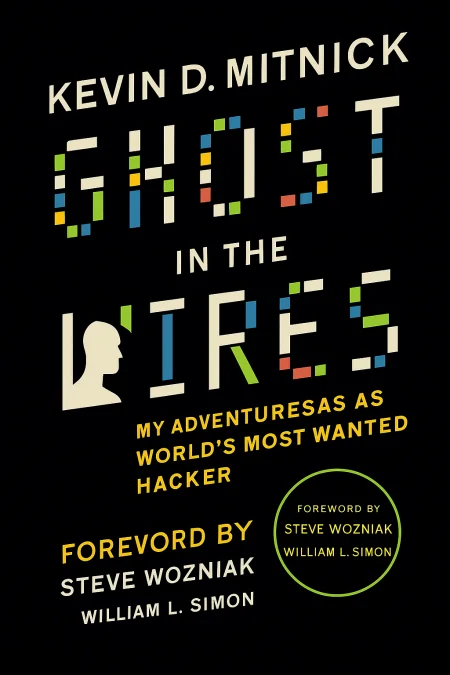
Ghost in the Wires
My Adventures as the World’s Most Wanted Hacker
byKevin D. Mitnick, Steve Wozniak, William L. Simon
Book Edition Details
Summary
Kevin Mitnick wasn't just a hacker; he was the digital Houdini of his time. "Ghost in the Wires" chronicles Mitnick's audacious escapades, revealing the mind of a man who danced through the firewalls of colossal corporations like Sun Microsystems and Motorola, driven by a love for the game, not greed. This isn’t just another cyber tale—it’s a firsthand dive into a world where one man’s curiosity outpaced the boundaries of technology and law. From his youthful pranks with phone systems to orchestrating some of the most jaw-dropping breaches in history, Mitnick’s story is a thrilling testament to human ingenuity and the timeless cat-and-mouse chase between a rogue genius and the authorities.
Introduction
In the early days of the digital revolution, when computer networks were still mysterious frontiers and cybersecurity was barely a concept, one man's extraordinary journey would define the very nature of hacking for generations to come. Kevin Mitnick emerged from the suburbs of Los Angeles as a curious teenager with an almost supernatural ability to penetrate the most secure computer systems in America, ultimately becoming the FBI's most wanted cybercriminal before transforming into one of the world's most respected security experts. Born into an era when personal computers were just beginning to reshape society, Mitnick possessed a rare combination of technical brilliance and psychological insight that made him a master of what would later be known as social engineering. His story unfolds against the backdrop of the 1980s and 1990s, when the boundaries between digital exploration and criminal activity were still being defined, and when a single individual with exceptional skills could penetrate corporate networks, government systems, and telecommunications infrastructure with nothing more than a phone and a computer. From Mitnick's remarkable life, readers will discover the evolution of cybersecurity from its chaotic early days to the sophisticated discipline it has become today. They will witness the psychological profile of someone whose insatiable curiosity and addiction to the intellectual challenge of hacking nearly destroyed his life, leading to years as a fugitive and eventual imprisonment. Most importantly, they will understand how exceptional talents, when properly channeled, can transform from destructive forces into powerful tools for protection and positive change, offering profound lessons about redemption, responsibility, and the ethical use of knowledge in our increasingly connected world.
The Making of a Digital Outlaw
Kevin Mitnick's path to becoming America's most notorious hacker began not with malicious intent, but with the innocent curiosity of a lonely teenager fascinated by magic tricks and the hidden workings of the world around him. Growing up in the San Fernando Valley during the 1970s, he discovered that the same principles that made magic compelling could be applied to the telephone system, which became his first playground for exploration and manipulation. His introduction to phone phreaking through a high school acquaintance opened his eyes to the vulnerabilities inherent in complex technical systems, particularly the human operators who could be convinced to reveal sensitive information through careful psychological manipulation. The transition from phone systems to computer networks was inevitable as personal computers became more prevalent in the early 1980s. Mitnick's approach was methodical and patient, often spending weeks studying target systems before attempting to gain access. His exceptional memory allowed him to retain vast amounts of technical information, while his natural talent for social engineering enabled him to extract passwords, procedures, and access codes from unsuspecting employees. Unlike many hackers who were motivated by financial gain or destructive impulses, Mitnick was driven purely by intellectual curiosity and the thrill of solving complex puzzles that others deemed impossible. His early exploits revealed a fundamental truth about computer security that remains relevant today: the weakest link in any system is often the human element. Mitnick developed an almost supernatural ability to assume false identities over the phone, convincing system administrators, help desk personnel, and corporate executives to provide him with the information he needed to penetrate their networks. This period established the pattern that would define his entire criminal career, as he accumulated source code, proprietary software, and sensitive information not for profit, but simply to prove that he could overcome any security measure placed in his path. The psychological profile that emerged during these formative years showed a brilliant mind struggling with the addictive nature of hacking. Mitnick himself would later describe his compulsion to hack as similar to a drug addiction, providing an intellectual high that he found impossible to resist despite understanding the legal consequences. This internal conflict between his desire to explore forbidden digital territories and his awareness of the risks would ultimately lead to his downfall, as he found himself unable to stop even when federal investigators began closing in on his activities.
Life as America's Most Wanted Hacker
When federal authorities began preparing to arrest him in the early 1990s, Mitnick made the fateful decision to disappear, beginning a two-and-a-half-year odyssey as one of America's most wanted fugitives. His life on the run required him to master an entirely different set of skills beyond hacking, including the creation of false identities, the art of remaining invisible in plain sight, and the psychological discipline needed to maintain multiple personas simultaneously. Drawing on techniques he had learned from underground survival manuals during his teenage years, he became expert at obtaining fake identification documents, opening bank accounts under fictitious names, and creating elaborate cover stories that would withstand casual scrutiny. Living under assumed names in cities like Denver and Seattle, Mitnick discovered both the freedom and the profound isolation that come with complete anonymity. He could reinvent himself professionally, landing jobs at respectable technology companies and forming new relationships, but always with the knowledge that a single mistake could expose his true identity and end his freedom. The constant vigilance required to maintain his cover was mentally exhausting, as every interaction became a performance that had to be flawlessly executed. He monitored law enforcement communications using his technical skills, analyzed every new acquaintance for signs of being an undercover agent, and lived with the paranoia that comes from knowing that discovery could happen at any moment. Despite the enormous risks, Mitnick found it impossible to abandon his hacking activities entirely. The intellectual challenges and adrenaline rush of penetrating secure computer systems proved too addictive to resist, even when he understood that these activities were the most likely to lead to his capture. From his various hideouts, he continued to target major technology companies, telecommunications providers, and government agencies, accumulating vast amounts of source code and proprietary information with an almost compulsive intensity. This period revealed the fundamental contradiction in his character: while capable of extraordinary discipline in maintaining his false identities and evading capture, he remained powerless to control his impulses when it came to hacking. The psychological toll of life as a fugitive was immense, as Mitnick was forced to sever all meaningful connections to his previous life, including relationships with family members and friends who had provided emotional support during his earlier troubles with the law. The isolation and constant stress of maintaining his cover began to wear on his mental health, yet he continued to find solace in the familiar world of computer networks and telecommunications systems, where his skills provided a sense of control and mastery that was absent from other aspects of his fugitive existence.
Capture, Consequences, and Transformation
Mitnick's downfall began with his infiltration of computer security expert Tsutomu Shimomura's systems on Christmas Day 1994, an attack that differed significantly from his usual pattern of careful, methodical intrusions. Whether driven by hubris, boredom, or simply poor judgment, this particular hack left clear digital fingerprints that provided Shimomura with both the motivation and the technical evidence needed to track down the elusive fugitive. The ensuing manhunt became a high-tech cat-and-mouse game that captured national media attention, as federal agents and security experts used sophisticated cellular phone tracking techniques to gradually narrow down Mitnick's location to Raleigh, North Carolina. His arrest in February 1995 marked the end of his life as a fugitive, but the beginning of another ordeal that would test his resilience in different ways. Held without bail and treated as a dangerous threat to national security, Mitnick spent over four years in federal custody awaiting trial, much of it in solitary confinement with restricted access to phones and computers. The government's case against him was built largely on fear and misunderstanding of his capabilities, with prosecutors making outrageous claims that he could launch nuclear missiles or crash financial markets with a few keystrokes. These characterizations, while factually absurd, reflected both the authorities' genuine concern about the emerging threat of cybercrime and their lack of understanding of what hackers actually did. The prolonged detention without trial raised serious questions about civil liberties in the digital age, as Mitnick's treatment seemed disproportionate to his actual crimes. While he had indeed penetrated numerous corporate networks and accumulated vast amounts of proprietary information, prosecutors struggled to demonstrate that he had caused significant financial damage or posed a genuine threat to national security. His case became a cause célèbre among civil liberties advocates and members of the hacker community, who argued that his punishment was more about making an example than achieving justice. Mitnick's eventual plea agreement and release in 2000 marked the beginning of his remarkable transformation from notorious cybercriminal to respected security consultant. Prohibited from using computers or accessing the internet for three years after his release, he used this forced hiatus to reflect on his past actions and plan his future. When the restrictions were finally lifted in 2003, he emerged as a legitimate cybersecurity expert, founding Mitnick Security Consulting and becoming one of the world's most sought-after penetration testers and security advisors. His unique perspective, combining deep technical knowledge with firsthand understanding of criminal hacking methodologies, made him invaluable to organizations seeking to protect themselves against the very types of attacks he had once perpetrated.
Summary
Kevin Mitnick's extraordinary journey from curious teenager to master hacker to respected cybersecurity guardian represents one of the most compelling stories of redemption and transformation in the digital age. His life demonstrates that the same intellectual gifts and technical abilities that can lead someone down a destructive path can, with proper channeling and personal growth, become powerful forces for positive change and protection. The most profound lesson from his experience lies in understanding that true security comes not just from technical measures, but from recognizing and addressing the human elements that make systems vulnerable, a insight that has become fundamental to modern cybersecurity practice. For anyone interested in technology, cybersecurity, or stories of personal transformation, Mitnick's journey offers invaluable insights into the evolving relationship between human curiosity and digital responsibility, proving that even those who have made serious mistakes can find redemption and make meaningful contributions to society when they choose to redirect their talents toward constructive purposes.
Related Books
Download PDF & EPUB
To save this Black List summary for later, download the free PDF and EPUB. You can print it out, or read offline at your convenience.
By Kevin D. Mitnick
