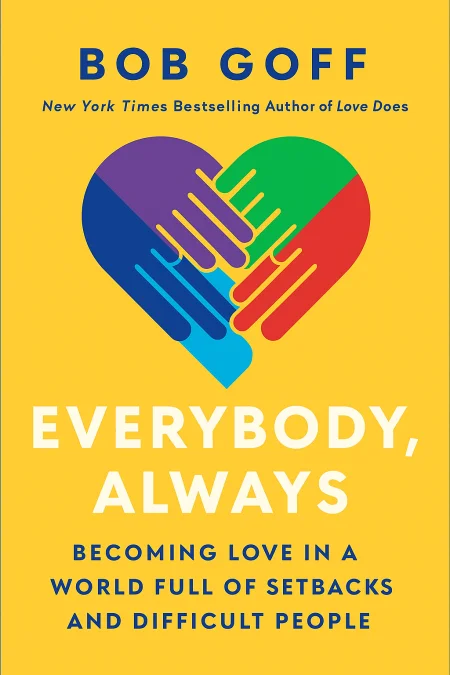
Everybody, Always
Becoming Love in a World Full of Setbacks and Difficult People
byBob Goff
Book Edition Details
Summary
What if embracing love without boundaries was the key to a life unshackled by fear? In "Everybody, Always," Bob Goff invites readers into his world of daring compassion, where the extraordinary emerges from everyday encounters. With wit and warmth, Goff shares his journey of befriending the unlikely and loving the unlovable, revealing the profound lessons tucked within each stumble and triumph. Whether he's soaring through the sky with missing shoes or forging unexpected friendships with a Ugandan witch doctor, Goff's infectious spirit challenges us to expand our own hearts. This isn't just a book—it's an invitation to live audaciously, to love relentlessly, and to find liberation in the most surprising places.
Introduction
Picture a small village where people have learned to lock their doors, not just against thieves, but against the uncomfortable presence of those they don't understand. We've all lived in such villages of the heart, where love feels safe only when it's predictable, where acceptance comes with conditions, and where grace is rationed like precious water in a drought. Yet what if the very people we've learned to avoid hold the keys to our deepest transformation? This collection of stories emerges from one man's journey beyond the comfortable boundaries of conditional love into the radical territory of loving everybody, always. Through encounters with airport security guards, prison inmates, former enemies, and even witch doctors, we discover that the people who challenge us most profoundly often become our greatest teachers. These aren't mere tales of good deeds or charitable acts, but invitations to a fundamentally different way of being human. The path ahead reveals how love, when practiced without reservation or safety nets, becomes the force that transforms not only those who receive it, but those brave enough to give it away. In a world increasingly divided by fear and misunderstanding, these stories offer a different possibility: that our capacity to love difficult people might be the very thing that saves us all.
From Yellow Trucks to Airport Encounters
Bob's yellow pickup truck had seen better days. With over 100,000 miles and not a single oil change, the vehicle had become a rolling testament to neglect. The windshield wipers didn't work, the door locks had surrendered, and even the gas cap had given up its simple duty. But it was in this decrepit vehicle that an unlikely friendship would bloom, teaching profound lessons about dignity and shame. Every day, Bob parked his truck across the railroad tracks from his law office, a twenty-minute walk that saved him two hundred dollars in parking fees. And every day, he discovered a homeless man sitting in the driver's seat, hands positioned at ten and two o'clock as if waiting for a traffic light to change. What began as awkward encounters evolved into a daily ritual: Bob would tap on the window, the man would wave, offer to drive him somewhere, then gracefully exit to let Bob reclaim his vehicle. This routine continued for months until one devastating day when Bob found his truck vandalized, filled with beer bottles and cigarette butts. The homeless man was nowhere to be found, having disappeared into the shadows of shame. That moment crystallized a universal truth: shame doesn't just wound us—it drives us away from the very places and people where we've found safety and acceptance. The story of the yellow truck reveals how easily we abandon relationships when we feel we've failed the people who matter to us. Yet it also points to something deeper: the revolutionary power of showing up consistently for people, even when they disappoint us, and the transformative potential of love that doesn't keep score.
Beyond Comfort Zones and Into Love
When Bob agreed to speak at a radio broadcasters conference in Orlando, he expected nothing more than a routine speaking engagement. Instead, he found himself in the back of a limousine with a driver who had been chauffeuring various personalities for twenty-five years. As they drove through the Florida landscape, Bob learned that this would be the driver's final month before retirement—a career spanning decades with no opportunity to experience the luxury he provided others. Without hesitation, Bob suggested they trade places. The absurdity of the moment—a passenger insisting his driver experience the back seat while he took the wheel—created an instant of pure joy. For the remaining journey, the roles reversed: the seasoned professional relaxed in leather seats while Bob navigated traffic wearing the driver's cap. When they reached Disney World, Bob pinned a medal on the driver's chest, speaking words of affirmation about his courage and character. This spontaneous act of role reversal illuminates how genuine love often requires us to step outside conventional boundaries. The limo driver went home that night with a story about meeting someone who saw his worth, not just his function. Bob discovered that sometimes the most profound ministry happens when we're willing to look ridiculous, to abandon our positions of comfort, and to honor the dignity of those who serve us. The exchange reminds us that everyone carries invisible stories of dreams deferred and experiences denied. When we pay attention to these stories and act with creative generosity, we participate in the kind of love that doesn't just talk about caring—it gets behind the wheel and drives.
From Enemies to Brothers in Faith
The courtroom in Northern Uganda buzzed with unprecedented tension as Kabi, a notorious witch doctor, sat shackled before a high court judge. For the first time in the nation's history, one of these feared figures would face justice for child sacrifice. Eight-year-old Charlie, the brave survivor whose testimony would change everything, stood barely four feet tall but cast a shadow larger than any adult in the room as he pointed at his attacker and declared, "That's the man who tried to kill me." The conviction sent shockwaves through the country—forty-one million people learned that witch doctors were no longer untouchable. Justice had prevailed, but Bob found himself wrestling with an unexpected darkness in his own heart. The hatred he felt toward Kabi troubled him deeply, creating distance between himself and the God he sought to serve. Despite his revulsion, Bob made a decision that would transform both their lives: he would visit his enemy in prison. In the dim confines of Luzira Maximum Security Prison, Bob encountered not the monster he expected, but a broken man seeking forgiveness. Kabi spoke of his childhood as a witch doctor's son, the destructive path that had led him to commit unspeakable acts, and his genuine remorse. In that moment, Bob witnessed something extraordinary: his enemy wasn't asking for freedom or reduced punishment, but for the one thing that could heal both their souls—forgiveness. This encounter reveals love's most radical demand: that we extend grace even to those who have caused unbearable harm. When Kabi later stood before three thousand death row inmates sharing his newfound faith, his broken testimony became more powerful than any polished sermon. The transformation of enemies into brothers demonstrates that redemption's reach extends farther than our capacity to imagine or deserve.
Becoming Love in Action
The stories collected in these pages chart a course from theoretical faith to embodied love, from agreeing with Jesus to actually following his most challenging commands. Through encounters with the homeless, prison inmates, witch doctors, and countless others society overlooks, we discover that loving "everybody, always" isn't just a noble ideal—it's the practical pathway to becoming the people God created us to be. Each story reveals love's transformative power working in both directions. The homeless man in the yellow truck taught dignity in the face of shame. The limo driver showed how small acts of recognition can illuminate someone's worth. Charlie demonstrated courage that could change a nation's history. Even Kabi, the witch doctor, became an unlikely teacher about forgiveness and redemption. In every case, extending radical love and acceptance changed the giver as much as the receiver. The progression from fear to love, from judgment to grace, from safety to vulnerability, maps the geography of spiritual transformation. These aren't stories about extraordinary people doing impossible things, but about ordinary individuals choosing to love beyond the boundaries of comfort and convention. They remind us that we don't need special qualifications to participate in this kind of love—only the willingness to show up, to see people as Jesus sees them, and to risk being changed by the encounter.
Summary
The journey through these interconnected stories reveals a fundamental truth: love isn't something we fall into or achieve through effort, but someone we become through practice. Each encounter with difficult people, each choice to extend grace to those who don't deserve it, each moment of choosing vulnerability over safety shapes us into more accurate reflections of divine love. The homeless man, the limo driver, the child survivor, and even the witch doctor become teachers in love's curriculum, showing us that everyone—literally everyone—has something to teach us about grace. The transformation happens not through grand gestures or perfect theology, but through daily decisions to see people as God sees them, to treat enemies as neighbors, and to risk our comfort for someone else's dignity. When we stop keeping score of who deserves our kindness and start drawing larger circles of inclusion, we discover that love multiplies rather than depletes. The more we give away, the more we become people capable of even greater love. This way of living demands everything and offers everything in return. It asks us to abandon the safety of loving only those who love us back, to forgive those who have wounded us deeply, and to see potential for redemption in the most unlikely people. Yet this risk opens us to experiences of divine love that transform not only our relationships but our very identity, turning us from people who merely know about love into people who have become love itself.
Related Books
Download PDF & EPUB
To save this Black List summary for later, download the free PDF and EPUB. You can print it out, or read offline at your convenience.
By Bob Goff
