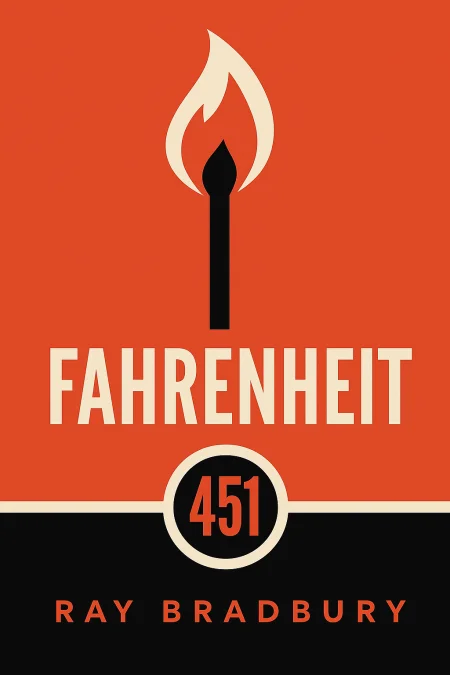
Fahrenheit 451
Explore a Future Where Books Burn
Book Edition Details
Summary
In a society where firemen ignite infernos instead of extinguishing them, Ray Bradbury's "Fahrenheit 451" explores a haunting future where books are forbidden and ignorance reigns. Guy Montag, a loyal enforcer of this anti-intellectual regime, finds his world turned upside down after an encounter with the inquisitive Clarisse. She opens his eyes to the possibility of a life unshackled by fear and conformity, igniting a rebellion within his soul. As Montag grapples with newfound doubts and an insatiable thirst for knowledge, he must navigate a landscape where the written word is a dangerous relic. Bradbury's tale is a searing indictment of a culture that sacrifices critical thought for superficial pleasure, posing urgent questions about our own world’s trajectory.
Introduction
Picture yourself walking through your neighborhood and discovering that every bookstore has closed, every library has been shuttered, and the simple act of reading has become not just unfashionable, but dangerous. What would you do if the stories that shaped your understanding of love, courage, and meaning were suddenly declared threats to social order? This haunting scenario unfolds through interconnected tales that explore humanity's most fundamental relationship with knowledge, imagination, and the price we pay when we surrender our right to think freely. These stories reveal a chilling truth about our modern world: the death of literature rarely happens through dramatic public spectacles, but through the quiet erosion of curiosity, the seductive comfort of passive entertainment, and our gradual acceptance of simplified truths over complex realities. Through vivid narratives of ordinary people facing extraordinary moral choices, you'll discover how individual acts of courage can preserve civilization's most precious treasures. You'll understand why the guardians of knowledge often become society's most dangerous rebels, and learn to recognize the everyday heroism required to keep wisdom alive when darkness falls. Most importantly, you'll see how the battle to preserve books is ultimately a battle to preserve the human capacity for wonder, empathy, and independent thought.
The Woman Who Chose Death Over Surrender
In a world where firemen arrive not to extinguish flames but to kindle them, an elderly woman makes a choice that changes everything. When the fire brigade comes to confiscate her illegal library, they expect the usual routine: evacuate the resident, seize the contraband books, and reduce them to ash. But this woman refuses to leave. Standing among towering shelves of poetry and philosophy, she looks directly into the fire chief's eyes and speaks with quiet certainty: "You can't have my books." The firemen try reasoning with her, explaining the law, offering safe passage to a detention center. She remains unmoved, kneeling among her beloved volumes, running weathered fingers over leather bindings worn smooth by decades of reading. As they douse her library with kerosene, she continues touching each book like an old friend, reading golden titles by memory rather than sight. When the firemen retreat to a safe distance, expecting her to follow, she produces a single kitchen match from her apron pocket. Before anyone can stop her, she strikes the match against the kerosene-soaked doorframe. The woman disappears in a pillar of flame, choosing to die with her books rather than live without them. Her sacrifice forces the witnessing firemen to confront an uncomfortable question: what could be so valuable that someone would choose death over surrender? This moment of devastating courage reveals that when we truly absorb great literature, it becomes inseparable from our identity. The woman understood that losing her books meant losing herself, that some things transcend the mere preservation of biological life. Her choice demonstrates that dignity sometimes requires the ultimate sacrifice, and that witnessing such conviction can shatter the comfortable assumptions of those who have never been asked to choose between survival and principle. For those present at her death, the unthinkable question begins to form: what would I be willing to die to protect?
When Machines Replace the Human Soul
The great promise of technology was liberation, yet somehow it became humanity's most elegant prison. The transformation happened so gradually that few noticed the chains being forged. First came the demand for shorter books, then condensed versions, then brief summaries, until finally books vanished altogether, replaced by wall-sized television screens and mechanical voices whispering constant entertainment into eager ears. Citizens celebrated their freedom from the burden of complex ideas, embracing instead the simple pleasures of immediate gratification. Why struggle through difficult poetry when you could experience synthetic emotions through interactive programs? Why wrestle with philosophical questions when pre-packaged answers arrived at the speed of light? The mechanical hound that tracked down remaining book-lovers became a symbol of this new efficiency, its electronic nose capable of detecting the faintest trace of forbidden knowledge on clothing or skin. Yet within this mechanized paradise, cracks begin to appear. The very technology that promised happiness delivers only a peculiar emptiness. People attempt suicide not from obvious despair but from a vague sense that something essential is missing from their lives, though they cannot name what they have lost. The mechanical phoenix of progress has indeed risen, but in burning away the past, it has consumed its own soul. This cautionary vision reveals that true progress cannot be measured by the sophistication of our machines, but by the depth of our humanity. When we surrender our capacity for independent thought in exchange for convenience, we become machines ourselves, efficient but soulless, productive but purposeless. The story warns that the most dangerous form of control is not oppression but the voluntary abandonment of our ability to think, feel, and imagine beyond the boundaries others set for us.
Walking Libraries in Tomorrow's Ruins
In the aftermath of civilization's collapse, a small group of wanderers carries something more precious than any material treasure: the complete works of human literature, preserved not in books but in living memory. The city lies in radioactive ruins, its towers reduced to twisted metal, its citizens scattered like ash in an atomic wind. Yet among the devastation, these walking libraries represent humanity's most audacious act of preservation. Each person has memorized entire volumes, becoming a living repository of knowledge. One elderly man carries Plato's Republic in his mind, reciting passages while warming his hands over a small fire. A middle-aged woman holds Shakespeare's complete works, occasionally speaking Hamlet's soliloquies to the empty sky. A younger man preserves the wisdom of Marcus Aurelius, finding comfort in ancient Stoic philosophy as he walks through tomorrow's wasteland. They understand that they are not the books themselves, merely their temporary guardians, responsible for passing the flame of knowledge to future generations. When they meet other survivors, they share fragments of their treasures, teaching children to memorize poems and stories. They know that civilization will eventually rebuild, and when it does, they will be ready to offer humanity's greatest gifts back to the world. Their patient vigil offers profound hope for renewal. When civilizations collapse, as they inevitably do, survivors must choose what to preserve and what to abandon. These memory-keepers have chosen to save not weapons or wealth, but wisdom. They prove that culture is not contained in buildings or institutions, but in the minds and hearts of people who refuse to let it die. In walking through tomorrow's ruins, they carry yesterday's treasures toward a better future, demonstrating that even in humanity's darkest hour, the light of knowledge can never be completely extinguished if someone has the courage to keep it burning in their heart.
Summary
The greatest act of rebellion is the simple refusal to forget what makes us human, and the most powerful weapon against tyranny is not violence but the preservation of wisdom, empathy, and the capacity for independent thought. Read deeply and regularly, choosing substance over superficiality in your daily consumption of information, and resist the seductive pull of entertainment that asks nothing of your mind or heart. Become a guardian of memory by sharing meaningful stories and ideas with others, especially younger generations who may never encounter them otherwise, and cultivate your own inner library of works that have shaped your understanding of what it means to be human. Remember that every time you choose complexity over simplification, reflection over reaction, and genuine human connection over artificial stimulation, you are participating in the most important battle of our time: keeping alive the flame of human imagination in an increasingly mechanized world.
Related Books
Download PDF & EPUB
To save this Black List summary for later, download the free PDF and EPUB. You can print it out, or read offline at your convenience.
By Ray Bradbury
