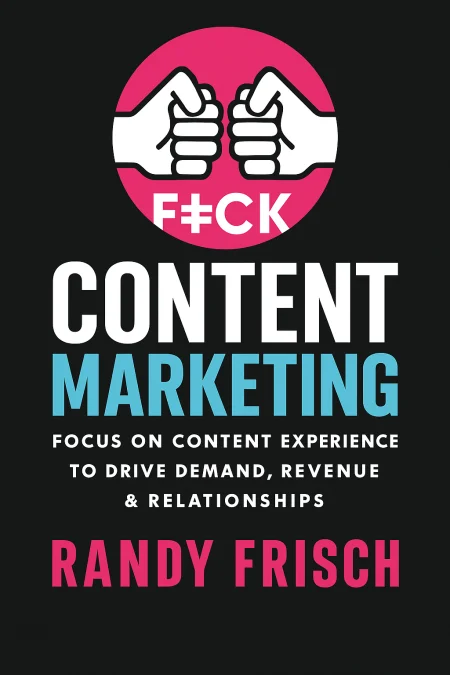
F#ck Content Marketing
Focus on Content Experience to Drive Demand, Revenue & Relationships
Book Edition Details
Summary
Randy Frisch’s "F#ck Content Marketing" rips the curtain back on how organizations squander their own creative output, challenging the conventional wisdom that more is better. This is not your typical guide for content marketers. Instead, it’s a manifesto for anyone craving a deeper connection with their audience through tailored content experiences that captivate like a binge-worthy series or an addictive playlist. Frisch dismantles the myth of content abundance, exposing the staggering reality that a significant chunk of created content goes untouched. By introducing the Content Experience Framework, he arms businesses with the tools to craft personalized narratives that resonate on a grand scale, all while pinpointing the pivotal players within an organization to champion this transformative process. Prepare to shift your perspective and harness the true power of your content arsenal.
Introduction
In today's marketing landscape, organizations are drowning in a paradox of their own making. Despite unprecedented investments in content creation, with 70% of marketers planning to produce even more content each year, a staggering 60-70% of all marketing materials go completely unused. This disconnect reveals a fundamental misunderstanding about what truly drives customer engagement and conversion in the modern digital economy. The challenge isn't content scarcity—it's content experience design. The Content Experience Framework emerges as a systematic response to this crisis, shifting focus from mere content production to the strategic orchestration of how audiences discover, consume, and engage with information throughout their buyer journey. This theoretical approach recognizes that in an attention economy where consumers expect Netflix-level personalization and Google-quality relevance, the environment surrounding content matters as much as the content itself. The framework addresses critical questions about organizational alignment, technological infrastructure, and the evolution of marketing roles in an experience-driven marketplace. By examining this systematic approach to content experience design, we gain insights into how modern organizations can transform scattered content assets into coherent, conversion-driving journeys that build trust and accelerate decision-making processes.
The Shift from Content Marketing to Content Experience
Traditional content marketing has fallen victim to its own success, creating what can be understood as the "Corona Analogy." Just as a beer tastes fundamentally different when consumed in a basement versus on a beach in Costa Rica, content performs dramatically differently depending on its environmental context. The beer remains identical in both scenarios, but the experience surrounding it transforms perception and enjoyment. This analogy illuminates why content experience represents an evolutionary leap beyond content marketing. Content marketing focused primarily on creation and distribution, treating individual pieces as standalone assets designed to attract and convert audiences. However, this approach assumed that quality content would naturally find its audience and drive desired behaviors. The Content Experience Framework recognizes that the environment, structure, and engagement mechanisms surrounding content are equally crucial determinants of success. The shift encompasses three fundamental dimensions. Environment refers to the visual design, navigation systems, and technological infrastructure that houses content. Structure involves the organizational logic that helps users discover relevant information efficiently, moving beyond chronological or format-based categorization toward persona and journey-stage alignment. Engagement mechanisms ensure that each piece of content strategically guides audiences toward the next logical step in their decision-making process. This transition reflects broader consumer expectations shaped by platforms like Spotify and Netflix, which excel at creating personalized, seamless experiences that keep users engaged across multiple content touchpoints. Modern buyers, whether B2B or B2C, expect the same level of sophistication from brand interactions, making content experience design a competitive necessity rather than a marketing luxury.
The Content Experience Framework: Five Essential Steps
The Content Experience Framework provides a systematic methodology for transforming content assets into cohesive buyer journeys through five interconnected phases. Unlike traditional content marketing approaches that end at publication, this framework treats content as raw material for experience design, requiring ongoing optimization and strategic orchestration. The framework begins with Centralization, which involves creating a comprehensive inventory of all organizational content assets regardless of format or location. This step addresses the common problem of "homeless content" scattered across platforms like YouTube, SlideShare, and various department drives. Centralization enables organizations to understand their full content portfolio and identify gaps or redundancies in their messaging ecosystem. Organization follows centralization, focusing on metadata tagging and taxonomic structure that supports discoverability. Rather than organizing by content format, effective organization prioritizes audience needs, journey stages, and contextual relevance. This phase involves comprehensive content auditing and the implementation of searchable categorization systems that enable rapid content retrieval based on campaign requirements. Personalization transforms organized content into tailored experiences that reflect individual buyer characteristics, interests, and journey progression. This goes beyond simple name personalization to encompass contextual content curation, dynamic recommendation engines, and adaptive user interfaces that respond to engagement patterns and behavioral signals. Distribution ensures that personalized experiences reach audiences through appropriate channels at optimal moments. This phase integrates content experiences across email campaigns, social media, paid advertising, and direct sales interactions, maintaining consistency while adapting to channel-specific requirements and audience expectations. Generate Results completes the framework by implementing measurement systems that track engagement, conversion, and attribution across multiple touchpoints. This phase enables continuous optimization based on performance data and buyer feedback, creating a closed-loop system that improves experience effectiveness over time.
Building Organizational Alignment Around Content Experience
The Content Experience Framework requires unprecedented organizational coordination because content creation and consumption span every department within modern companies. From sales presentations and customer success materials to billing communications and HR recruitment content, every organizational touchpoint represents an opportunity to reinforce or undermine brand consistency and messaging coherence. Traditional organizational structures often create content silos where departments develop materials independently, leading to what can be described as "broken telephone syndrome." Marketing develops one narrative, sales adapts it differently, customer success interprets it through their lens, and billing communicates yet another version. This fragmentation confuses audiences and dilutes brand authority, ultimately reducing conversion rates and customer satisfaction. The solution requires establishing a Content Experience Manager role that serves as both conductor and translator across departmental boundaries. This position differs from traditional content marketing roles by focusing on experience orchestration rather than content creation. The Content Experience Manager ensures that sales decks align with marketing messages, customer onboarding materials reflect pre-sale promises, and even administrative communications reinforce brand values and positioning. Organizational alignment also demands technological infrastructure that supports collaborative content management and real-time experience optimization. Content Management Systems, originally designed for simple web publishing, prove inadequate for the complex, multi-format, personalized experiences that modern marketing requires. Content Experience Platforms emerge as purpose-built solutions that enable marketers to create, modify, and optimize buyer journeys without requiring technical development resources. Success depends on leadership commitment to treating content experience as a strategic priority rather than a tactical marketing function. Organizations that achieve this alignment create competitive advantages through superior buyer experiences that accelerate decision-making, increase deal sizes, and generate sustainable customer advocacy that drives organic growth through referrals and reviews.
Summary
The fundamental insight driving content experience design is elegantly simple: in an attention-saturated marketplace, the context surrounding information matters as much as the information itself. Just as Spotify transforms music discovery through intelligent curation and Netflix revolutionizes entertainment consumption through personalized recommendations, successful organizations must orchestrate content experiences that guide audiences through coherent journeys rather than expecting them to navigate scattered assets independently. This framework represents a maturation of marketing thinking from volume-based content production to experience-based audience engagement, promising to transform how organizations build relationships, accelerate sales cycles, and create sustainable competitive advantages in an increasingly commoditized information economy.
Related Books
Download PDF & EPUB
To save this Black List summary for later, download the free PDF and EPUB. You can print it out, or read offline at your convenience.

By Randy Frisch
