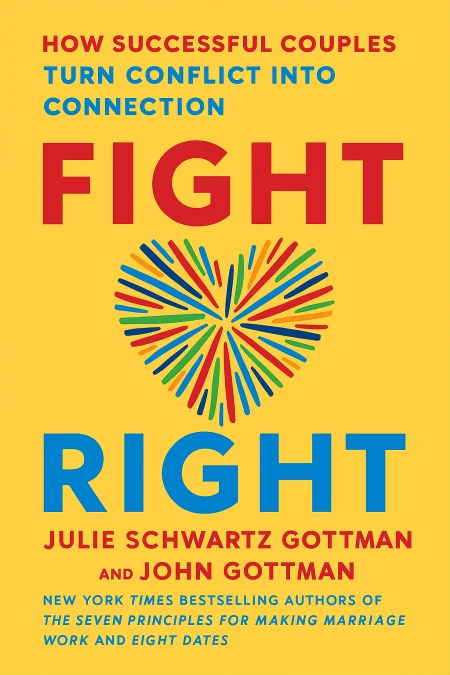
Fight Right
How Successful Couples Turn Conflict into Connection
byJohn M. Gottman, Julie Schwartz Gottman
Book Edition Details
Summary
In the bustling arena of love and conflict, "Fight Right" emerges as your guide to transforming turmoil into tenderness. Renowned relationship architects Drs. John and Julie Gottman illuminate the paradox of fighting in love—it's not about avoiding conflict, but about wielding it to fortify your bond. Here, the Gottmans unveil five pivotal secrets to navigate the stormy seas of discord, turning clashes into conduits for intimacy. With insights drawn from their legendary Love Lab, this book explores how your unique conflict style—shaped by personal history—can either be a barrier or a bridge to deeper connection. Discover the nuanced dance of Avoiders, Validators, and Volatiles, and learn how each can synergize for harmonious outcomes. "Fight Right" is more than a manual; it's a lifeline for couples seeking to replace the tug-of-war with a tapestry of understanding, ensuring every argument ends in unity rather than division.
Introduction
Sarah stared at the pile of dishes in the sink, her jaw clenched tight. It was the third night this week that David had left everything for her to clean up after dinner. When he walked into the kitchen scrolling through his phone, she finally exploded: "Do you think these dishes wash themselves? I'm not your maid!" The fight that followed was brutal—accusations flying, doors slamming, both of them retreating to separate corners of the house, hearts pounding with hurt and rage. Sound familiar? Most of us have been there, caught in the wreckage of a fight that started small but somehow became a battlefield. We love our partners deeply, yet we find ourselves locked in conflicts that leave us feeling misunderstood, disconnected, and sometimes questioning whether we're truly compatible. The cruel irony is that the people we care about most are often the ones who can trigger our strongest reactions. But what if conflict didn't have to be destructive? What if our biggest fights could actually become doorways to deeper understanding and intimacy? After decades of studying thousands of couples, researchers have discovered that successful relationships aren't defined by the absence of conflict, but by how partners navigate disagreements. The couples who thrive have learned something profound: how to fight right. They've discovered that beneath every heated argument about dishes or money or in-laws lies an opportunity to truly see and understand each other. This journey will show you how to transform your conflicts from sources of pain into bridges of connection.
The First Three Minutes: How Arguments Begin and Spiral
The trail was getting steeper, and Kristen felt her excitement building as she scrambled up the rocky path in Sedona. This was exactly what she'd been craving—adventure, challenge, time alone with Steve away from the kids and endless responsibilities. But when she turned back to check on her husband, she saw him frozen on the narrow ledge, his face pale with fear. "I don't think this is such a good idea," he said, gripping his walking stick. "This trail is too dangerous. We're heading back down." The words that came out of Kristen's mouth next would haunt their marriage for months: "Of course you won't go. I should have known you'd be too much of a pussy to go on a hike with me. You treat me like a child, and you're such a coward. Are you going to grow some balls, Steve, or just stand there?" The fight that erupted on that thousand-foot cliff was vicious, ending with both of them flooded with rage and hurt, the vacation ruined. Research reveals that we have exactly 180 seconds to get a conflict off on the right foot. After those first three minutes, the trajectory of the fight is essentially set, and the ripple effects extend far into the future. Studies tracking couples over six years found that harsh start-ups—beginning with criticism, blame, or contempt—predicted relationship failure with startling accuracy. When we launch into conflict by attacking our partner's character rather than expressing our own feelings and needs, we leave them with only one option: to defend themselves. From that attack-and-defend position, no real communication can occur. The key lies in learning to express our deepest frustrations and disappointments with gentleness, focusing on our own experience rather than our partner's failures, creating space for understanding rather than warfare.
When Hearts Race and Logic Fails: Managing Emotional Flooding
Susan's world shattered the day a strange woman called asking for her husband Stan. When she confronted him about the affair, his defensive response sent her reeling: "You never have time for me anyway. We're more like business partners than lovers." Within moments, both their hearts were racing, stress hormones flooding their systems, rational thought abandoning them completely. "I don't know why I bother coming home at all!" Stan screamed. "I wish I had never met you," Susan sobbed back, her chest tight with panic. This is flooding—the emotional hijacking that occurs when our nervous system perceives threat and launches us into fight-or-flight mode. Heart rates spike from 80 to over 100 beats per minute, adrenaline courses through our veins, and our capacity for empathy and clear thinking evaporates. In this state, we become incapable of fighting constructively. We say things we don't mean, miss our partner's attempts at repair, and cause damage that takes far longer to heal than the original issue warranted. The solution isn't to avoid getting emotional—it's to recognize the early warning signs of flooding and take breaks before we cross the point of no return. Learning to identify our body's signals, whether it's gritted teeth, a racing heart, or that familiar heat rising in our chest, allows us to pause and say, "I'm feeling overwhelmed and don't want to say something I'll regret. Let me take twenty minutes to calm down, and then we can continue talking." This isn't abandoning the conversation—it's protecting it from the destruction that flooding inevitably brings.
Beyond Surface Battles: Uncovering the Dreams That Drive Conflict
For years, Manuel and Shanae fought the same battle over and over. She wanted him to surprise her with gifts; he insisted they couldn't afford such frivolous spending. They'd tried every compromise imaginable—gift-giving only on holidays, strict price limits, detailed budgets—but nothing worked. The fights kept getting nastier, leaving both feeling misunderstood and rejected. When Manuel gave Shanae a blender for Valentine's Day, technically following their agreed-upon rules, her devastated expression told him he'd failed again, though neither could articulate why. It wasn't until they stopped arguing about money and started exploring their deeper stories that everything changed. Shanae revealed how, as a child living with relatives, she'd watched her cousins receive piles of Christmas presents while she got only a pair of socks—gifts meant love, and she wasn't getting any. Manuel shared his own painful history: the only person who'd ever given him gifts was his godmother, who later abandoned him when his life took a difficult turn. To him, gifts felt like manipulation, a setup for inevitable betrayal and disappointment. The most persistent conflicts in relationships are rarely about their surface topics. Beneath arguments about dishes, money, or social plans lie deeper dreams about love, security, adventure, or belonging. When couples get stuck fighting the same battle repeatedly, it's often because they're trying to solve the wrong problem. The real work lies in excavating these buried dreams and fears, creating space for partners to share not just their positions but their stories. In that vulnerable exchange, criticism transforms into compassion, and gridlock gives way to genuine understanding and creative solutions that honor both people's deepest needs.
From Gridlock to Growth: Building Collaborative Solutions Together
Rachel and James sat across from each other at their kitchen table, the familiar tension of an unresolved conflict hanging between them like a thick fog. For months, they had been deadlocked over James's job opportunity in another city. Rachel had finally achieved her dream position at a nonprofit organization she was passionate about, while James had been offered a promotion that would require relocating across the country. Each saw the situation as zero-sum: one person's dream would have to die for the other's to live. Their conversations had become increasingly polarized, with each partner digging deeper into their position and viewing the other as an obstacle to their happiness. The breakthrough came when they learned to separate their core needs from their assumed solutions. Rachel's inflexibility wasn't really about the specific job or city; it was about her deep need to make a meaningful impact through her work and to feel that her career mattered. James's desire to relocate wasn't just about the promotion; it was about his need to feel challenged and to provide security for their family. When they mapped out what was truly non-negotiable for each of them versus what was flexible, they discovered far more room for creative solutions than either had imagined. Through careful exploration of their areas of flexibility, they crafted a solution that initially seemed impossible: James would take the promotion but negotiate a hybrid arrangement that allowed him to work remotely part of the time, while Rachel would explore opportunities to expand her organization's reach to the new city. The process required both of them to let go of their rigid assumptions about how their dreams had to unfold and to trust that supporting each other's core needs would ultimately strengthen their partnership. Their experience illustrates a fundamental truth about successful relationships: the couples who thrive are those who approach conflict as a collaborative puzzle to be solved together rather than a competition where one person must lose for the other to win.
Summary
The most profound truth about relationship conflict is this: we're never really fighting about what we think we're fighting about. Behind every heated argument about household chores or spending habits lies a deeper conversation about love, respect, safety, and dreams. The couples who build lasting, joyful partnerships aren't those who never disagree—they're the ones who've learned to see conflict as an invitation to know each other more deeply. When we approach our disagreements with curiosity instead of criticism, when we pause to calm our nervous systems before they hijack our hearts, and when we dig beneath surface complaints to uncover the dreams and fears that drive them, something magical happens. Our biggest fights become our greatest opportunities for intimacy. The very differences that spark our conflicts—his caution and her adventurous spirit, her need for security and his fear of being controlled—reveal themselves as the complementary qualities that drew us together in the first place. Love isn't about finding someone who never triggers us; it's about learning to dance gracefully with our differences, turning the friction into a force that polishes us both into better versions of ourselves. In this dance of understanding, every couple can discover that their love is not only strong enough to survive conflict, but to be transformed by it.
Related Books
Download PDF & EPUB
To save this Black List summary for later, download the free PDF and EPUB. You can print it out, or read offline at your convenience.
By John M. Gottman
