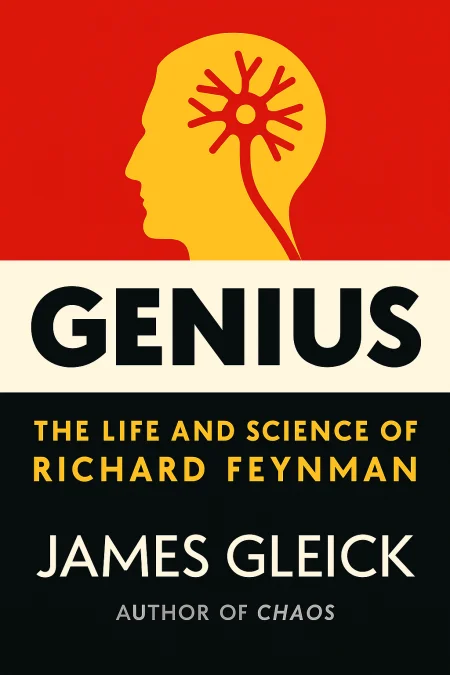
Genius
The Life and Science of Richard Feynman
Book Edition Details
Summary
Born in the vibrant yet austere backdrop of Depression-era Rockaway Beach, Richard Feynman emerged as a trailblazer in the nascent field of physics, renowned not just for his intellect but for his irrepressible zest for life. James Gleick's "Genius" intricately weaves the tapestry of Feynman's life, from a curious child fiddling with radios to a formidable presence at Los Alamos, contributing to the birth of the Atomic Age under the shadow of the Manhattan Project. Gleick captures Feynman's boundless curiosity and rebellious spirit, painting a vivid portrait of a man who, even amidst the gravity of quantum mechanics, never lost his sense of wonder. More than a mere biography, this book invites readers to witness how Feynman's unconventional approach transformed scientific thought and inspired future generations. Here is a tale of relentless curiosity, playful intellect, and an enduring legacy that resonates far beyond the confines of traditional academia.
Introduction
In the summer of 1945, as the world's first atomic bomb exploded over the New Mexico desert, a young physicist named Richard Feynman watched the historic Trinity test through an ordinary truck windshield while his colleagues donned dark welding glasses. His reasoning was characteristically simple yet bold: the windshield would filter out the dangerous ultraviolet rays, allowing him to witness this pivotal moment in human history with his own eyes. This blend of scientific calculation and irrepressible curiosity perfectly captured the essence of a man who would become one of the most influential and beloved figures in twentieth-century physics. Richard Phillips Feynman emerged from the working-class streets of Far Rockaway, Queens, to revolutionize our understanding of the fundamental forces that govern the universe. His journey from a radio-repairing teenager to Nobel Prize winner illuminates not just the development of modern physics, but the power of maintaining childlike wonder in the face of nature's deepest mysteries. Feynman possessed that rarest of combinations: the analytical brilliance to solve the most complex theoretical problems and the gift to explain profound concepts with infectious enthusiasm and crystal clarity. Through Feynman's extraordinary life, we discover how genuine scientific thinking develops from relentless curiosity rather than formal credentials, how breakthrough discoveries emerge from the courage to question established wisdom, and how one person's refusal to accept conventional answers can reshape entire fields of knowledge. His story reveals the transformative power of approaching even the most intimidating subjects with honesty, humor, and an unshakeable belief that understanding the world around us is not just possible but profoundly joyful.
From Radio Repair to Quantum Mechanics
Richard Feynman's scientific awakening began not in a prestigious laboratory but in his childhood bedroom in Far Rockaway, where he had assembled what he proudly called his "lab" from a wooden crate filled with batteries, motors, and salvaged radio parts. By age thirteen, he had earned a neighborhood reputation as the kid who could fix any broken radio, not through trial and error but by carefully listening to the symptoms and reasoning through the underlying electrical principles. When a radio produced terrible sounds only when first turned on, young Feynman deduced that certain tubes needed time to warm up, demonstrating an early mastery of thinking from first principles rather than memorizing repair procedures. The foundation of this analytical approach came from his father Melville, a uniform salesman who possessed no formal scientific training but understood something profound about the nature of knowledge. During their walks through the local woods, Melville would point to a bird and explain that knowing its name in English, Latin, or any other language revealed nothing about the bird itself. What mattered was understanding how it behaved, why it moved as it did, what made it unique among living creatures. This early lesson that labels were often barriers to genuine understanding became the cornerstone of Feynman's intellectual philosophy and his lifelong skepticism toward authority and conventional wisdom. At Far Rockaway High School, Feynman's mathematical gifts flourished in ways that both impressed and puzzled his teachers. As captain of the mathematics team, he developed an almost supernatural ability to visualize complex problems and find elegant solutions that often bypassed standard methods entirely. His approach was intuitive rather than mechanical, guided by an inner sense of mathematical beauty and logical necessity that allowed him to see patterns others missed. Teachers began to recognize that this young man possessed something beyond mere computational skill: he had developed a genuine feel for how mathematical relationships behaved in the abstract realm of pure thought. The transition to MIT in 1935 marked Feynman's first encounter with formal physics education, and characteristically, he approached it with both enthusiasm and irreverence. While his classmates dutifully memorized standard problem-solving techniques, Feynman often arrived at correct answers through methods he had invented himself, sometimes frustrating professors who couldn't follow his unconventional reasoning. His undergraduate thesis on molecular forces already displayed the hallmarks of his mature work: an ability to cut through mathematical complexity to reveal underlying physical principles, and an insistence on developing new approaches when existing methods proved inadequate or unsatisfying.
Los Alamos and the Birth of Modern Physics
The Manhattan Project transformed Feynman from a promising graduate student into a key figure in humanity's most ambitious and consequential scientific undertaking. At Los Alamos, surrounded by the world's most distinguished physicists, the twenty-five-year-old found himself not intimidated but energized by the unprecedented challenge of building an atomic weapon before Nazi Germany could achieve the same goal. His contributions extended far beyond his official role in the theoretical division, as he became the laboratory's unofficial problem-solver, equally comfortable calculating neutron diffusion rates and repairing the mechanical calculators that the computing division desperately needed to function. Feynman's ability to visualize complex physical processes proved invaluable in understanding how a nuclear explosion would actually unfold, not just in elegant theoretical equations but in the messy reality of shock waves, heat transfer, and rapidly expanding gases. Working closely with Hans Bethe, he developed crucial formulas for calculating the efficiency of nuclear reactions, work that remained classified for decades but was essential to the bomb's success. Yet even as he threw himself into these technical challenges with characteristic enthusiasm, he maintained the playful curiosity that had defined his approach to learning, famously spending his spare time picking locks on safes containing atomic secrets and studying the psychology of secrecy and security. The personal cost of these war years was devastating, as Feynman watched his beloved first wife Arline slowly succumb to tuberculosis in a sanatorium in nearby Albuquerque. Their relationship, conducted largely through letters and weekend visits, became a poignant counterpoint to the abstract violence he was helping to create. Arline's death in June 1945, just weeks before the Trinity test, left Feynman emotionally shattered yet somehow more determined to find meaning in his scientific work. The successful detonation of the atomic bomb marked both the culmination of his wartime service and the beginning of a profound questioning of science's role in human affairs. The experience of witnessing that first nuclear explosion from twenty miles away filled Feynman with a complex mixture of triumph and horror that would influence his thinking for the rest of his life. He had helped demonstrate physics' terrible power to reshape the world, forcing him and his colleagues to confront fundamental questions about the responsibility of scientists and the relationship between knowledge and its applications. This awareness of science's dual potential for creation and destruction would inform his later commitment to honest communication about both the possibilities and the dangers inherent in scientific progress.
Nobel Prize and the Art of Scientific Teaching
In the decade following the war, Feynman revolutionized quantum electrodynamics through his development of a radically new approach that abandoned traditional mathematical machinery in favor of intuitive methods based on simple diagrams. These "Feynman diagrams" allowed physicists to visualize and calculate complex particle interactions with unprecedented clarity, transforming what had once required pages of nearly incomprehensible equations into elegant drawings that captured the essential physics at a glance. His path integral formulation provided a completely new foundation for quantum mechanics, one that emphasized physical intuition over mathematical formalism and opened new avenues for understanding the fundamental nature of reality. The recognition that culminated in his 1965 Nobel Prize, shared with Julian Schwinger and Sin-Itiro Tomonaga, represented just one facet of Feynman's contributions to theoretical physics during his most productive years at Caltech. He made groundbreaking advances in understanding superfluidity, the strange behavior of liquid helium at extremely low temperatures, and developed new insights into the weak nuclear force responsible for certain types of radioactive decay. Perhaps most remarkably, his theoretical work on "partons" helped lay the groundwork for the modern understanding of quarks and the strong nuclear force, demonstrating his ability to anticipate experimental discoveries through pure theoretical reasoning. Yet Feynman's influence on physics extended far beyond his research achievements to his revolutionary approach to teaching and scientific communication. His legendary undergraduate lectures at Caltech, later published as "The Feynman Lectures on Physics," redefined how the subject could be presented to students, emphasizing physical understanding over mathematical manipulation and demonstrating that the most profound concepts could be explained in clear, vivid language. He possessed an almost magical ability to strip away unnecessary complexity and reveal the elegant simplicity underlying natural phenomena, guided by his fundamental belief that if you truly understood something, you should be able to explain it to anyone willing to think carefully about it. Feynman's teaching philosophy reflected his deep conviction that genuine learning required active engagement rather than passive absorption of information. He encouraged students to question everything, to work out problems for themselves rather than memorizing solutions, and to maintain the sense of wonder that made physics an adventure rather than a chore. His approach challenged both students and colleagues to think more deeply about familiar concepts, often revealing new insights hidden beneath layers of conventional wisdom and mathematical formalism that had accumulated over decades of academic tradition.
Legacy of Wonder and Intellectual Courage
As Feynman's scientific reputation grew throughout the 1960s and 1970s, so did his status as a cultural figure who embodied a new kind of scientist: irreverent, curious about everything, and skeptical of all forms of pretension and authority. His adventures extended far beyond physics laboratories to include learning to play bongo drums with professional musicians, studying Mayan hieroglyphs, experimenting with artistic techniques, and even spending time in sensory deprivation tanks exploring altered states of consciousness. These pursuits weren't mere hobbies but reflected his deep conviction that the same curiosity and analytical thinking that made him a great physicist could illuminate any aspect of human experience. The final chapter of Feynman's public life unfolded on the national stage when he served on the commission investigating the 1986 Challenger disaster. At sixty-eight, battling cancer and initially reluctant to accept the appointment, he approached this assignment with the same relentless curiosity and disregard for bureaucratic authority that had characterized his entire career. While other commissioners focused on organizational charts and procedural reviews, Feynman went directly to the engineers and technicians who understood the shuttle's actual operation, ultimately tracing the tragedy to the failure of rubber O-ring seals that became brittle in cold weather. His famous demonstration before television cameras, showing how the rubber lost its flexibility when cooled in ice water, provided a moment of scientific clarity that cut through months of bureaucratic obfuscation and revealed the fundamental cause of the disaster. The investigation exemplified Feynman's lifelong commitment to truth over convenience, his belief that nature could not be fooled regardless of human wishes or institutional pressures. His minority report concluded with words that became his epitaph: "For a successful technology, reality must take precedence over public relations, for nature cannot be fooled." Throughout his final years, even as illness weakened his body, Feynman's intellectual curiosity remained undiminished, and he continued exploring new frontiers from quantum computing to the fundamental nature of consciousness and computation. His popular books and lectures during this period revealed a man who had lost none of his wonder at the natural world, who remained as eager to learn and discover as the young boy who had once fixed radios in Far Rockaway. His approach to his own mortality reflected the same honest, unflinching examination of reality that had guided his scientific work, facing death with the same courage and curiosity with which he had approached every other mystery.
Summary
Richard Feynman's extraordinary life demonstrates that the greatest scientific achievements emerge not from rigid adherence to conventional methods but from maintaining an almost childlike sense of wonder combined with the intellectual courage to question everything, including one's own assumptions. His legacy transcends his specific contributions to quantum mechanics and particle physics, embodying a way of approaching the world that values understanding over mere knowledge, curiosity over certainty, and honest inquiry over comfortable assumptions. From his revolutionary Feynman diagrams that transformed theoretical physics to his fearless investigation of the Challenger disaster, he showed that true expertise comes not from accumulating credentials but from developing the ability to see familiar problems with fresh eyes and the determination to follow evidence wherever it leads. For anyone seeking to navigate our complex world with greater wisdom and effectiveness, Feynman's example offers invaluable guidance: embrace uncertainty as an opportunity for discovery rather than a source of anxiety, never stop asking fundamental questions about how things really work, and remember that the most profound insights often come from the willingness to play with ideas rather than merely work with them. His life reminds us that genuine understanding requires not just intelligence but humility, not just knowledge but the recognition of how much we still don't know, and not just expertise but the courage to admit when we might be wrong and change course accordingly.
Related Books
Download PDF & EPUB
To save this Black List summary for later, download the free PDF and EPUB. You can print it out, or read offline at your convenience.
By James Gleick
