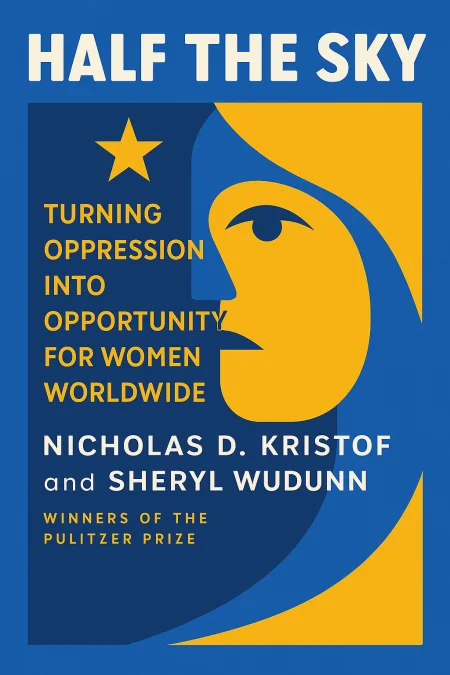
Half the Sky
Turning Oppression into Opportunity for Women Worldwide
byNicholas D. Kristof, Sheryl WuDunn
Book Edition Details
Summary
In a world where injustice often lurks in the shadows, Pulitzer Prize winners Nicholas D. Kristof and Sheryl WuDunn bring to light the fierce courage of women transforming adversity into triumph. "Half the Sky" unveils the heart-wrenching and inspiring stories of women from Africa to Asia who defy the chains of oppression. A Cambodian girl escapes the clutches of sex slavery to become a successful entrepreneur, an Ethiopian woman overcomes childbirth injuries to wield a surgeon's scalpel, and a Zimbabwean mother of five rises to academic prominence. This gripping narrative does more than recount tales of survival; it champions the indomitable spirit of women as the catalyst for global economic change. Kristof and WuDunn argue with passion and clarity that empowering women is not merely a moral imperative but the smartest investment in battling poverty. Essential and urgent, this book challenges each of us to recognize and unleash the untapped potential that lies in half the world's population.
Introduction
The systematic oppression of women worldwide represents one of the most pervasive yet overlooked human rights crises of our time, challenging fundamental assumptions about progress and moral priorities in the twenty-first century. While international attention focuses on terrorism and nuclear proliferation, millions of women face daily violence, trafficking, and death simply because of their gender. This reality exposes a stark contradiction between societies that claim to value human dignity while routinely tolerating practices that would be unconscionable if applied to men. The evidence reveals that gender-based oppression operates not as isolated incidents but as coherent systems of control that correlate directly with economic stagnation, political instability, and social dysfunction. Through examining specific cases across different cultures and contexts, combined with empirical data and personal narratives, a clear pattern emerges demonstrating that women's liberation serves not merely as a moral imperative but as a practical necessity for global development and security. The analysis employs both statistical evidence and individual stories to construct a compelling argument that addressing women's oppression requires understanding its systematic nature and implementing comprehensive solutions that address root causes rather than symptoms.
The Scale of Crisis: Systematic Gender-Based Violence and Oppression Worldwide
Gender-based violence operates on a scale that dwarfs most recognized humanitarian crises, yet remains largely invisible to international attention and resources. More women and girls have been killed in the past fifty years simply because they were female than men died in all the wars of the twentieth century, representing a form of ongoing "gendercide" that the international community has failed to acknowledge or address adequately. This violence takes multiple interconnected forms, each serving to reinforce women's subordinate status within social hierarchies. Sex trafficking enslaves an estimated three million women and girls worldwide, generating billions in profits for criminal networks while destroying countless lives through systematic brutalization. Honor killings claim at least six thousand victims annually, with actual numbers likely far higher due to systematic underreporting and cultural normalization of such practices. Acid attacks have spread across South Asia as a cheap and devastating method of punishment for women who dare assert independence or reject male authority. These practices function not as random acts of individual cruelty but as calculated strategies of social control. The threat of violence shapes women's behavior even when actual violence does not occur, creating climates of fear that restrict movement, education, and economic participation across entire populations. This systematic intimidation represents a form of terrorism specifically targeting half the world's population, yet receives less than one percent of international aid funding despite clear evidence that gender equality drives economic development and political stability. Maternal mortality provides perhaps the starkest indicator of how systematically women's lives are devalued globally. Every minute, a woman dies from preventable complications during pregnancy or childbirth, with lifetime risk of maternal death one thousand times higher in poor countries than wealthy ones. These disparities reflect not inevitable poverty but systematic neglect, as families routinely spend more on veterinary care for livestock than medical care for pregnant women, revealing economic calculations that treat women as expendable resources rather than valuable human beings.
The Solution Framework: Education and Economic Empowerment as Liberation Tools
Education emerges as the most powerful weapon against gender-based oppression, transforming not only individual lives but entire communities through multiplier effects that break cycles of poverty and discrimination across generations. When girls receive schooling, they marry later, have fewer children, earn higher incomes, and invest more heavily in their families' health and education than their uneducated counterparts. Countries that educate girls experience faster economic growth, lower infant mortality, and greater political stability, with East Asia's integration of women into manufacturing driving unprecedented economic expansion that lifted hundreds of millions out of poverty. However, educational access alone proves insufficient without addressing cultural barriers that prevent girls from attending school or completing their studies. Families often view daughters as temporary members who will join their husbands' households, making investment in their education seem economically irrational under existing social structures. Traditional gender roles that confine women to domestic spheres create additional resistance to female education, requiring direct confrontation through community engagement and cultural change initiatives. Microfinance and entrepreneurship programs offer complementary pathways to empowerment by providing women with economic independence and decision-making authority within households. When women control income, they typically invest more in children's health and education than men do, creating positive feedback loops that benefit entire communities over time. These programs achieve highest success rates when combined with education and social support, creating comprehensive approaches to liberation that address both practical needs and cultural constraints simultaneously. The economic evidence proves compelling across multiple contexts and time periods. Women entrepreneurs demonstrate higher loan repayment rates than male borrowers while investing profits more consistently in family welfare and business expansion rather than personal consumption. This pattern reflects not inherent gender differences but social constraints that make women more committed to economic opportunities when they become available, suggesting that systematic investment in women's economic participation generates returns that benefit entire societies rather than zero-sum competition between genders.
The Cultural Debate: Universal Rights versus Traditional Values and Practices
The tension between respecting cultural diversity and upholding universal human rights creates complex challenges for addressing gender-based oppression, with critics arguing that intervention constitutes cultural imperialism that fails to respect non-Western societies' autonomy and authentic values. This relativist position suggests that practices such as arranged marriage, restrictions on women's mobility, or traditional gender roles reflect legitimate cultural choices that outsiders should not judge or attempt to change through external pressure or resource allocation. However, this perspective encounters significant problems when examined closely through historical and contemporary evidence. Many practices justified as cultural traditions actually represent relatively recent developments or reflect power structures that benefit specific groups rather than expressing authentic community values. The voices of women within these societies often reveal significant dissent from supposedly traditional practices, suggesting that cultural arguments frequently serve to silence rather than represent genuine community perspectives or democratic decision-making processes. Historical precedents demonstrate that cultural practices can change rapidly when underlying economic and social conditions shift, without societies losing essential identity or continuity. China's transformation from a society practicing foot-binding and female infanticide to one where women participate extensively in education and economic life occurred within decades rather than centuries. Similarly, many Western societies abandoned restrictive practices regarding women's property rights, political participation, and professional opportunities relatively recently in historical terms. The most compelling argument for universal human rights standards rests not on cultural superiority claims but on practical outcomes that benefit everyone within societies. Countries that have moved toward greater gender equality consistently demonstrate improved economic performance, political stability, and social welfare compared to those maintaining restrictive practices. These improvements benefit men as well as women, suggesting that gender equality serves universal human interests rather than representing cultural imperialism or zero-sum competition between different value systems or demographic groups.
The Implementation Strategy: Building Coalitions for Sustainable Global Change
Effective change requires coordinated action at multiple levels, from individual advocacy to international policy reform, with particular emphasis on grassroots initiatives that build local ownership and long-term sustainability rather than dependence on external resources. The most successful interventions combine outside funding and expertise with indigenous leadership and community engagement, avoiding top-down approaches that impose solutions without understanding local contexts or building genuine commitment to change among affected populations. Religious traditions, while sometimes used to justify women's subordination, also contain powerful resources for promoting equality and justice that can be mobilized through strategic coalition-building. Many of the most effective programs supporting women operate under religious auspices, particularly in remote areas where secular organizations fear to venture or lack cultural credibility. Catholic Relief Services, Islamic charities, and evangelical missions provide healthcare, education, and social services to millions of women who would otherwise have no support systems or advocacy. The key lies in finding common ground around shared values of human dignity and social justice rather than engaging in ideological debates about gender roles or cultural authenticity. Both religious and secular advocates oppose sex trafficking, support maternal health improvements, and recognize the importance of education for human development. These areas of agreement provide foundations for cooperation that can transcend ideological differences while maintaining focus on practical outcomes that improve women's lives regardless of cultural context. Historical precedents demonstrate the power of such alliances in creating social change that seemed impossible before broad coalitions formed around shared moral convictions. The nineteenth-century abolitionist movement succeeded by uniting religious conservatives and secular liberals around the conviction that slavery was morally wrong, despite significant disagreements about other social and political issues. Similarly, the movement for women's rights must bridge ideological divides to create the political momentum necessary for systemic change, requiring mutual respect, strategic pragmatism, and focus on concrete goals rather than abstract theoretical positions.
Summary
The systematic oppression of women represents not merely a humanitarian crisis but a fundamental obstacle to human progress that constrains economic development, political stability, and social welfare for entire societies rather than affecting only female populations. The evidence overwhelmingly demonstrates that societies investing in women's education, healthcare, and economic participation experience accelerated development across multiple indicators, while those maintaining restrictive practices remain trapped in cycles of poverty and instability despite natural resource wealth or strategic advantages. The path forward requires sustained commitment to comprehensive solutions that address root causes through education, economic empowerment, and healthcare access, supported by broad coalitions that transcend traditional political and religious boundaries through focus on shared values and practical outcomes. Only through such coordinated efforts can the world address what represents perhaps the paramount moral challenge of our century, with implications extending far beyond gender equality to encompass fundamental questions about human dignity, social justice, and the kind of global civilization humanity chooses to build for future generations.
Related Books
Download PDF & EPUB
To save this Black List summary for later, download the free PDF and EPUB. You can print it out, or read offline at your convenience.
By Nicholas D. Kristof
