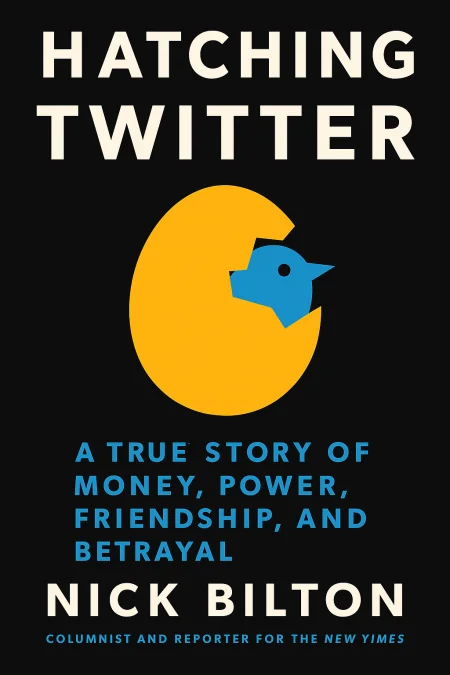
Hatching Twitter
A True Story of Money, Power, Friendship, and Betrayal
Book Edition Details
Summary
In the bustling heart of Silicon Valley, where innovation often comes at a cost, the dramatic rise of Twitter unfolds—a saga of ambition, betrayal, and relentless pursuit of influence. Within a mere six years, a quartet of visionary minds—Biz Stone, Evan Williams, Jack Dorsey, and Noah Glass—transformed a faltering podcasting venture into a $11.5 billion behemoth, reshaping global communication and media. As fame and fortune beckoned, friendships fractured under the weight of power struggles and public adulation, all captured with piercing insight by Nick Bilton. Through meticulous research and unprecedented access, "Hatching Twitter" reveals not just the rollercoaster journey of these tech titans but the seismic impact of their creation, a tool powerful enough to topple governments and redefine the digital age. This is the untold story of Twitter's meteoric ascent and the human drama that fueled it.
Introduction
In the span of just a few years, a simple idea born from a group of friends working at a failing podcasting company would transform into one of the most influential platforms in human history. The story of Twitter's creation and the subsequent battles for its control reads like a modern-day Shakespearean tragedy, filled with brilliant minds, fierce ambitions, and devastating betrayals. At its heart are four unlikely protagonists: Ev Williams, the Nebraska farm boy turned serial entrepreneur; Jack Dorsey, the quiet programmer with dreams of grandeur; Biz Stone, the eternally optimistic idealist; and Noah Glass, the passionate dreamer whose contributions would be systematically erased from history. What began as a collaborative effort among friends to save their dying company became an epic power struggle that would see each founder rise and fall in dramatic fashion. Their personal conflicts and competing visions didn't just shape Twitter itself, but influenced how billions of people communicate, consume news, and express themselves in the digital age. This is a tale that reveals how revolutionary technologies emerge not from boardrooms or grand strategic plans, but from the messy intersection of human ambition, creative collaboration, and the relentless pursuit of relevance in Silicon Valley's unforgiving ecosystem. Through their triumphs and betrayals, we witness the birth pangs of the social media revolution and the very human cost of building something that would change the world.
The Founding Alliance: Four Dreamers and a Billion-Dollar Idea
The origins of Twitter trace back to the unlikely convergence of four distinct personalities at Odeo, a struggling podcasting company in San Francisco's South Park neighborhood. Evan Williams arrived as the seasoned entrepreneur, having already sold Blogger to Google for millions. His Nebraska farm upbringing had instilled in him a methodical approach and unwavering determination, though his tendency toward indecision would later prove costly. Jack Dorsey joined as a contract programmer, a quiet figure who had overcome childhood speech impediments to become fascinated with dispatch systems and status updates. His early notebooks contained sketches for what would eventually become Twitter's core concept. Biz Stone brought an infectious optimism and moral compass that would define Twitter's early ethical stance. Having left millions in Google stock options on the table to follow Ev, Biz represented the idealistic side of Silicon Valley entrepreneurship. Meanwhile, Noah Glass served as the company's energetic catalyst, the one who could translate technical concepts into human connections. It was Noah who coined the name "Twitter" after flipping through dictionary pages, settling on a word that captured the essence of brief, bird-like communications. The crucial moment came during a company hackathon in early 2006, when these four minds collaborated to transform Jack's status update concept into something revolutionary. Where Jack envisioned a utility for sharing personal activities, Ev saw the potential for a news and information network. Noah understood its power to combat loneliness and create connections, while Biz grasped its democratic potential to give everyone an equal voice. Their different perspectives created the perfect storm of functionality. What made their early collaboration so powerful was how their individual weaknesses became collective strengths. Jack's technical vision needed Noah's human insight and naming genius. Ev's business acumen required Biz's ethical grounding and communication skills. Together, they created something none could have achieved alone, transforming a simple idea about status updates into a platform that would facilitate revolutions, break news faster than traditional media, and fundamentally alter human communication. Their friendship and shared mission in those early days represented Silicon Valley idealism at its finest, before ambition and ego would tear them apart.
Rise and Fall: Jack's Ascent to Power and Inevitable Downfall
Jack Dorsey's journey from quiet programmer to Twitter's first CEO embodied both the promise and peril of Silicon Valley's rapid ascent culture. Initially hired as a contractor at Odeo, Jack's methodical programming skills and unique vision for status-based communication quickly earned him recognition among the chaotic collective of hackers and idealists. When Twitter emerged from the company's hackathon, Jack naturally assumed leadership of the technical development, transforming his childhood fascination with dispatch systems into a real-time communication platform. His appointment as CEO in 2007 came almost by default rather than design. With Noah pushed out due to personality conflicts and Ev preferring to focus on his broader vision through Obvious Corporation, Jack found himself thrust into a role for which he was temperamentally and experientially unprepared. The boy who had once struggled to communicate was suddenly responsible for leading a rapidly growing company through its most critical phase. His management style reflected his introverted nature, often appearing distant and indecisive when bold leadership was desperately needed. The challenges that would ultimately doom Jack's tenure were both technical and personal. Twitter's explosive growth following the 2007 South by Southwest conference exposed the platform's fragile infrastructure, leading to constant outages that became the company's defining characteristic. The infamous "Fail Whale" became a symbol not just of Twitter's technical struggles, but of Jack's inability to scale both the product and the organization. His tendency to pursue side interests like fashion design and yoga classes while the company burned created resentment among employees and investors who expected total dedication. Perhaps more damaging than his management deficiencies was Jack's fundamental disagreement with Ev about Twitter's purpose and direction. While Jack remained focused on personal status updates and mobile functionality, Ev pushed for a more news-oriented, web-centric approach. Their philosophical divide reflected deeper questions about whether Twitter should remain a intimate communication tool or evolve into a global information network. By 2008, as technical failures mounted and revenue remained nonexistent, Jack's position had become untenable. His firing by the board marked not just the end of his first act as a tech CEO, but the beginning of a bitter rivalry with Ev that would define Twitter's internal politics for years to come.
The Coup: Ev's Reign and the Boardroom Betrayals
Ev Williams's ascension to CEO represented Twitter's evolution from scrappy startup to serious business, but his reign would be marked by the same interpersonal dynamics that had plagued the company from its inception. Taking control in late 2008, Ev brought the management experience Jack lacked, having previously built and sold Blogger to Google. His vision for Twitter as a news and information platform rather than merely a status update service began to reshape the product, changing the fundamental question from "What are you doing?" to "What's happening?" This shift reflected Ev's deeper understanding of Twitter's potential to democratize information sharing. Under Ev's leadership, Twitter began to demonstrate its world-changing power. The platform played crucial roles in the 2008 presidential election, the Iranian Green Revolution, and countless other global events. When Ev appeared on Oprah Winfrey's show to help the media mogul send her first tweet, Twitter officially entered mainstream consciousness. The platform's growth exploded, reaching hundreds of millions of users and establishing itself as an essential communication infrastructure for governments, celebrities, and ordinary citizens alike. Yet Ev's success as a product visionary couldn't mask his fundamental weaknesses as a CEO. His notorious indecision, stemming from traumatic experiences with his first failed startup in Nebraska, paralyzed important business decisions. His preference for hiring friends rather than experienced executives created a culture of loyalty but limited professional capability. Most critically, his focus on product development came at the expense of revenue generation, leaving Twitter burning through investment money without a clear path to profitability. The conspiracy that ultimately removed Ev was orchestrated by the very people he had trusted most. Jack, nursing his wounds from being fired, began a sophisticated campaign to turn board members and senior executives against Ev. Using his network of relationships and his growing public profile as Twitter's "founder," Jack whispered concerns about Ev's leadership to anyone who would listen. When board members like Peter Fenton and investors like Fred Wilson began hearing complaints from multiple sources, they concluded that Ev had to go. The brutal boardroom coup that followed revealed the depths of Silicon Valley's ruthless ambition, as former friends became enemies in the pursuit of power and control over one of the world's most influential platforms.
New Leadership: Dick's Era and the Corporate Transformation
Dick Costolo's unexpected rise to CEO marked Twitter's final transformation from chaotic startup to corporate powerhouse, though his path to leadership was anything but conventional. A former Second City comedian turned serial entrepreneur, Dick brought a unique combination of business acumen and interpersonal skills that Twitter desperately needed. His background in improv comedy proved surprisingly valuable in navigating the complex personalities and competing egos that had defined Twitter's early culture. When he famously joked in his first tweet as COO that his task would be to "undermine CEO, consolidate power," few realized how prophetic those words would prove. The circumstances of Dick's promotion revealed the Byzantine nature of Twitter's internal politics. Though he had been positioned as interim CEO following Ev's ouster, the role only became permanent after a dramatic weekend of negotiations that saw Biz Stone literally fighting for Ev's professional survival. Dick's reluctance to appear complicit in Ev's downfall demonstrated the ethical complexities facing Silicon Valley executives caught between friendship and business necessity. His eventual acceptance of the permanent CEO role came with the understanding that he would need to complete Twitter's evolution from idealistic platform to profitable enterprise. Under Dick's leadership, Twitter finally achieved the stability and profitability that had eluded his predecessors. The constant site outages that had plagued the Jack and Ev eras were eliminated through massive infrastructure investments. More importantly, Dick successfully monetized the platform through advertising innovations like promoted tweets, transforming Twitter from a money-losing experiment into a billion-dollar business generating hundreds of millions in annual revenue. His corporate background enabled him to professionalize the organization, implementing the management structures and processes necessary for a company preparing for public offering. Perhaps Dick's greatest achievement was managing the return of Jack Dorsey while maintaining organizational stability. Jack's re-emergence as Executive Chairman represented both vindication for the ousted founder and a potential threat to Dick's authority. By carefully managing Jack's public profile while limiting his operational influence, Dick demonstrated the political sophistication necessary to lead in Silicon Valley's ego-driven environment. His success in balancing these competing forces while driving Twitter toward its IPO established him as the adult supervision the company had always needed, even as the founders who created the platform faded into supporting roles in their own creation's story.
Summary
The story of Twitter's founding and early years serves as a cautionary tale about the human cost of building revolutionary technology in Silicon Valley's pressure-cooker environment. What began as a collaborative effort among friends to save their failing company ultimately destroyed most of those relationships, revealing how the pursuit of power and recognition can corrupt even the most idealistic ventures. The platform that was designed to connect people and combat loneliness ended up isolating its own creators, with each founder experiencing betrayal, exile, or displacement in their own creation's success story. The Twitter wars demonstrate that truly transformative technologies emerge not from individual genius but from the complex interplay of diverse perspectives, competing visions, and collaborative innovation. Jack's technical insights needed Noah's human understanding and naming brilliance, just as Ev's business experience required Biz's moral compass and communication skills. Their individual limitations became collective strengths until ambition and ego drove them apart. For aspiring entrepreneurs and anyone seeking to understand how revolutionary ideas become world-changing platforms, the Twitter story offers both inspiration and warning: the very human drama behind technological innovation reveals that success often comes at the price of the relationships that made it possible in the first place.
Related Books
Download PDF & EPUB
To save this Black List summary for later, download the free PDF and EPUB. You can print it out, or read offline at your convenience.
By Nick Bilton
