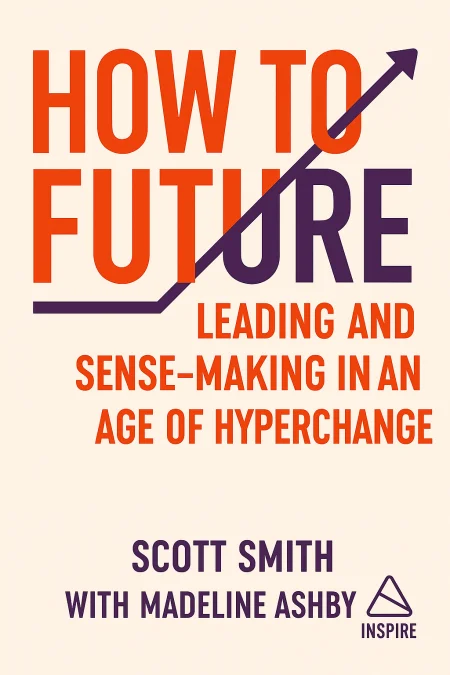
How to Future
Leading and Sense-making in an Age of Hyperchange
Book Edition Details
Summary
In the unpredictable whirl of today's business landscape, where tomorrow's trends threaten today's strategies, "How to Future" emerges as a beacon for the proactive mind. This groundbreaking guide, crafted by visionary futurists Scott Smith and Madeline Ashby, shatters the myth of a singular destiny, offering instead a kaleidoscope of possible tomorrows. With their insights, you won't just brace for change—you'll master it. Learn to decode the torrent of daily information into actionable foresight, crafting adaptable, resilient strategies. As businesses stand on the precipice between relevance and obsolescence, this book equips you to not just survive the tides of change, but to navigate them with confidence and clarity. Prepare to redefine what it means to anticipate and thrive in a world that refuses to stand still.
Introduction
In our rapidly changing world, uncertainty has become the only constant. From technological disruptions reshaping entire industries to climate challenges demanding immediate action, we find ourselves navigating uncharted territory daily. Traditional planning methods that worked for previous generations now feel inadequate when faced with exponential change and complex global interconnections. The future no longer unfolds predictably from the present, leaving many individuals and organizations feeling reactive rather than proactive. Yet within this seeming chaos lies tremendous opportunity. The same forces creating uncertainty also open doorways to innovation, transformation, and meaningful impact. The key is developing the capacity to sense emerging patterns, explore multiple possibilities, and craft strategies that remain robust across different potential futures. This isn't about predicting what will happen, but rather building the skills to thrive regardless of which future emerges. By learning to future effectively, we transform from passive observers into active architects of the world we want to create.
Sensing and Scanning: Finding Signals of Change
Sensing represents our fundamental capacity to notice meaningful shifts in the world around us, while scanning provides the systematic framework to capture and organize these observations. Together, they form the foundation of effective futuring by helping us detect early indicators of change before they become obvious to everyone else. Consider the story of a global pharmaceutical company exploring the future of wellbeing in 2016. Their research team initially focused on traditional digestive health trends, examining in-market products and established consumer behaviors. However, their scanning process revealed an unexpected signal: the emerging legalization of marijuana across various state legislatures. While this trend seemed disconnected from their core business, the team recognized it as a potential game-changer that could fundamentally alter how consumers approached wellness and where they allocated their spending. At first, this insight met internal resistance. The connection between cannabis legalization and digestive health wasn't immediately apparent to stakeholders focused on conventional pharmaceutical development. Yet by late 2019, marijuana-related wellness products had become a significant force in the world's largest consumer health market, validating the early signal detection. This transformation occurred because the scanning team maintained what the authors call "active noticing" - a continuous state of awareness that captures both obvious and peripheral signals of change. To develop effective sensing capabilities, begin by diversifying your information diet beyond industry-specific sources. Allocate time daily for scanning across different domains - technology blogs, cultural publications, policy updates, and even entertainment trends. Create simple systems for capturing interesting observations, whether through bookmarking tools or shared team documents. Most importantly, practice the art of connecting seemingly unrelated dots, asking yourself how emerging patterns in one domain might influence your areas of focus. Remember that sensing and scanning require patience and persistence. Not every signal will prove significant, but developing this muscle memory for noticing change positions you to recognize important shifts before they become conventional wisdom.
Mapping Possibilities: From Trends to Strategic Stories
Mapping transforms scattered observations into coherent pictures of possible futures by organizing trends across dimensions of time, certainty, and impact. This process moves us from simply collecting information to understanding the relationships and patterns that shape tomorrow's landscape. The power of mapping becomes clear in Changeist's work with media giant Comcast's VIPER team in 2018. Initially tasked with exploring the future of internet protocol video over a 10-15 year horizon, the project's scope expanded dramatically as the team recognized the interconnected nature of media consumption. Their mapping exercise revealed that understanding video's future required examining everything from interior design trends to climate change impacts on living environments, from gambling behaviors to real estate development patterns. This broad approach initially surprised the technical engineering team. How could housing trends possibly relate to video protocol development? The mapping process revealed these connections by plotting trends across different time horizons and certainty levels. Near-term shifts in home media consumption patterns connected to medium-term changes in real estate development, which in turn influenced long-term infrastructure investment decisions. What emerged was a rich landscape of five distinct narrative threads, each representing different pathways for how video consumption might evolve based on broader societal changes. To create your own strategic maps, start by plotting your collected trends across three time horizons relevant to your context. Place each trend according to your assessment of its timing and probability, creating a visual representation of your future landscape. Look for gaps in your map - empty spaces often indicate areas requiring deeper research or assumption-challenging. Most importantly, resist the temptation to force trends into neat, predetermined categories. Let unexpected connections emerge naturally as you work with the materials. The goal isn't creating perfect predictions but rather developing a sufficiently rich picture of possibilities to inform better decision-making in the present. Your map becomes a living document that evolves as new information emerges and circumstances change.
Prototyping Futures: Making Tomorrow Tangible
Prototyping transforms abstract future scenarios into concrete experiences that others can engage with, debate, and refine. By creating tangible representations of possible tomorrows, we move beyond intellectual exercises into emotionally resonant explorations that drive meaningful action. The International Federation of Red Cross and Red Crescent Societies discovered this power when exploring humanitarian challenges of 2030. Rather than producing another analytical report, the team developed the "DyNaMo" scenario - a speculative system providing temporary digital citizenship for climate refugees. The concept emerged from signals of increasing climate displacement combined with trends in digital governance, inspired by Estonia's successful e-citizen programs. The breakthrough came when they prototyped physical artifacts representing this future system. Working with designer Sjef van Gaalen, they created identity documents, operational manuals, and processing equipment that refugees and aid workers might actually use. These weren't polished marketing materials but authentic-feeling objects that conveyed both the promise and complexity of such a system. When humanitarian professionals encountered these prototypes, their responses revealed insights impossible to capture through surveys or interviews alone. One aid worker examining the digital identity scanner immediately raised concerns about power availability in emergency situations. Another questioned the psychological impact on displaced persons of receiving temporary rather than permanent status. These weren't abstract policy debates but visceral responses to tangible representations of lived experience. The prototypes succeeded in making an imaginary future feel real enough to generate authentic reactions and useful feedback. To prototype your own futures, start by identifying specific situations within your broader scenarios where people would interact with new systems, services, or experiences. Focus on everyday moments rather than dramatic scenes - mundane interactions often reveal more profound insights. Create simple representations using available materials: mock-up forms, instruction manuals, website screenshots, or even role-playing scenarios. Remember that effective prototypes raise questions rather than provide answers. They serve as conversation starters that help diverse stakeholders explore implications and possibilities together.
Building Futuring Culture: Leading Change Forward
Building sustainable futuring capabilities requires more than mastering individual tools - it demands cultivating organizational cultures that embrace uncertainty as creative material rather than threat. This cultural transformation happens through consistent practice, expanded participation, and demonstrated value over time. The transformation becomes visible through subtle but important shifts in organizational behavior. When Scott Smith received a recruiter's call about a corporate futurist position, the conversation revealed how traditional metrics fail to capture futuring's value. The recruiter asked, "How many predictions have you gotten right?" - a question that fundamentally misunderstood the practice. Futuring's impact appears in framing better conversations, driving strategic discussions, seeding organizational agility, and expanding collective imagination about what's possible. Global retail giant ASOS demonstrated this cultural approach during their 2018 employee gathering in London. Rather than limiting futures thinking to senior strategists, they created six conversation forums exploring major themes - globalization, work, experience, technology, and communication - accessible to over a thousand employees across all functions. These weren't training sessions but engaging dialogues that gave frontline staff language and frameworks for recognizing future-relevant signals in their daily work. The results extended far beyond the event itself. Employees returned to their global roles with heightened awareness of emerging patterns and permission to surface future-oriented insights in regular business discussions. Customer service representatives began noticing changing consumer communication preferences. Warehouse staff identified efficiency innovations inspired by automation trends. Marketing teams connected cultural shifts with campaign strategies. The organization's collective sensing capacity expanded exponentially. To build futuring culture in your context, start by creating regular opportunities for speculation and exploration. This might mean dedicating agenda time in meetings for "what if" discussions, establishing informal scanning networks among colleagues, or simply encouraging questions about long-term implications of current decisions. Celebrate examples of successful anticipation while normalizing the reality that not every exploration yields immediate results. Most importantly, model the behavior you want to see. Share interesting signals you've discovered, openly discuss uncertainties you're tracking, and invite others to contribute their own observations and insights. Futuring culture grows through practice and participation, not through mandate or formal training alone.
Summary
The future belongs not to those who predict it, but to those who actively shape it through informed imagination and strategic action. As the authors remind us, "If you see a better world, you are morally obligated to go and make it happen." This isn't merely an inspirational sentiment but a practical imperative for our times. By developing capabilities in sensing emerging patterns, mapping possibilities, prototyping tangible experiences, and building cultures of anticipatory thinking, we transform from passive recipients of whatever future emerges to active architects of the world we want to inhabit. The tools and frameworks presented here offer a pathway from reactive confusion to proactive engagement with uncertainty. Yet their ultimate power lies not in their technical application but in their capacity to expand our collective imagination about what's possible. In a world facing unprecedented challenges - from climate change to technological disruption to social transformation - we desperately need more people equipped with the skills and confidence to envision and work toward better futures. Start today by choosing one trend that intrigues you, one scenario that challenges you, or one prototype that could spark meaningful conversation. The future is waiting for your contribution.
Related Books
Download PDF & EPUB
To save this Black List summary for later, download the free PDF and EPUB. You can print it out, or read offline at your convenience.
By Scott Smith
