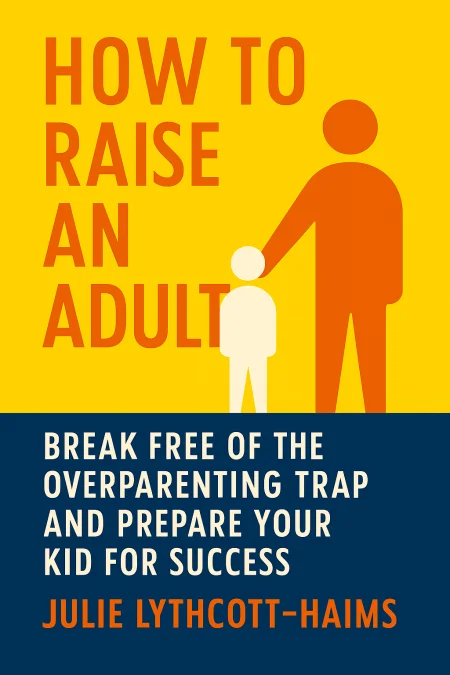
How to Raise an Adult
Break Free of the Overparenting Trap and Prepare Your Kid for Success
Book Edition Details
Summary
Parenting in the modern age demands a recalibration, and Julie Lythcott-Haims delivers just that with her transformative blueprint in "How to Raise an Adult." She peels back the layers of helicopter parenting to reveal its unintended consequences, not just on children but on a frayed societal fabric. Through keen observations and extensive research, Lythcott-Haims champions a liberating parenting style that encourages children to stumble, learn, and ultimately thrive on their own terms. This manifesto doesn't merely criticize; it offers a compelling roadmap to cultivate resilience and self-reliance in the next generation. A compelling read for those yearning to nurture capable, confident adults, this book is a clarion call for change—a gentle reminder that true growth often sprouts from the cracks of imperfection.
Introduction
Picture a summer afternoon in 1975: children pour out of houses after lunch, disappearing into neighborhoods for hours of unsupervised adventure. They climb trees, explore construction sites, and settle disputes without adult intervention. Now imagine today's carefully orchestrated playdates, GPS-tracked teenagers, and parents calling college professors about grades. This dramatic transformation represents one of the most profound shifts in child-rearing philosophy in modern American history. This exploration reveals how a perfect storm of cultural fears, safety obsessions, and educational pressures created what we now call helicopter parenting. We'll uncover the specific moments when stranger danger became a national fixation, when academic achievement transformed into an arms race, and when protecting children from failure became more important than teaching them resilience. The story challenges our assumptions about what children need to thrive and forces us to confront an uncomfortable truth: in our quest to give our children everything, we may have taken away the very experiences that build character and confidence. This journey through recent history speaks to parents questioning current approaches, educators witnessing the effects firsthand, and anyone curious about how childhood became so structured and fearful. Whether you're seeking to understand the forces that shaped modern parenting or looking for a path toward raising more resilient children, this story illuminates how we arrived at this moment and points toward a different way forward.
The Golden Age of Independence: American Childhood Before 1980
Before the safety revolution of the 1980s, American childhood operated on fundamentally different principles. Children enjoyed what seems almost unimaginable today: genuine independence. The typical child of the 1970s spent entire Saturday mornings building forts in vacant lots, riding bicycles through neighborhoods, or simply reading on back steps. Parents operated on a philosophy of benign neglect, trusting that children would learn essential life skills through trial and error. When problems arose between children, adults expected them to work things out themselves. This approach wasn't born from indifference but from a deep belief that independence was a gift parents gave their children. The educational landscape reflected this philosophy as well. Homework was manageable, allowing time for play and family dinners. Extracurricular activities existed but didn't dominate family calendars. Children participated in sports for enjoyment rather than college admission strategies. The pressure to excel was present but balanced with an understanding that childhood itself had value beyond preparation for the next achievement level. This era produced a generation that learned to solve problems independently, cope with disappointment, and develop what psychologists call self-efficacy. These children grew up with fundamental confidence that they could figure things out, make mistakes, and recover. They developed street smarts, social skills, and resilience through direct experience rather than adult instruction. The foundation was laid for individuals who could navigate life's challenges with internal resources rather than external support. Little did anyone know that this childhood model was about to undergo a radical transformation. The seeds of change were already germinating in the cultural anxieties and shifting demographics that would soon reshape American family life for decades to come.
Seeds of Change: The Safety Revolution of the 1980s
The transformation began with tragedies that would fundamentally alter how Americans viewed childhood safety. In 1981, six-year-old Adam Walsh was abducted and murdered, a horrific crime that became the subject of a 1983 television movie watched by 38 million Americans. This single event catalyzed a national obsession with child safety that continues to shape parenting decisions today. The response was swift and comprehensive, creating a new landscape of fear that would define the next generation's childhood experience. Missing children's faces began appearing on milk cartons, creating daily reminders of potential danger. John Walsh successfully lobbied Congress to establish the National Center for Missing and Exploited Children in 1984. Television shows like America's Most Wanted brought the threat of stranger danger into living rooms across the country. Despite statistical evidence showing that stranger abduction remained extraordinarily rare, the perception of danger became the new reality for American parents. Simultaneously, the 1983 report A Nation at Risk declared American education inadequate compared to international competitors. This sparked an academic arms race that would intensify over the following decades. Parents began to worry that their children weren't working hard enough, weren't competitive enough, weren't prepared enough for an increasingly challenging world. The solution seemed obvious: more structure, more supervision, more intervention. The decade also witnessed the birth of the playdate around 1984, initially a practical solution for working parents but eventually a symbol of how play itself became scheduled and supervised. What had once been spontaneous neighborhood adventures transformed into carefully orchestrated activities. The self-esteem movement gained momentum, promoting the idea that children's feelings needed constant protection and validation. These seemingly separate developments converged to create a new parenting paradigm that would reshape childhood itself.
The Perfect Child Project: The College Arms Race Era
By the 1990s and 2000s, American parenting had evolved into something resembling high-stakes project management. The baby boom generation, having questioned authority in their youth, now applied that same intensity to their children's development. Every aspect of childhood became optimized for future college admission success, creating what can only be described as a checklisted childhood where spontaneity gave way to strategic planning. Parents began treating their children's development like carefully orchestrated campaigns. Preschool selection became competitive. Elementary school grades carried weight for middle school placement. Middle school performance determined high school track placement. Every homework assignment, every extracurricular activity, every summer experience was evaluated through the lens of college admission potential. The message to children was clear: there was one path to success, and deviation from that path meant failure. The rise of the internet and parent portals allowed unprecedented monitoring of children's academic progress. Parents could check grades daily, communicate directly with teachers, and intervene at the first sign of difficulty. What had once been the child's responsibility became parental territory. Children learned that adults would handle life's challenges for them, creating a generation skilled at following directions but struggling with independent decision-making. Sports became another arena for intensive cultivation. Children specialized in single sports at younger ages, trained year-round, and competed for elite team positions that might lead to college scholarships. The joy of play gave way to the pressure of performance. Parents invested thousands of dollars in coaching and travel, viewing it as investment in their child's future rather than childhood enjoyment. This era produced children who looked impressive on paper but often lacked the internal compass necessary for independent navigation.
Breaking Point: Mental Health Crisis and the Need for Reform
The consequences of intensive parenting began manifesting in alarming ways as the first generation of helicoptered children reached college campuses in the late 1990s and early 2000s. College counseling centers reported unprecedented demand for mental health services. Students arrived academically accomplished but emotionally fragile, struggling with anxiety, depression, and an inability to cope with normal life challenges without parental intervention. The generation that had been most protected was also the most anxious in recent history. The statistics painted a troubling picture. By 2013, 95 percent of college counseling directors reported growing numbers of students with significant psychological problems. Nearly a third of college students reported feeling so depressed it was difficult to function. The correlation between intensive parenting and poor mental health outcomes became impossible to ignore. Simultaneously, employers began reporting concerns about young workers who seemed incapable of independent problem-solving or resilience in the face of setbacks. The breaking point came when communities began confronting teen suicide clusters, often in the most affluent, high-achieving school districts. The pressure to be perfect, combined with the inability to cope with imperfection, created a toxic environment for adolescent development. Parents who had sacrificed everything for their children's success found themselves facing the ultimate failure: children who couldn't find meaning or joy in their accomplished lives. This crisis forced a reckoning with fundamental assumptions about child development and parenting effectiveness. Research began demonstrating that children needed struggle, failure, and independence to develop psychological resilience. The very experiences that helicopter parents worked so hard to prevent were revealed as essential for healthy development. The stage was set for a new understanding of what children actually need to thrive, pointing toward approaches that honor both safety and autonomy.
Summary
The transformation of American childhood from independence to intensive management represents one of the most significant cultural shifts of the late twentieth century. What began as understandable responses to perceived threats evolved into a parenting philosophy that prioritized short-term protection over long-term development. The result has been a generation of young adults who excel at following directions but struggle with the independence, resilience, and self-efficacy that adulthood requires. This historical journey reveals a fundamental tension between love and trust. Parents' fierce love for their children led them to intervene, protect, and manage in ways that ultimately undermined their children's development of essential life skills. The irony is profound: in trying to ensure their children's success, parents created conditions that made genuine success more difficult to achieve. The path forward requires reclaiming trust in children's capacity for growth through challenge and failure. Moving ahead demands that parents step back not because they love their children less, but because they love them enough to let them develop the skills they'll need for a lifetime of independence. The goal isn't to return to the 1970s but to find a balance that honors both safety and autonomy, both support and independence. Success must be redefined to include not just achievements but the character, resilience, and capability that emerge when children are trusted to navigate their own growth and learning.
Related Books
Download PDF & EPUB
To save this Black List summary for later, download the free PDF and EPUB. You can print it out, or read offline at your convenience.
By Julie Lythcott-Haims
