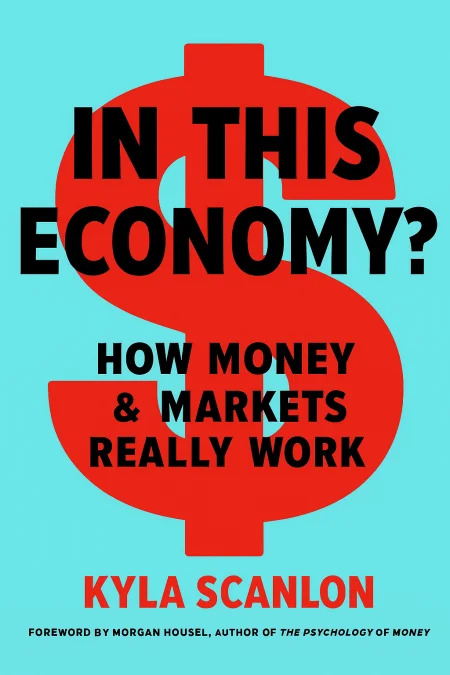
In This Economy?
How Money & Markets Really Work
Book Edition Details
Summary
In the chaotic carnival of modern economics, Kyla Scanlon emerges as the ultimate ringmaster, guiding us through the perplexing spectacle with flair and insight. "In This Economy?" demystifies the jargon and myths that cloud our understanding of financial systems, offering a refreshing lens through which to view topics like national debt, recessions, and employment markets. With a blend of sharp illustrations and clever analogies, Scanlon challenges outdated assumptions and invites readers to rethink the very fabric of economic thought. This book isn't just a guide—it's a manifesto for navigating the intricate dance of money and markets with confidence and clarity. Whether you're baffled by bank rates or puzzled by political headlines, Scanlon's engaging style promises to enlighten and entertain, making complex concepts accessible to all.
Introduction
Picture this: you're standing in line at a coffee shop, card in hand, about to pay $5 for a latte that cost $3 just two years ago. As you swipe your card, a small knot forms in your stomach—not from caffeine anticipation, but from a nagging sense that something fundamental has shifted in the world around you. You're not alone in this feeling. Millions of people wake up each day to headlines about inflation, recession fears, housing crises, and market volatility, yet feel disconnected from the abstract numbers and jargon-filled explanations that dominate economic discourse. This disconnect between lived experience and economic reality has become one of the defining challenges of our time. We're told the economy is "strong" based on certain metrics, yet struggle to afford basic necessities. We hear about record corporate profits while wages feel stagnant. We witness unprecedented government spending and wonder about the long-term consequences for our financial future. The truth is, economics isn't just about charts and formulas—it's about people. It's about the hopes and fears that drive our financial decisions, the stories we tell ourselves about money, and the very human emotions that ultimately shape markets and policy. Understanding this human dimension of economics isn't just intellectually satisfying; it's essential for navigating an increasingly complex financial world and making informed decisions about our personal and collective future.
The Vibe Economy: How Feelings Drive Financial Reality
Sarah stared at her phone, scrolling through news headlines about soaring gas prices and inflation fears. Even though her job was secure and her finances relatively stable, an uncomfortable anxiety settled in her chest. Without fully realizing it, she began making small changes—skipping the weekly dinner out, postponing that vacation booking, choosing generic brands at the grocery store. Sarah wasn't responding to her actual financial situation; she was responding to a feeling, a vibe about where the economy was heading. This phenomenon extends far beyond individual behavior. When millions of people like Sarah simultaneously shift their spending patterns based on economic sentiment rather than personal financial reality, they create what becomes known as a "vibecession"—a period where the economy feels bad even when traditional metrics suggest it's performing adequately. Consumer confidence surveys reveal stark gaps between how people feel about the current situation versus their expectations for the future, creating a psychological drag on economic activity that can become self-fulfilling. The power of collective sentiment becomes evident when we examine how expectations shape outcomes. If people believe inflation will rise, they hurry to make purchases before prices increase further, inadvertently driving up demand and contributing to the very inflation they feared. Similarly, when workers expect prices to keep rising, they demand higher wages, which can prompt companies to raise prices to cover increased labor costs, creating a feedback loop that reinforces the original concern. What emerges is a recognition that economics operates as much on psychology as on mathematics. The "vibes" of an economy—the collective emotional response to financial conditions—don't just reflect economic reality; they actively shape it. Markets rise and fall on sentiment, consumer behavior shifts with mood, and policy decisions must account for both data and the human stories behind the numbers. Understanding this emotional dimension of economics helps explain why expert predictions often miss the mark and why solutions require addressing not just technical problems, but the feelings and perceptions that drive economic behavior.
The Mechanics of Money: From Banking to Bonds
When Maria deposited her paycheck at the local bank, she assumed her money would simply sit there waiting for her next withdrawal. But within hours, her $1,000 deposit had become part of an intricate financial dance that would touch lives across the country. The bank kept $100 in reserve and promptly lent out $900 to Tom, who needed a small business loan for his food truck. Tom used that money to buy equipment from Jennifer's restaurant supply company, who then deposited the payment into her own bank account, where the process began anew. This multiplication of money through fractional reserve banking represents one of the most fundamental yet misunderstood aspects of our financial system. Banks don't simply store money like digital vaults; they're active creators of purchasing power, transforming deposits into loans and loans into new deposits in an endless cycle. The Federal Reserve influences this process through tools that most people never see—adjusting reserve requirements, buying and selling government securities, and setting benchmark interest rates that ripple through every corner of the economy. The elegance and fragility of this system became apparent during recent banking crises, when Silicon Valley Bank collapsed partly because it failed to hedge against interest rate risk. As the Federal Reserve raised rates to combat inflation, the bank's bond holdings lost value, creating losses that ultimately sparked a digital-age bank run when nervous customers withdrew billions in deposits through their smartphones. The speed of modern banking, while convenient, also amplifies systemic risks in ways that didn't exist when bank runs required people to physically line up at branch offices. Understanding these mechanics reveals why monetary policy decisions affect everyone, often in unexpected ways. When central banks raise interest rates to cool inflation, they're not just changing numbers on financial screens—they're altering the fundamental cost of money throughout the economy, affecting everything from mortgage payments to business expansion plans. The interconnected nature of modern banking means that decisions made in marble-walled Federal Reserve buildings ultimately determine whether Maria's paycheck maintains its purchasing power and whether Tom's food truck dreams remain financially viable.
The Labor Crisis: When Work Doesn't Work Anymore
David graduated college in 2020, expecting to follow a familiar path: find a good job, work hard, get promoted, buy a house, start a family. Instead, he found himself in a fundamentally different economy than the one his parents had navigated. Despite historically low unemployment rates, good jobs felt scarce. Despite working full-time, homeownership seemed impossibly distant. Despite economic headlines celebrating recovery, his generation carried student debt loads that previous generations couldn't imagine, while facing housing costs that consumed the majority of their income. This disconnect between employment statistics and lived experience reveals deep structural changes in how work functions in the modern economy. The labor force participation rate remains below pre-2008 levels, partly due to an aging population but also because traditional career paths have been disrupted. Many jobs that once provided middle-class stability have been eliminated or transformed into gig work without benefits. Meanwhile, essential workers—those who kept society functioning during the pandemic—often remain among the lowest paid, highlighting fundamental contradictions in how we value different types of work. The concept of worker power has emerged as a central theme in recent economic discussions. The pandemic gave many employees their first real leverage in decades, as labor shortages forced employers to offer higher wages and better conditions. Phenomena like "quiet quitting" and the "Great Resignation" represented not laziness, but a collective reassessment of work's role in life. Workers began demanding not just better pay, but meaningful work, flexible arrangements, and a voice in workplace decisions. Yet this worker renaissance faces significant headwinds. Automation and artificial intelligence threaten to displace many jobs, while the gig economy often provides flexibility at the expense of security. The solution may require reimagining work itself—moving toward employee ownership models, universal basic services, and economic structures that recognize care work and community contribution alongside traditional employment. The labor crisis isn't just about finding jobs; it's about creating an economy where work enhances rather than diminishes human dignity and where everyone can contribute meaningfully to society while securing their basic needs.
Building an Economy for People: Problems and Solutions
Imagine an economy designed from the ground up to serve human flourishing rather than abstract metrics. In this system, healthcare wouldn't bankrupt families, education wouldn't create decades of debt, and housing would be affordable for teachers, nurses, and other essential workers. While this might sound utopian, many of the necessary components already exist—they just require the political will to implement and scale. The path forward requires what some economists call an "abundance agenda"—policies designed to make essential services more accessible and affordable. This includes reforming zoning laws to allow more housing construction, expanding healthcare access through public options or improved private systems, and creating educational pathways that don't saddle students with crushing debt. Immigration reform could address labor shortages while bringing talent and entrepreneurship. Clean energy investments could create jobs while addressing climate change. These solutions face predictable opposition based on zero-sum thinking—the fear that helping others means losing something yourself. But the evidence suggests otherwise. When more people have access to healthcare, everyone benefits from reduced emergency room costs and better public health. When housing is more affordable, entire communities become more economically dynamic. When education is accessible, society gains from increased innovation and productivity. The challenge lies not in knowing what to do, but in building the political consensus to do it. This requires moving beyond partisan divisions to recognize shared interests in economic stability and opportunity. It means rejecting both market fundamentalism and government overreach in favor of pragmatic policies that harness both public and private sector strengths. Most importantly, it requires remembering that economies exist to serve people, not the other way around, and that our ultimate measure of success should be human wellbeing rather than abstract financial metrics.
Summary
Throughout these pages, we've seen how the economy operates as a fundamentally human system, driven as much by emotions and expectations as by supply and demand curves. The stories of individual experience—Sarah's anxiety about gas prices, Maria's deposited paycheck circulating through the banking system, David's struggle to find meaningful work—illuminate broader truths about how financial systems actually function when we look beyond the abstractions of economic theory. The central insight that emerges is that we are not passive victims of economic forces, but active participants whose collective decisions shape the very reality we experience. Understanding this empowers us to engage more thoughtfully with financial decisions, policy debates, and the broader question of what kind of economy we want to build. When we recognize that markets reflect human psychology, that monetary policy affects real families, and that labor markets are ultimately about human dignity, we can begin to demand and create economic systems that truly serve human flourishing. The path forward requires both individual wisdom and collective action. On a personal level, this means making financial decisions based on understanding rather than fear, seeking out reliable information sources, and recognizing how our own behavior contributes to broader economic trends. On a societal level, it means supporting policies that create genuine abundance rather than artificial scarcity, and insisting that our economic institutions serve the public good rather than narrow interests. The economy we have is not inevitable—it's a choice, and we have the power to choose differently.
Related Books
Download PDF & EPUB
To save this Black List summary for later, download the free PDF and EPUB. You can print it out, or read offline at your convenience.
By Kyla Scanlon
