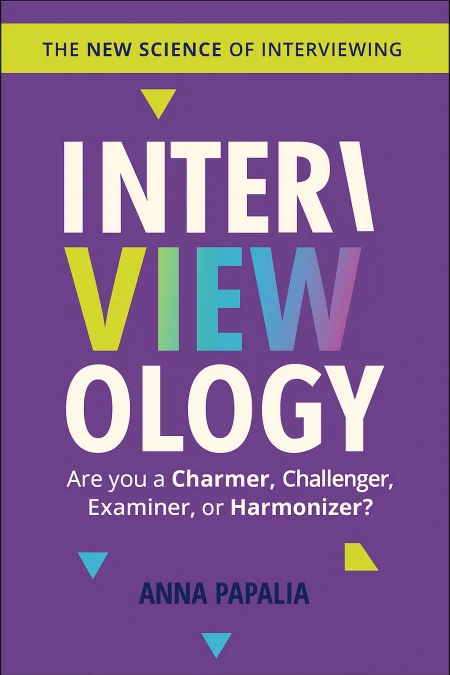
Interviewology
The New Science of Interviewing
Book Edition Details
Summary
Crack the code of the job interview with a tool that transforms the way you present yourself and perceive others. Anna Papalia, with her rich background in HR and academia, dismantles the myths that shroud conventional interview wisdom. At the heart of "Interviewology" lies a revelation: four distinct styles—Charmer, Challenger, Examiner, and Harmonizer—define your interaction dynamics. It's not about rehearsed answers; it's about self-awareness. Papalia guides you to identify your style and harness it effectively, whether you're the one hiring or being hired. This book is your gateway to understanding not just what you say, but how you align with the interview's rhythm, making every encounter an opportunity to shine. Embrace this revolutionary approach and unlock the potential of truly knowing yourself.
Introduction
In the high-stakes world of professional advancement, most people approach interviews with a fundamental misunderstanding: that there exists one "correct" way to present themselves. This assumption leads to countless missed opportunities, mismatched hires, and the perpetuation of unconscious bias in organizational cultures. The reality reveals a more complex truth that challenges conventional interview wisdom. Through extensive research involving thousands of candidates and hiring managers, a groundbreaking framework emerges that identifies four distinct interview styles, each with its own internal logic, strengths, and potential blind spots. This systematic approach moves beyond generic advice to provide a scientifically validated understanding of how different personality types naturally approach the interview process. The framework addresses core questions about human behavior in evaluative settings: Why do some people thrive in interviews while others struggle despite equal qualifications? How do unconscious biases shape hiring decisions? What role does self-awareness play in professional success? This comprehensive system offers both job seekers and hiring managers tools for authentic self-presentation and more equitable evaluation processes. By understanding these four fundamental approaches to interviewing, individuals can leverage their natural strengths while developing strategies to connect across different styles, ultimately transforming interviews from anxiety-inducing performances into genuine opportunities for mutual discovery.
The Four Interview Styles Model
At the foundation of effective interviewing lies a crucial insight: people don't simply perform poorly or well in interviews randomly, but rather express consistent patterns of behavior that reflect deeper psychological orientations. The Four Interview Styles Model identifies these patterns through two intersecting dimensions that create a comprehensive framework for understanding interview behavior. The first dimension spans from introversion to extroversion, determining how individuals naturally process information and derive energy during social interactions. Introverts typically think before speaking, prefer depth over breadth in conversations, and find extended social interaction draining, while extroverts think aloud, enjoy wide-ranging discussions, and gain energy from interpersonal engagement. The second dimension ranges from steadfast to accommodating approaches, revealing whether someone maintains consistent messaging regardless of audience feedback or adapts their presentation based on perceived expectations and social cues. These two dimensions intersect to create four distinct interview styles, each with its own internal logic and behavioral patterns. Charmers combine extroversion with accommodation, creating engaging personalities who excel at reading rooms and building rapport. Challengers pair extroversion with steadfastness, resulting in direct communicators who prioritize authenticity and aren't afraid to push boundaries. Examiners blend introversion with steadfast approaches, producing careful, precise individuals who focus on accuracy and competence. Harmonizers merge introversion with accommodation, generating thoughtful team players who excel at listening and adapting to group dynamics. Consider how this plays out in real interviews. A Charmer might immediately engage with personal questions and adjust their energy to match the interviewer's style, while a Challenger would likely steer the conversation toward substantial topics regardless of the interviewer's initial approach. An Examiner would carefully consider each response to ensure accuracy, potentially taking longer pauses, while a Harmonizer would observe the interviewer's preferences before determining their own level of engagement. Understanding these natural tendencies allows both sides of the interview table to recognize authenticity and make more informed decisions.
Style-Specific Strategies and Applications
Each interview style possesses unique strengths that, when properly leveraged, can create compelling impressions, but these same qualities can become liabilities when overused or misunderstood. Successful interviewing requires not just self-awareness but also the ability to recognize and adapt to different styles across the table. Charmers naturally excel at building connections and creating positive atmospheres, making interviews feel more like engaging conversations than formal evaluations. Their ability to read social cues and adjust their approach makes them particularly effective at putting others at ease. However, they risk being perceived as superficial if they focus too heavily on rapport-building at the expense of demonstrating concrete qualifications. The key strategy for Charmers involves balancing their natural warmth with substantial content, ensuring they communicate both likability and competence. When interviewing Charmers, evaluators should probe for specific examples and measurable achievements to see beyond the engaging personality. Challengers bring valuable authenticity and directness to interviews, often raising important questions that others might avoid. Their willingness to engage with difficult topics can demonstrate leadership potential and critical thinking skills. The challenge lies in modulating their approach to avoid appearing confrontational or overly critical. Effective Challenger strategies involve channeling their natural directness into constructive inquiry and showing respect for different perspectives while maintaining their authentic voice. When working with Challengers, interviewers should appreciate their willingness to engage deeply while setting clear boundaries for productive dialogue. Examiners contribute precision and thoroughness to interview conversations, demonstrating careful consideration and attention to detail. Their measured approach often leads to highly accurate and reliable information sharing. However, they may struggle with the interpersonal aspects of interviewing, potentially appearing disengaged or overly formal. Successful Examiner strategies focus on finding ways to show personality and warmth while maintaining their natural precision, perhaps through sharing specific examples that reveal both competence and human connection. Interviewers working with Examiners should allow extra time for responses and ask questions that invite storytelling rather than just factual reporting. Harmonizers excel at understanding group dynamics and demonstrating how they might fit into existing teams or cultures. Their thoughtful, adaptive approach often makes them appear as ideal colleagues. The risk lies in being perceived as lacking strong opinions or individual initiative. Effective Harmonizer strategies involve finding ways to assert their own perspectives and accomplishments while maintaining their collaborative spirit, perhaps by discussing times when they've taken leadership roles or made independent contributions. When interviewing Harmonizers, it's crucial to create safe spaces for them to share individual achievements and ask direct questions about their personal contributions to team success.
Implementing Interview Style Awareness
The practical application of interview style awareness requires systematic changes to both preparation and evaluation processes, moving beyond surface-level adjustments to fundamental shifts in how we approach professional assessment. Implementation success depends on creating structures that support authentic expression while maintaining fair and consistent evaluation standards. For individual interview preparation, style awareness begins with honest self-assessment and recognition of natural tendencies. This involves identifying not just primary style characteristics but also understanding how stress, unfamiliar environments, or power dynamics might influence typical behavior patterns. Effective preparation includes developing strategies for leveraging natural strengths while building capacity in areas that don't come naturally. For example, a Harmonizer might practice articulating individual achievements, while a Challenger might work on asking questions in ways that invite collaboration rather than defensiveness. Organizational implementation requires training programs that help hiring managers recognize their own style biases and develop appreciation for different approaches to professional communication. This includes creating structured interview processes that allow different styles to showcase their strengths rather than defaulting to formats that favor extroverted, accommodating approaches. Organizations might develop style-specific interview questions or create panel structures that include diverse interviewing styles to provide multiple perspectives on candidate capabilities. The most profound implementation involves cultural shifts that value diverse communication styles and recognize that effective performance can look different across individuals and roles. This means moving beyond the assumption that interview performance directly correlates with job performance and instead developing nuanced understanding of how different styles might contribute to organizational success. For instance, recognizing that a thoughtful, reserved candidate might bring valuable analysis and careful decision-making to a team, even if they don't create immediate rapport in a brief interview setting. Successful implementation also requires ongoing calibration and feedback systems that help both interviewers and candidates understand how their natural styles are being perceived and adjust accordingly. This creates more authentic interactions where individuals can present their genuine capabilities rather than attempting to conform to imagined expectations. The result is more accurate hiring decisions and better long-term fit between individuals and organizational cultures.
Summary
The fundamental insight that emerges from understanding interview styles is this: authenticity in professional settings isn't about being unfiltered, but rather about understanding and skillfully expressing one's natural approach while remaining open to connection across different communication styles. This framework represents a significant advancement in both individual career development and organizational hiring practices, offering tools for more equitable and effective professional evaluation. By recognizing that diverse communication styles can all contribute to professional success, we create opportunities for broader talent recognition and more inclusive workplace cultures. For individuals, this understanding provides a foundation for confident self-presentation that honors their natural strengths while building capacity for professional growth. For organizations, it offers pathways to more diverse and effective teams by moving beyond narrow definitions of interview success to appreciate the full spectrum of human professional capability.
Related Books
Download PDF & EPUB
To save this Black List summary for later, download the free PDF and EPUB. You can print it out, or read offline at your convenience.
By Anna Papalia
