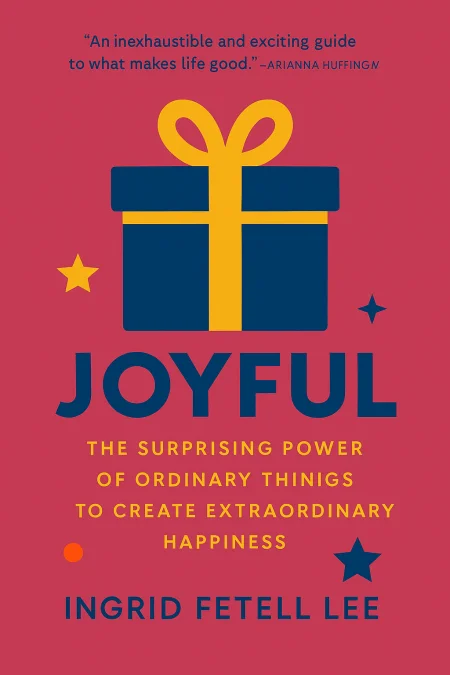
Joyful
The Surprising Power of Ordinary Things to Create Extraordinary Happiness
Book Edition Details
Summary
Why do we find ourselves spellbound by the orange hues of a sunset or captivated by the delicate dance of cherry blossoms in the spring? What is it about a puppy's wide-eyed innocence or the burst of colors from confetti that sparks a smile? In "Joyful," Ingrid Fetell Lee takes readers on a vibrant journey through the unnoticed power of the physical world around us. Drawing from neuroscience and psychology, Lee unravels the secret language of spaces and objects, revealing how they profoundly shape our emotions and well-being. This insightful exploration challenges the inward gaze of mindfulness by spotlighting the external sources of happiness—colors, shapes, and whimsical details—that make life delightful. Discover how to transform your environment into a wellspring of joy, unlocking a fuller, healthier existence through the artful embrace of design's uplifting magic.
Introduction
Have you ever wondered why stepping into a sunlit room instantly lifts your spirits, or why certain colors make you feel more energetic while others calm you down? The connection between what we see and how we feel runs far deeper than most of us realize. Every day, we're surrounded by shapes, colors, textures, and patterns that quietly influence our mood, creativity, and overall well-being, yet we rarely stop to consider how these visual elements work their magic on our minds. The emerging field of environmental psychology reveals that joy isn't just an internal state we must cultivate through positive thinking or meditation. Instead, it's something we can actively create and amplify through the deliberate design of our surroundings. Scientists are discovering that certain aesthetic experiences trigger predictable neurological responses, releasing chemicals that enhance our sense of happiness and connection to the world around us. When we understand these principles, we gain the power to transform ordinary spaces into sources of extraordinary delight. Throughout this exploration, you'll discover how your brain responds to different visual stimuli, why certain environments make you feel more creative and energized, and how simple changes to your surroundings can literally rewire your neural pathways for greater joy and well-being.
The Neuroscience of Color and Light Energy
Color isn't just decoration for our eyes—it's energy made visible, and our brains are evolutionarily wired to respond to it in powerful ways. When light bounces off objects and reaches our retinas, it doesn't simply create a pretty picture. Instead, it triggers a cascade of neurochemical reactions that can influence everything from our hormone levels to our cognitive performance. This happens because our ancestors developed sophisticated color vision specifically to identify ripe fruits, nutritious young leaves, and other life-sustaining resources in their environment. The same neural pathways that once meant the difference between feast and famine still fire today, which explains why a bowl of bright oranges or a field of vibrant flowers can trigger an almost primal sense of abundance and vitality. Research shows that exposure to bright, saturated colors has measurable effects on our physiology and behavior. People working in colorful environments consistently report higher energy levels, increased alertness, and greater confidence compared to those in drab, neutral surroundings. When schools in underserved communities were painted with vibrant hues, both teachers and students reported feeling safer and more engaged, with attendance rates showing significant improvement. The colors didn't change the physical security of the buildings, but they transformed how people felt within them by signaling to the unconscious mind that this was a thriving, life-sustaining environment. Light amplifies color's power exponentially, and the quality of illumination in our spaces profoundly affects our mental state. Natural sunlight doesn't just help us see better—it regulates our circadian rhythms, boosts vitamin D production, and influences serotonin levels, the neurotransmitter that helps stabilize our emotions. Hospital patients in sunny rooms recover faster and require less pain medication, while students in naturally lit classrooms show dramatic improvements in reading and math performance. Even artificial light can have therapeutic effects when it mimics the full spectrum of daylight, demonstrating that our brains treat light as essential nutrition rather than mere illumination. The practical implications are remarkable: even small additions of pure, saturated color can transform a dingy space by acting like mirrors that bounce light around a room, magnifying its energizing effects. When we consciously choose to surround ourselves with this kind of visual energy, we're not just decorating our spaces—we're literally painting light and vitality into our daily lives, creating environments that support our neurological need for stimulation and joy.
Environmental Psychology: From Sensory Abundance to Spatial Harmony
Our brains are constantly hungry for sensory input, a craving that stems from millions of years of evolution when staying alert to environmental details meant the difference between survival and danger. This "sense hunger" explains why we feel energized and engaged in rich, textured environments while feeling depleted and restless in sterile, monotonous spaces. Modern environments often starve our senses with their stripped-down aesthetics, leading to a kind of sensory malnutrition that we might unconsciously try to satisfy through mindless snacking, compulsive shopping, or endless scrolling on our devices. True abundance in design isn't about accumulating more possessions—it's about layering colors, textures, and patterns in ways that create sensory richness and visual complexity. Think about why candy stores, vibrant marketplaces, or grandmother's cluttered but cozy kitchens feel so delightful: these spaces offer a feast for our senses, with countless small details that reward exploration and discovery. Research demonstrates that environments with moderate complexity and abundant sensory stimulation actually improve cognitive function, boost creativity, and enhance emotional well-being, as long as this complexity is well-organized rather than chaotic. This is where harmony becomes crucial as the organizing principle that prevents abundance from becoming overwhelming. Our brains are sophisticated pattern-seeking machines, constantly scanning for connections and relationships that help us make sense of the world around us. When we group similar objects together, create symmetrical arrangements, or repeat colors and shapes throughout a space, we're providing the visual anchors our minds need to process complexity without stress. A room full of different patterns can feel perfectly cohesive if they share a common color palette, just as a collection of mismatched vintage dishes can look intentional when arranged by size, shape, or material. The most joyful spaces achieve a delicate balance between sensory richness and visual order, offering enough variety to keep our minds stimulated and engaged while providing enough structure to feel peaceful and coherent. This balance mirrors what we find most appealing in nature, where incredible diversity exists within underlying patterns—like the fractal geometry of trees or the organized complexity of a thriving coral reef. By understanding these principles, we can create environments that satisfy both our evolutionary need for stimulation and our psychological desire for tranquility and order.
Movement, Play and Surprise: The Biology of Joyful Interaction
Play isn't a frivolous luxury—it's a fundamental biological drive that promotes brain development, emotional regulation, and social bonding throughout our lives. Neuroscientists have discovered that playful activities activate multiple brain networks simultaneously, enhancing neuroplasticity and fostering the kind of flexible thinking that leads to creative breakthroughs. Interestingly, the movements we make during play tend to be curvilinear rather than angular, and this flowing quality appears to unlock more innovative thought patterns. Studies show that people who trace curved lines with their arms generate significantly more creative ideas and demonstrate less rigid thinking than those who make sharp, angular movements. Circular and spherical forms act as universal play cues, signaling safety and possibility to our brains in ways that angular shapes simply cannot. Unlike sharp edges and corners, which can trigger subtle stress responses in the amygdala, rounded forms invite approach and exploration. This explains why balls have been beloved toys across cultures for thousands of years, and why we instinctively find bubbles, balloons, and other floating spheres so enchanting. These shapes offer what designers call broad "affordances"—multiple ways they can be used and interacted with—making them perfect catalysts for open-ended play and discovery. Surprise works as a powerful amplifier for joy, taking small pleasures and making them memorable and meaningful. When something unexpected appears in a familiar context—like colorful yarn wrapped around a parking meter, a hidden note tucked in a coat pocket, or an unusual piece of art in an otherwise ordinary hallway—it jolts us out of autopilot mode and brings our attention fully into the present moment. This heightened awareness creates opportunities for wonder, connection, and delight that might otherwise pass us by completely. The key to designing effective surprise lies in understanding contrast: the greater the difference between an object and its context, the more powerful the surprise effect. A single bright red chair in a room full of neutral furniture creates more impact than an entire rainbow of colors competing for attention. By incorporating more curves into our environments, creating opportunities for gentle surprises, and designing spaces that invite playful movement and interaction, we can create surroundings that naturally bring out our most creative, joyful, and socially connected selves.
Ten Universal Aesthetics That Spark Human Happiness
Across cultures and throughout history, researchers have identified ten aesthetic elements that consistently trigger positive emotional responses in humans, suggesting that our capacity for joy is rooted in shared biological and evolutionary foundations. These universal patterns offer a practical toolkit for creating more joyful environments, each corresponding to fundamental human needs that helped our species survive and thrive over millions of years. Energy manifests through vibrant colors and dynamic forms that signal vitality and life force, particularly the warm yellows of sunlight, rich reds of ripe fruits, and fresh greens of new growth. Abundance appears in diverse textures, layered patterns, and rich sensory experiences that suggest plenty and variety in our environment. Freedom expresses itself through open spaces, natural elements, and flowing forms that connect us to our ancestral love of expansive landscapes and unrestricted movement. Harmony emerges from symmetry, rhythm, and balanced proportions that create predictability and order, helping our pattern-seeking brains feel safe and oriented. Play reveals itself in rounded shapes, whimsical forms, and interactive elements that invite exploration and experimentation. Surprise delights us through unexpected contrasts, hidden details, and novel combinations that capture our attention and stimulate curiosity. Transcendence lifts our spirits through elevation, dramatic lighting, and elements that draw our gaze upward, connecting us to something greater than our immediate concerns. Magic enchants us with mysterious phenomena, optical illusions, and experiences that playfully challenge our understanding of how the world works. Celebration brings us together through sparkling elements, festive colors, and communal spaces that encourage social connection and shared joy. Renewal inspires us with symbols of growth, seasonal changes, and organic forms that remind us of life's constant capacity for regeneration and transformation. These ten aesthetics work both individually and in powerful combination, creating infinite possibilities for designing environments that naturally support human happiness, creativity, and well-being in our modern world.
Summary
The most profound insight from exploring the science of aesthetic joy is recognizing that happiness isn't just an internal state we must struggle to achieve through willpower or positive thinking, but something we can actively cultivate through thoughtful attention to our physical environment. By understanding the deep evolutionary connections between what we see and how we feel, we gain practical tools for transforming ordinary spaces into extraordinary sources of daily well-being and delight. This knowledge fundamentally democratizes joy, making it accessible to anyone willing to experiment with the colors, shapes, textures, and patterns that surround them. How might your own relationship with your surroundings change if you began to see every design choice as an opportunity to enhance your mental and emotional health? What would it mean for our communities if we designed all our shared spaces—schools, offices, hospitals, and public areas—with the same intentional attention to human joy that we might give to our most cherished personal retreats?
Related Books
Download PDF & EPUB
To save this Black List summary for later, download the free PDF and EPUB. You can print it out, or read offline at your convenience.
By Ingrid Fetell Lee
