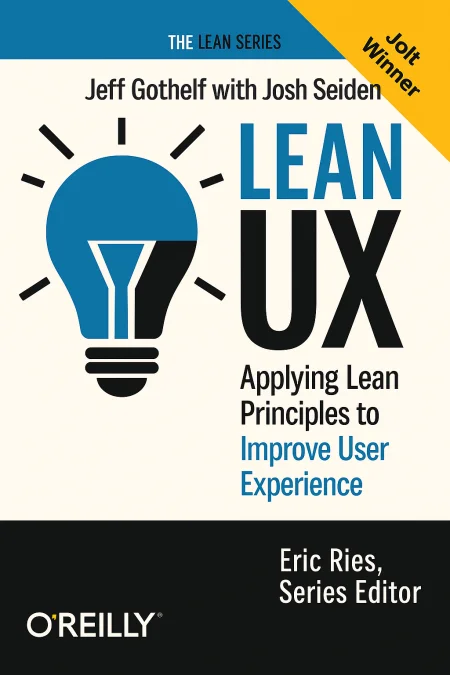
Lean UX
Applying Lean Principles to Improve User Experience
Book Edition Details
Summary
In the high-speed realm of digital design, "Lean UX" emerges as a beacon for innovation and efficiency. Penned by the visionary Jeff Gothelf, this groundbreaking guide dismantles traditional boundaries, urging designers to immerse themselves in the dynamic interplay of experimentation and feedback. Drawing from the wisdom of Lean and Agile methodologies, Gothelf orchestrates a symphony of collaboration, enabling teams to craft user experiences that resonate with authenticity and purpose. With a focus on iterative design and real-world validation, "Lean UX" champions a process where ideas evolve fluidly, transforming user insights into powerful design solutions. Crowned with the prestigious Jolt Award, this book is not just a manual—it's a catalyst for creative evolution in the digital age.
Introduction
In the fast-paced world of digital product development, teams often find themselves caught in a frustrating cycle of creating detailed specifications, beautiful wireframes, and comprehensive documentation that never quite translates into successful products. The traditional approach of designing everything up front, then handing it off to developers, frequently results in missed deadlines, wasted effort, and products that don't resonate with users. This disconnect between design intention and market reality has plagued product teams for decades, leading to countless hours spent on features that customers never wanted and interfaces that solve problems nobody has. The evolution toward lean principles in user experience design represents a fundamental shift from this document-heavy, assumption-driven approach to one grounded in collaboration, experimentation, and continuous learning. By embracing rapid prototyping, cross-functional teamwork, and direct customer feedback, teams can break free from the cycle of building the wrong things beautifully and instead focus on creating the right solutions efficiently. This methodology transforms the traditional design process from a linear, isolated activity into a dynamic, integrated practice that keeps customer needs and business outcomes at its center.
From Assumptions to Hypotheses
Traditional product development operates on dangerous assumptions disguised as facts, leading teams down expensive paths that often end in failure. The fundamental shift from assumptions to hypotheses represents a transformation in how we approach product decisions, moving from speculation to structured experimentation. Consider the team at TheLadders, an online recruiting platform, who discovered their communication system between job seekers and employers was failing. Rather than assuming they knew the problem, they transformed their beliefs into testable statements. They hypothesized that creating an efficient communication system within their product experience for recruiters and employers would achieve higher contact success rates and increased satisfaction. This hypothesis format forced them to define clear success metrics and identify specific market feedback they would seek. The transformation became evident when the team realized their previous approach of building features based on executive intuition had led to low response rates and frustrated users. By structuring their beliefs as hypotheses, they created a framework for validation that would either prove their direction correct or pivot them toward better solutions before investing significant resources. The process begins with declaring assumptions openly as a team, using structured worksheets to capture beliefs about user needs, business value, and competitive advantages. Teams must then prioritize these assumptions based on risk and uncertainty, focusing first on those that could cause the project to fail if proven wrong. Each assumption transforms into a hypothesis with clear success criteria, creating a roadmap for experimentation rather than speculation. The key lies in embracing uncertainty as a starting point rather than a weakness. Teams that master this transition find themselves making faster, more confident decisions because they're grounded in market reality rather than internal politics or personal preferences.
Collaborative Design and Rapid Prototyping
Design as a solitary, heroic endeavor belongs to a bygone era where manufacturing constraints demanded getting everything right the first time. Modern digital products require a fundamentally different approach that breaks down silos and harnesses collective intelligence to solve complex user problems. At PayPal, a cross-functional team faced the challenge of redesigning a consumer-facing dashboard with tight deadline constraints. Instead of the designer disappearing into isolation for weeks, the team adopted a collaborative approach. The lead interaction designer pulled the developer to a whiteboard, sketching initial layout concepts while discussing technical feasibility in real-time. They passed the marker back and forth, building on each other's ideas and constraints, ultimately converging on a solution that balanced usability with implementation realities. This collaborative session transformed their working relationship and project timeline. Within two hours, they had created shared understanding that would have taken weeks to achieve through traditional handoff processes. The developer began building infrastructure code immediately while the designer refined wireframes, working in parallel rather than sequence. Their solution launched within the two-week sprint because both disciplines contributed their expertise from the beginning. The Design Studio method formalizes this collaboration through structured exercises that engage entire teams in solution generation. Teams begin with individual ideation, creating six rough concepts in ten minutes, then present and critique each other's work before converging on shared solutions. This process democratizes design while leveraging diverse perspectives to create more robust outcomes. Success requires establishing style guides that codify design decisions and eliminate repetitive debates about interface elements. Living pattern libraries allow teams to focus creative energy on novel problems rather than recreating basic components, accelerating both design and development workflows.
Continuous Learning Through User Feedback
The gap between what teams think users want and what users actually need often determines the difference between product success and failure. Continuous user engagement transforms design from guesswork into informed decision-making, creating a steady stream of insights that guide product evolution. Meetup revolutionized their product development by implementing a "three users every Thursday" program that brought customer voices directly into their sprint cycles. Rather than conducting expensive, infrequent usability studies, they created a weekly rhythm where product managers, designers, and developers observed real users interacting with their latest prototypes and features. The entire team watched sessions via video feed, taking notes and debriefing immediately afterward to capture insights while they were fresh. This continuous feedback loop transformed their decision-making process and significantly reduced the time between concept and validation. When they noticed mobile usage growing, instead of waiting months for formal mobile testing equipment, they built their own testing rig for twenty-eight dollars using basic materials. Their scrappy approach enabled them to run approximately six hundred test sessions annually at a fraction of traditional research costs. The key insight emerged when they realized that feedback quality matters more than artifact polish. Teams can test rough sketches for concept validation, wireframes for information architecture, and coded prototypes for usability refinement. Each fidelity level provides different insights, allowing teams to learn iteratively rather than waiting for perfect solutions. Effective teams create multiple feedback channels including customer service insights, usage analytics, and A/B testing to validate their hypotheses from various angles. They look for patterns across multiple data sources rather than relying on individual opinions, building confidence in their direction through triangulated evidence. This approach transforms user research from an expensive, specialized activity into an integrated team practice that happens continuously rather than occasionally.
Making Organizational Change Work
Implementing lean user experience principles requires more than adopting new tools or processes; it demands fundamental shifts in how organizations structure teams, measure success, and approach product development challenges. These changes often encounter resistance from established practices and entrenched mindsets. Emily Holmes at Hobsons faced typical enterprise skepticism when introducing lean methodologies to her education technology team. Colleagues insisted these approaches only worked for startups, not established companies with complex stakeholder requirements. Through persistent coaching and demonstrated results, she transformed her organization's structure from siloed departments throwing requirements over walls to integrated cross-functional squads working toward shared outcomes. Her team's evolution became visible through organizational charts that showed the dramatic restructuring from separate UX, development, and business analysis groups to collaborative pods focused on specific user problems. The transformation required ongoing coaching to help team members unlearn waterfall habits and embrace iterative experimentation, but the results spoke for themselves through faster delivery times and improved user satisfaction metrics. The shift demands moving from role-based thinking to competency-based collaboration, where team members contribute beyond their job descriptions to solve shared challenges. Designers must develop facilitation skills to guide cross-functional ideation sessions, while developers and product managers participate actively in user research and design decisions. This requires physical workspace changes that break down cubicle walls and create collaboration areas where teams can sketch, prototype, and review work together. Success requires leadership commitment to outcome-focused metrics rather than feature delivery milestones. Organizations must give teams permission to fail fast and iterate based on learning rather than delivering predetermined specifications. This cultural shift from hero-driven design to team-based problem-solving creates more sustainable and effective product development practices. Management must communicate proactively with stakeholders about this new approach, helping dependent departments understand how iterative development affects their workflows and preparing them for more frequent, smaller changes rather than monolithic releases.
Summary
The transformation from traditional user experience design to lean methodologies represents a fundamental evolution in how teams create digital products that truly serve user needs and business objectives. By embracing collaboration over isolation, experimentation over assumption, and continuous learning over big upfront design, teams can dramatically improve their success rates while reducing waste and frustration. As the principles demonstrate, the key lies not in perfect planning but in rapid learning through direct market contact and iterative refinement. The most powerful insight from this approach comes from recognizing that "all life is an experiment, and the more experiments you make, the better." This philosophy transforms failure from something to avoid into valuable learning opportunities that guide teams toward better solutions. Rather than spending months creating comprehensive specifications that may miss the mark, teams can test core assumptions within days and adjust their direction based on real user feedback. The path forward requires commitment to changing not just processes but fundamental mindsets about how product development works. Start by identifying one assumption your team is making about users or the market, transform it into a testable hypothesis, and create the smallest possible experiment to validate or disprove it within the next week. This single step will begin building the muscle memory and confidence needed to embrace lean user experience principles fully, setting your team on the path toward more effective, user-centered product development.
Related Books
Download PDF & EPUB
To save this Black List summary for later, download the free PDF and EPUB. You can print it out, or read offline at your convenience.
By Jeff Gothelf
