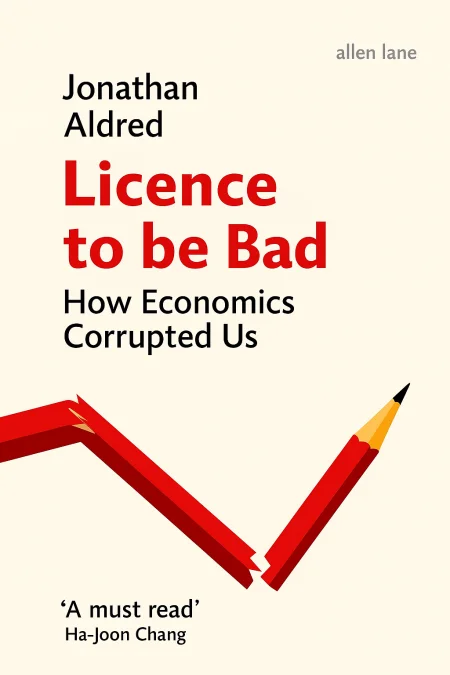
Licence to be Bad
How Economics Corrupted Us
Book Edition Details
Summary
In "Licence to be Bad," Jonathan Aldred dismantles the sacred doctrines of modern economics, revealing their insidious influence on our moral compass. Over the last half-century, what was once deemed reckless or immoral has been rebranded as logical and justified, courtesy of a cadre of economic theorists whose ideas have stealthily infiltrated our societal fabric. From the seductive ease of free-riding to the manipulative subtlety of Nudges, Aldred exposes how these concepts have reshaped our collective psyche and ethical norms. Yet, with wit and urgency, he argues that this corrosion of values isn't irreversible. This provocative narrative challenges readers to reconsider the moral costs of economic reasoning and provides a roadmap for reclaiming our integrity. Prepare for an eye-opening exploration that questions the very foundations of what we consider 'good' and 'right.'
Introduction
A profound intellectual transformation has reshaped how modern societies understand human behavior, moral obligation, and social cooperation. What was once considered virtuous conduct—acting from duty, caring for others without expectation of reward, sacrificing personal gain for collective benefit—has been systematically reinterpreted as either economically irrational or disguised self-interest. This shift represents far more than academic theorizing; it constitutes a fundamental alteration in the moral architecture of contemporary life. The transformation originated in elite academic institutions where economists developed mathematically elegant models that reduced human complexity to simple calculations of cost and benefit. These theories gradually escaped their academic origins to permeate public policy, corporate culture, and everyday decision-making processes. Traditional values like trust, civic duty, and collective responsibility have been steadily eroded, replaced by a worldview that treats virtually every human relationship—from education to organ donation—as a market transaction governed by self-interested calculation. This intellectual revolution succeeded not through coercion or obvious propaganda, but through the seductive power of seemingly objective scientific analysis. By clothing inherently moral and political judgments in the language of mathematical neutrality, economic theory created a new form of common sense that made selfishness appear rational while rendering cooperation naive. The analysis that follows traces the origins and development of these influential ideas, examining how they escaped academic confines to reshape society itself, and exploring what their dominance means for human flourishing and democratic governance.
The Intellectual Revolution: From Game Theory to Market Fundamentalism
The mathematical foundations of modern market fundamentalism emerged from an unexpected convergence of Cold War military strategy and academic ambition during the 1950s. At institutions like the RAND Corporation, brilliant theorists including John von Neumann and John Nash developed game theory as a tool for nuclear warfare planning, creating mathematical models that treated all human interaction as strategic competition between rational, self-interested actors pursuing maximum individual advantage. These pioneering theorists shared a revolutionary vision that would transform economics from a descriptive social science into a predictive mathematical discipline comparable to physics or chemistry. They believed that by reducing human behavior to simple axioms about rational choice and preference maximization, they could construct universal laws governing all social phenomena. The intellectual appeal was intoxicating—finally, a rigorous scientific approach to understanding society that could cut through messy political debates with objective mathematical truths. The mathematical elegance of rational choice theory concealed profound assumptions about human nature and social relationships. By defining rationality exclusively as consistent preference maximization, economists created an analytical framework that had no conceptual space for moral reasoning, social obligation, or genuine altruism. Any behavior that appeared cooperative or selfless was systematically reinterpreted as disguised self-interest, while actions that seemed irrational were dismissed as errors to be corrected through better incentive structures. This reductionist approach gained tremendous credibility through its association with prestigious academic institutions and its promise of direct policy relevance. Politicians and business leaders enthusiastically embraced economic models that seemed to offer clear, scientifically grounded answers to complex social problems, while the mathematical sophistication of the theories intimidated potential critics who lacked technical training. The result was the gradual elevation of market logic from one useful analytical tool among many to the dominant intellectual lens through which all social relationships came to be understood and evaluated.
Crowding Out Ethics: How Economic Logic Erodes Intrinsic Motivation
The systematic application of economic reasoning to non-market domains has produced a well-documented phenomenon known as motivational crowding-out, where the introduction of monetary incentives and market logic undermines the intrinsic motivations that previously sustained cooperative behavior. This process operates through several interconnected mechanisms, the most important being the transformation of moral obligations into economic transactions, which fundamentally alters how people understand their relationships and responsibilities. Extensive empirical research demonstrates that introducing monetary rewards into relationships previously governed by trust, duty, or altruism consistently weakens these non-economic motivations. Parents become less punctual when daycare lateness is treated as a market transaction rather than a moral failing. Blood donation rates decline when donors receive payment, because compensation transforms a gift relationship into a commercial exchange. Civic engagement deteriorates when public duties are reduced to cost-benefit calculations rather than expressions of shared citizenship. This crowding-out effect reflects a deeper conceptual problem with the economic approach to human motivation and social organization. By treating all values as mere preferences and insisting that all preferences are equally valid expressions of individual choice, economic theory eliminates the possibility of moral education, character development, or reasoned discourse about better and worse ways of living. When someone's preference for exploiting others is theoretically equivalent to someone else's preference for helping them, there remains no intellectual foundation for moral criticism beyond arbitrary individual taste. The practical consequences of this moral flattening extend far beyond academic theory into the design of real institutions and policies. When policymakers assume that people respond only to external incentives, they create institutional structures that reward selfish behavior while punishing cooperation. When businesses treat employees as purely economic actors, they foster workplace cultures that discourage loyalty, creativity, and ethical conduct. When educational systems focus exclusively on measurable outcomes and test scores, they systematically undermine the intrinsic love of learning that makes education personally meaningful and socially valuable.
False Neutrality: Economics as Hidden Ideology Justifying Inequality
Economic theory has provided intellectually sophisticated justifications for levels of inequality and social dysfunction that would have been considered morally outrageous in previous historical periods. These justifications typically rely on claims about individual merit, market efficiency, and the natural operation of economic forces that systematically obscure the crucial roles of inherited advantage, institutional design, and collective choice in determining social outcomes. The most influential of these justifications is marginal productivity theory, which claims that individuals are compensated according to their economic contribution to society. This theory faces obvious empirical difficulties, since most valuable economic activity is fundamentally collaborative and the individual contribution of any particular person is practically impossible to isolate or measure. More fundamentally, it completely ignores the role of inherited knowledge, social infrastructure, and collective institutions in making individual productivity possible in the first place. The rhetorical strategy of scientific neutrality plays a crucial role in maintaining these false justifications for existing arrangements. By presenting itself as a value-free science comparable to physics or chemistry, economics claims to describe natural laws rather than political choices about how society should be organized. This intellectual maneuver makes it extremely difficult to challenge economic policies on moral or democratic grounds, since any such challenge can be dismissed as unscientific sentimentality that ignores objective reality. The consequences of these false justifications extend far beyond mere intellectual error into the realm of practical politics and social policy. When extreme inequality is treated as the natural result of market forces rather than the predictable outcome of specific policy choices, it becomes much more difficult to build democratic support for redistributive measures. When poverty is explained primarily as the result of individual failings rather than structural disadvantages, society feels less moral obligation to provide meaningful assistance to those in need. When concentrated wealth is celebrated as evidence of exceptional merit rather than questioned as a potential threat to democratic governance, the wealthy gain both material resources and moral authority to shape social institutions according to their particular interests.
Reclaiming Human Agency: Beyond Economic Reductionism
The intellectual and political dominance of market fundamentalism is neither inevitable nor permanent, and there are encouraging signs that its hegemonic influence is beginning to weaken under the weight of its practical failures and moral contradictions. Growing public awareness of inequality, environmental destruction, and social fragmentation has created intellectual and political space for alternative approaches that take seriously the full range of human values, motivations, and capabilities. This reconstruction must begin with a more realistic and nuanced understanding of human psychology and social relationships that acknowledges both individual agency and collective interdependence. Real people are neither the perfectly rational calculators of orthodox economic theory nor the predictably irrational actors of behavioral economics, but complex social beings capable of both selfishness and generosity, both careful calculation and moral reasoning, both individual achievement and collective cooperation. The goal is not to eliminate markets entirely or to ignore questions of economic efficiency, but rather to restore a proper balance between economic and non-economic values in both theory and practice. Markets can indeed be powerful tools for coordination, innovation, and resource allocation, but they are not appropriate mechanisms for organizing all social relationships, and they do not automatically produce just or sustainable outcomes without democratic oversight and moral constraint. This intellectual and political transformation requires sustained effort on multiple fronts simultaneously. At the theoretical level, we need economic models that acknowledge the roles of power, history, culture, and values in shaping economic outcomes rather than treating them as external disturbances to natural market processes. At the institutional level, we need democratic mechanisms capable of constraining market forces when they conflict with human dignity, environmental sustainability, or democratic equality. Most importantly, we need to recover collective confidence in our capacity to make conscious choices about the kind of society we want to inhabit, rather than passively accepting whatever outcomes emerge from supposedly natural economic forces beyond human control.
Summary
The central insight emerging from this analysis reveals that economic ideas are never politically neutral, despite their claims to scientific objectivity, and their current dominant form has systematically undermined the moral, social, and democratic foundations necessary for genuine human flourishing. What presents itself as objective science is actually a particular way of organizing social life that consistently privileges narrow efficiency over justice, individual choice over collective welfare, and market outcomes over democratic deliberation. Recognizing this ideological dimension allows us to reclaim democratic agency over our economic institutions and to insist that they serve broader human purposes rather than abstract theoretical ideals. The path forward requires neither the wholesale rejection of economic thinking nor naive faith in unregulated market solutions, but rather the patient intellectual and political work of rebuilding economic theory and practice on more realistic, humane, and democratically accountable foundations that honor the full complexity of human motivation and social relationships.
Related Books
Download PDF & EPUB
To save this Black List summary for later, download the free PDF and EPUB. You can print it out, or read offline at your convenience.
By Jonathan Aldred
