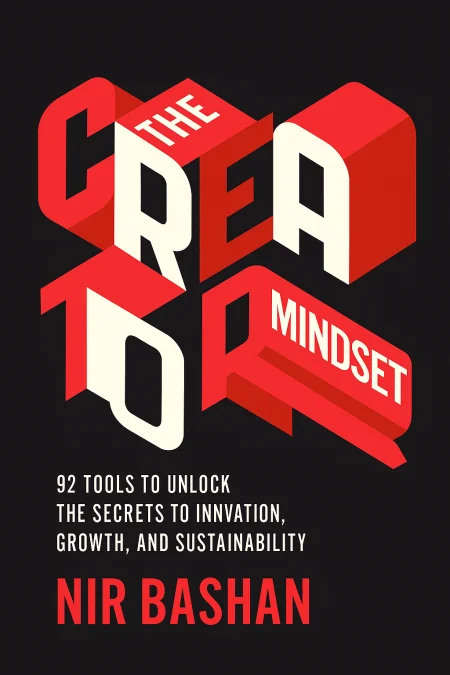
The Creator Mindset
92 Tools to Unlock the Secrets to Innovation, Growth, and Sustainability
Book Edition Details
Summary
Creativity isn't reserved for the artists of the world—it's the secret ingredient behind any thriving career or business. "The Creator Mindset" shatters the myth that creativity is elusive or esoteric, transforming it into an accessible toolkit for everyday innovation. Bashan, a seasoned business virtuoso, distills a lifetime of insights into pragmatic strategies that anyone can apply to ignite their creative potential. Each chapter is a masterclass in turning ordinary office settings into hotbeds of fresh ideas, with real-world examples and actionable steps that demystify the creative process. No jargon, no fluff—just a straightforward guide to seeing the world not as it is, but as it could be. Prepare to challenge conventional thinking and uncover the creative powerhouse within you that promises to propel your business beyond the competition.
Introduction
In today's rapidly evolving business landscape, countless professionals find themselves trapped in analytical thinking patterns, operating at merely half their potential while wondering why breakthrough solutions remain elusive. The stark reality is that most people have overdeveloped their analytical minds while allowing their creative faculties to atrophy, leading to stagnant careers, lackluster sales, and businesses that struggle to adapt to change. Yet within each of us lies an untapped reservoir of creative power that can transform how we approach problems, generate innovations, and achieve extraordinary results. This creative capacity isn't reserved for artists or designers—it's a fundamental human birthright that can be reawakened and harnessed by anyone willing to bridge the gap between analytical precision and creative possibility, unlocking the full spectrum of human potential in both business and life.
Awakening Your Inner Creative Power
The journey toward creative awakening begins with recognizing a fundamental truth: creativity isn't a mystical gift bestowed upon a chosen few, but rather a learnable skill that every human being possesses from birth. Our brains are uniquely designed among all creatures on Earth to alternate between analytical and creative thinking, yet most of us have forgotten how to access this innate creative capacity that once served as our primary problem-solving mechanism. Consider the story of nine-year-old Nir and his friend Richard, who desperately needed money for baseball cards and fast food but came from families living paycheck to paycheck. Rather than accepting defeat, they launched a door-to-door car washing service with nothing but hand soap, a leaky hose, and a broken vacuum cleaner. After facing countless rejections and sitting dejected on a sidewalk, they reached a critical "what now" moment that would define their future approach to challenges. Instead of giving up, they transformed their simple car wash into a comprehensive customer service operation, offering to clean junk from porches, empty trash, organize car trunks, and top off windshield wiper fluid. They even created playful sales rhymes like "Junk in your trunk, not any more. Nir and Richard will wash your car for sure!" This creative pivot turned their failing venture into a successful $5-per-service business that taught them the power of seeing opportunities where others see obstacles. To reawaken your creative power, start by giving yourself permission to think like a child again. Pick up a pen and draw a simple flower in any margin available to you, regardless of your artistic ability. Notice how this simple act of creation feels different from writing letters and words. This exercise isn't about art—it's about reactivating dormant neural pathways and reminding your brain of its creative capacity. Next, identify a persistent problem you're currently facing and write it down, then study the shape and formation of the letters themselves, allowing your mind to make unexpected associations. The key to creative awakening lies in listening to that inner voice that suggests wild ideas you typically dismiss as "too crazy" or "too risky." That voice represents your creative mind trying to break through the concrete barrier of pure analytical thinking. By consciously choosing to listen to and explore these seemingly outlandish ideas, you begin to rebuild the creative muscle that has been waiting patiently for your permission to emerge once again.
Building Creative Habits for Success
Sustainable creativity requires a systematic approach that combines structure with spontaneity, transforming sporadic creative moments into consistent innovative thinking. The Trinity of Creativity provides this framework through three distinct yet interconnected levels: Concept, Idea, and Execution, each offering different perspectives and opportunities for creative breakthrough. The Concept represents the satellite view of your business or career—the highest-level perspective that captures the broadest meaning of what you do. For a nurse, this might be "communication" or "care." The Idea functions as the street-level view, providing practical specifics like "pediatric nursing" or "head nurse." Finally, Execution delivers the microscopic details—the precise, laser-focused definition such as "neonatal intensive care unit nurse." Steve Jobs demonstrated this creative framework masterfully when Apple faced bankruptcy in the late 1990s. While the board pursued traditional analytical solutions like layoffs, restructuring, and lawsuits against Microsoft, Jobs employed creative thinking to envision an unprecedented solution. His radical idea—asking bitter rival Bill Gates to bail out Apple with a $150 million investment—seemed impossible to the analytical mind but proved transformative when viewed creatively. This bold move not only saved Apple but established a new paradigm where competition could coexist beneficially. To build your creative habits, regularly work through the Trinity framework with any challenge you face. Start by identifying your Concept, Idea, and Execution, then allow your mind to generate variations and alternatives for each level. Subtle changes at the Execution level create incremental improvements, modifications at the Idea level generate significant innovations, and shifts in Concept enable radical transformation. Practice this exercise weekly, individually or with your team, treating it as essential maintenance for your creative thinking capacity. Remember that creativity thrives on the language of positivity rather than limitation. Replace phrases like "this doesn't work" with "this is different from what I expected," and "this is terrible" with "this is unexpected." This linguistic shift opens pathways for creative solutions to emerge while keeping the analytical mind from prematurely shutting down promising possibilities.
Overcoming Obstacles to Innovation
The path to sustained creativity inevitably encounters three primary obstacles that can derail even the most well-intentioned innovative efforts: comfort, self-doubt, and the dangerous trap of resting upon past success. Understanding and actively countering these barriers becomes essential for anyone seeking to maintain creative momentum in their personal and professional endeavors. Comfort represents perhaps the most insidious obstacle to innovation. While we naturally gravitate toward predictable patterns and familiar solutions, creativity requires us to venture into uncomfortable territory where genuine breakthroughs await. Dr. Kenneth Alexander exemplified this principle when studying the Zika virus, which causes devastating effects in developing infants. Rather than accepting conventional limitations, he courageously explored the radical possibility of using this same virus as a cancer treatment, ultimately discovering its potential to kill cancer cells in laboratory cultures. Self-doubt serves as creativity's most persistent enemy, creating a paralyzing form of introspection that prevents action and extinguishes innovative thinking before it can take root. This psychological barrier manifests as the analytical mind's demand for certainty and perfection, making us afraid to propose ideas that might be deemed "wrong" or "foolish." Combat self-doubt using three powerful techniques: the faucet tap visualization, where ideas flow like water molecules without pressure for immediate perfection; the light of positivity, which reframes self-doubt as simply "one idea of many"; and the shotgun method, where you write down all your doubts on separate pieces of paper until they transform into ideas. The third obstacle, resting upon success, proves particularly dangerous because it masquerades as wisdom. Companies like Kodak exemplify this trap—when employee Steve Sasson invented the world's first digital camera in 1975, leadership dismissed his breakthrough as threatening rather than revolutionary. They assumed past photographic success guaranteed future relevance, ultimately leading to bankruptcy in 2012 while digital photography transformed the world. To overcome these obstacles, establish regular practices that push you beyond comfort zones. Schedule technology detox days to reconnect with direct human interaction. Challenge yourself to do something uncomfortable each day, whether speaking up in meetings or exploring unfamiliar approaches to routine tasks. Most importantly, continuously question the status quo and refuse to assume that current success guarantees future relevance, always asking what innovations might be emerging around the corner.
Sustaining Long-term Creative Growth
Long-term creative sustainability requires more than occasional bursts of innovation—it demands a systematic approach that balances the analytical and creative minds while continuously evolving to meet changing circumstances. The Four Ps framework provides this comprehensive structure: People, Process, Product, and Profit, each requiring creative infusion to achieve lasting success. People represent your most valuable creative resource, demanding that you hire slowly and fire quickly while focusing on character and potential rather than résumés alone. Military veterans often make exceptional hires not because of industry experience but because of their disciplined approach to problem-solving and leadership development. Process transforms creative ideas into actionable results through clear steps and little victories that build momentum toward larger goals. Product requires seeing beyond surface functions to underlying value—a manufacturing company might actually be in the trust business, while a nurse's true product might be communication rather than medical tasks. The story of Porsche illustrates how profound reinvention can overcome even the darkest past. After World War II, the company faced the devastating legacy of manufacturing vehicles for the Nazi regime and operating its own concentration camp. Rather than being paralyzed by this history, Ferry Porsche chose complete reinvention, dedicating the company exclusively to creating the world's finest sports cars. This transformation required both breaking away from the past while eventually acknowledging it, ultimately creating a brand so successfully reinvented that few people today remember its origins. Crisis situations often provide the greatest opportunities for creative growth, as demonstrated by Johnson & Johnson during the 1982 Tylenol poisonings. CEO James Burke's response embodied four critical principles: embracing vulnerability by immediately sharing incomplete information with the public; restoring trust at all costs by voluntarily removing products from shelves; communicating relentlessly through every available channel; and creating innovation through new safety packaging that became industry standard. To sustain creative growth, recognize that complacency represents creativity's greatest long-term threat. Companies like Toys "R" Us, Columbia House, and Pan Am Airlines all succumbed to three distinct flavors of complacency: ignoring early warning signals, building business models on exploitive sales practices, or experiencing paralysis of choice when faced with multiple options. Combat complacency by regularly questioning established norms, maintaining awareness of changing market conditions, and choosing action over indecision even when facing imperfect information.
Summary
The journey toward unleashing your creative potential represents far more than acquiring new business skills—it constitutes a fundamental return to your authentic human nature, where analytical precision combines with creative vision to unlock extraordinary possibilities. As this exploration has revealed, "When your thinking has no barriers, your potential has no barriers," and the systematic application of creative principles transforms not only individual careers and businesses but entire communities and cultures. The evidence surrounding us demonstrates that humanity continues progressing through creative innovation: life expectancy increases globally, charitable giving reaches new heights, and access to clean drinking water expands despite population growth, all testament to our collective creative capacity to solve seemingly insurmountable challenges. Begin immediately by implementing one creative practice today—whether drawing that simple flower, applying the Trinity of Creativity to a current challenge, or scheduling your first technology detox day—because your creative reawakening starts not with perfect conditions but with the courageous decision to see the world as it can be rather than as it merely appears to be.
Related Books
Download PDF & EPUB
To save this Black List summary for later, download the free PDF and EPUB. You can print it out, or read offline at your convenience.
By Nir Bashan
