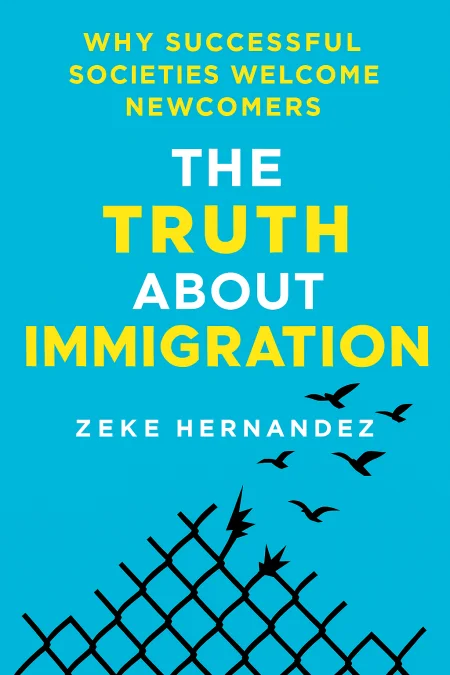
The Truth About Immigration
Why Successful Societies Welcome Newcomers
Book Edition Details
Summary
In a world teeming with debate and division, "The Truth About Immigration" emerges as a clarion call for clarity and compassion. Zeke Hernandez, a renowned Wharton professor, weaves together nearly two decades of meticulous research with poignant personal narratives to dismantle the myths surrounding immigration. Through a vibrant tapestry of facts and stories, Hernandez illuminates how newcomers infuse economies with innovation, enrich cultures with diversity, and fortify societies with resilience. This book transcends the polarizing rhetoric of villains and victims, revealing a landscape where immigrants are indispensable allies in building prosperous and harmonious communities. With a fresh perspective that transforms fear into understanding, this groundbreaking work is destined to redefine how we perceive one of the most pressing issues of our time.
Introduction
Contemporary immigration debates remain trapped between two fundamentally flawed narratives that obscure the true relationship between human mobility and societal prosperity. The dominant discourse frames immigration either as an economic threat requiring defensive measures or as a humanitarian burden demanding charitable accommodation. Both perspectives fundamentally misunderstand how newcomers function within modern economies and societies, leading to policies that fail to harness immigration's transformative potential. The evidence reveals a starkly different reality where immigrants serve as catalysts for innovation, investment, and social renewal rather than competitors for finite resources. This transformation occurs through mechanisms that extend far beyond simple labor market dynamics to encompass entrepreneurship, technological advancement, and cultural revitalization. The key insight lies in recognizing that differences between immigrants and natives create complementary advantages rather than zero-sum competition. This analysis employs rigorous economic research, demographic data, and historical case studies to demonstrate how immigration generates expanding opportunities for entire communities. By examining the specific pathways through which newcomers drive economic growth and social progress, we can move beyond polarized rhetoric toward evidence-based policies that maximize mutual benefits while addressing legitimate integration challenges.
Economic Catalyst: Immigration as Investment and Innovation Driver
Immigration functions as a powerful economic multiplier that generates investment flows, technological breakthroughs, and job creation far exceeding what newcomers consume in public resources. The relationship between human mobility and capital formation operates through networks of trust and knowledge that immigrants establish between origin and destination countries. When businesses follow established immigrant communities into new markets, they create employment opportunities while introducing novel products and services that expand consumer choices and drive competitive innovation. The entrepreneurial impact proves particularly significant, with immigrants starting businesses at rates substantially higher than native-born citizens. These enterprises often serve as bridges between global markets, helping domestic companies access international supply chains while attracting foreign investment to local communities. The conveyor belt of ideas and capital that immigrants create operates bidirectionally, with venture capital firms achieving higher success rates when they leverage immigrant networks and cultural knowledge to identify promising opportunities across borders. Innovation effects extend throughout the economy as foreign-born inventors contribute disproportionately to patent creation and scientific research. This occurs not merely because immigrant populations include highly educated individuals, but because the immigration process itself selects for people willing to embrace change and pursue new possibilities. Their diverse backgrounds enable novel connections between ideas, leading to breakthrough technologies that benefit entire industries while making native inventors more productive through collaboration and knowledge transfer. Historical evidence reinforces these contemporary patterns, with immigration restrictions consistently producing lasting damage to innovative capacity and international competitiveness. The economic ecosystem that emerges from immigration-driven entrepreneurship demonstrates how human diversity translates directly into economic complexity and resilience, creating expanding opportunities rather than finite competition for existing resources.
Integration Success: Cultural Diversity Strengthens Social Cohesion
Integration occurs most successfully through a bidimensional process where immigrants maintain connections to their heritage while adopting fundamental values and practices of their new society. This approach contradicts common assumptions that cultural assimilation requires abandoning one's origins or that diversity inevitably fragments social cohesion. Research across multiple generations reveals that immigrants integrate at remarkably consistent rates compared to historical periods, with their children typically surpassing native-born citizens in economic mobility and civic engagement. The integration process unfolds predictably across economic, political, and cultural dimensions without requiring heavy-handed government intervention. First-generation immigrants often struggle with language barriers and economic adjustment, but subsequent generations demonstrate higher rates of upward mobility while contributing distinctive perspectives that enhance creativity and problem-solving capacity. Politically, immigrants adopt local attitudes and voting patterns based on their communities rather than ethnic solidarity, with shared values around entrepreneurship and civic participation transcending cultural backgrounds. Cultural adaptation follows similar patterns, with immigrants gradually adopting mainstream practices while contributing elements that enrich the broader society. The rate of convergence mirrors historical precedents, with complete linguistic transition typically occurring within three generations. Forced assimilation efforts consistently backfire, while incentive-based approaches that embrace cultural diversity alongside civic unity produce superior outcomes for both individuals and communities. The most successful integration emerges when societies adopt what researchers term the integration model, where newcomers maintain healthy attachments to both origin and destination cultures. This approach produces better psychological outcomes for immigrants while maximizing their contributions to their new communities, demonstrating that cultural diversity and national unity function as complementary rather than competing objectives in building stronger societies.
Debunking Myths: Crime Data and Security Realities
Comprehensive crime statistics consistently demonstrate that immigrants, including undocumented residents, commit crimes at significantly lower rates than native-born citizens across all categories of criminal activity. Texas, the only state systematically tracking crime by immigration status, shows undocumented immigrants arrested for violent crimes at half the rate of natives, with similar patterns holding for property crimes and drug offenses. This relationship has remained stable over decades while actually widening over time, contradicting persistent public perceptions about immigrant criminality. The persistence of contrary beliefs stems from systematic media bias and organized misinformation campaigns rather than empirical reality. News coverage disproportionately associates immigrants with criminal activity, while social media amplifies fabricated statistics that wildly exaggerate immigrant crime rates. These misperceptions drive expensive but counterproductive enforcement measures that treat immigration primarily as a security threat rather than recognizing its economic and social benefits. Immigration enforcement programs provide natural experiments in security outcomes, with jurisdictions increasing cooperation with federal authorities showing no reduction in crime rates while those limiting such cooperation experiencing no increase in criminal activity. The enforcement approach creates self-fulfilling prophecies of fear and hostility that undermine community safety by discouraging immigrant cooperation with law enforcement and diverting resources from addressing actual public safety threats. The real security challenge emerges from fear-based policies themselves, which cause societies to lose access to global talent essential for technological leadership and economic competitiveness. Historical parallels demonstrate the costs of xenophobic approaches, with the exclusion of European scientists permanently damaging innovative capacity. Current restrictions similarly risk ceding technological advantages to competitors while solving no actual security problems, since immigrants pose minimal criminal or terrorist threats compared to domestic sources of violence.
Strategic Reform: Evidence-Based Policy for Mutual Prosperity
Effective immigration policy requires abandoning false choices between open borders and restrictionist approaches in favor of strategic frameworks that maximize benefits while addressing legitimate concerns about integration and social order. The most successful systems combine generous legal pathways with efficient processing and comprehensive integration support, creating predictable processes that serve both immigrants and receiving communities while maintaining public confidence in orderly governance. Several key principles emerge from comparative policy analysis and outcome research. Legal immigration levels should align with economic demand and demographic needs rather than arbitrary numerical caps, with flexibility to respond to changing conditions proving more important than rigid quotas. Multiple pathways for different types of immigrants reflect the reality that newcomers contribute in various ways, from high-skilled innovation to essential services that support aging populations and growing economies. Integration support should begin before arrival and continue throughout the settlement process, including language training, credential recognition, and civic education programs that build on immigrants' existing strengths rather than treating them as deficient. The goal involves facilitating contribution rather than enforcing conformity, recognizing that successful integration benefits from maintaining cultural connections that enable immigrants to serve as bridges between global markets and local communities. Policy development must remain evidence-based and regularly updated based on outcomes rather than political rhetoric or ideological assumptions. This requires robust data collection, program evaluation, and willingness to adjust approaches when research indicates more effective alternatives. The stakes prove too high for immigration policy to be driven by fear or wishful thinking rather than empirical analysis of what actually works to generate mutual prosperity while maintaining social cohesion.
Summary
The comprehensive evidence reveals that immigration represents one of the most powerful mechanisms available for generating shared prosperity, technological advancement, and social vitality in modern societies. Rather than creating zero-sum competition between newcomers and established residents, human mobility produces expanding opportunities where differences become sources of mutual benefit through innovation, entrepreneurship, and cultural enrichment. Current immigration policies designed around unfounded fears rather than empirical realities prevent societies from capturing these benefits while imposing unnecessary costs on both immigrants and natives, suggesting that the path forward requires replacing ideological frameworks with evidence-based approaches that maximize the productive potential of human diversity while addressing legitimate concerns through proactive planning rather than exclusion.
Related Books
Download PDF & EPUB
To save this Black List summary for later, download the free PDF and EPUB. You can print it out, or read offline at your convenience.
By Zeke Hernandez
