
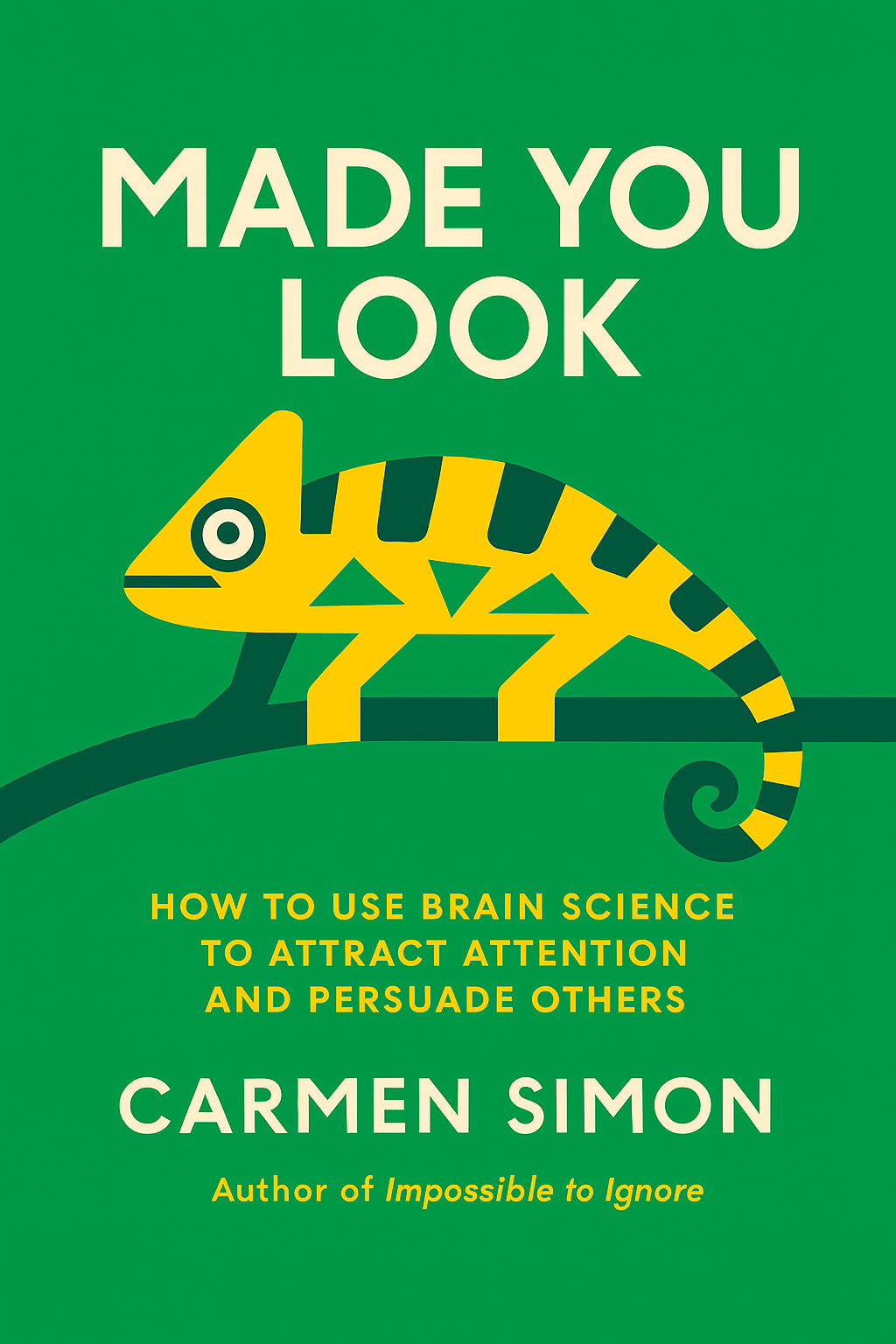
Made You Look
How to Use Brain Science to Attract Attention and Persuade Others
Book Edition Details
Summary
In a world overflowing with noise and distraction, capturing attention is an art—and science holds the brush. Carmen Simon, a cognitive neuroscientist, unveils the secrets behind the human brain's fixation on certain stimuli in her groundbreaking work, *Made You Look*. This vibrant guide offers a peek into the intricate dance of attention and memory, providing a four-part blueprint that transforms mundane marketing into magnetic content. Each segment of Simon's framework teaches you how to irresistibly draw in your audience, guiding them toward choices they didn't even realize they wanted to make. Whether you're sculpting a sales pitch or crafting a corporate presentation, this book empowers you to craft messages that not only seize attention but embed themselves into your audience's consciousness. Elevate your influence and lead your industry by mastering the compelling strategies within these pages.
Introduction
In our hyperconnected world, capturing and maintaining human attention has become one of the most critical challenges facing business communicators. Every day, professionals struggle to break through the noise of endless distractions, competing messages, and information overload that characterizes modern workplace communication. The question is no longer simply what to say, but how to make audiences truly see, process, and remember what matters most. This challenge has given rise to a scientific approach grounded in cognitive neuroscience and attention research. By understanding how the brain naturally directs, sustains, and shifts its focus, we can develop evidence-based strategies that work with, rather than against, our neurological wiring. The framework presented here draws from extensive research using EEG, eye-tracking, and other biometric tools to decode the mechanisms of human attention in business contexts. The core insight is that attention operates through four distinct but interconnected pathways: automatic responses to external triggers, guided internal focus through strategic engagement, introspective states where minds naturally wander, and active visual search behaviors. Each pathway requires different approaches and techniques, yet together they form a comprehensive system for creating compelling, memorable communication that drives real behavioral change in professional settings.
Automatic Triggers: Priming and Movement
The foundation of effective attention capture lies in understanding how the brain can be primed to notice and process information more readily. Automatic triggers represent the most immediate and powerful tools available to communicators, operating below the threshold of conscious awareness to create optimal conditions for attention and engagement. Priming works by exposing the brain to specific stimuli that influence how it responds to subsequent information. This neurological phenomenon manifests in four primary forms: perceptual priming through sensory elements like texture and visual contrast, semantic priming through conceptually related content, affective priming through emotional states, and repetition priming through strategic message reinforcement. Each type activates different neural pathways, but all share the common ability to prepare cognitive resources for enhanced processing of target messages. The integration of movement and embodied cognition represents another crucial automatic trigger system. Research consistently demonstrates that physical engagement, whether through actual movement or the perception of motion, significantly enhances attention, memory formation, and decision-making processes. This occurs because our brains evolved to prioritize moving objects and dynamic environments as potentially significant for survival. Modern applications include encouraging handwritten note-taking during presentations, incorporating animation and annotation in digital content, and designing materials that suggest movement even in static formats. Consider the difference between watching a presenter click through static slides versus observing someone draw concepts on a whiteboard in real-time. The latter activates mirror neurons and creates embodied representations that engage multiple brain systems simultaneously. Even subtle movements, such as varying slide transitions every 90 seconds or including visual elements that imply motion, can maintain neural engagement and prevent the cognitive drift that leads to lost attention. These automatic trigger systems work precisely because they require no conscious effort from audiences while delivering measurable improvements in focus and retention.
Guided Action: Preventing Boredom Through Engagement
Once automatic triggers have captured initial attention, the challenge shifts to sustaining engagement through deliberate, strategic guidance of cognitive resources. This requires understanding the psychology of boredom and implementing specific countermeasures that keep minds actively processing rather than wandering or disengaging. Boredom emerges when the brain encounters insufficient stimulation relative to its processing capacity, leading to a state characterized by negative emotions and low arousal. However, the solution is not simply adding more content, but rather creating optimal cognitive load through three key mechanisms: variety, challenge, and choice. Variety involves systematically alternating between different types of stimulation—switching from visual to textual information, formal to informal tone, or simple to complex concepts—to prevent habituation and maintain neural responsiveness. Challenge represents the cognitive equivalent of physical exercise for the brain. Research reveals that tasks which are too easy or too difficult both lead to disengagement, while appropriately challenging content activates attention systems and promotes deeper processing. This might involve presenting surprising statistics that reframe common assumptions, posing complex problems that require genuine thought, or accelerating the pace of information delivery to create productive cognitive pressure. The element of choice proves particularly powerful because it activates intrinsic motivation systems while providing audiences with a sense of autonomy and control. This can be implemented by offering multiple pathways through content, allowing preferences for information format or delivery method, or providing options for depth of engagement with specific topics. When people feel they have chosen to pay attention rather than being forced to do so, their brains naturally allocate more resources to processing and retention. The key insight is that guided action works not by commanding attention, but by creating conditions where attention feels rewarding and worthwhile to sustain.
Introspection: Mind Wandering and Future Thinking
Rather than viewing mind wandering as an obstacle to overcome, sophisticated attention strategies recognize it as a natural cognitive state that can be channeled productively. Understanding when and how minds naturally turn inward allows communicators to remain present in audiences' internal dialogues even when external attention appears to drift. Mind wandering occurs when attention decouples from immediate sensory input and shifts to internally generated thoughts, memories, or future scenarios. Far from being purely disruptive, this state often facilitates creative problem-solving, goal processing, and integration of new information with existing knowledge structures. The challenge lies in ensuring that when minds wander, they carry relevant messages and associations rather than drifting to entirely unrelated concerns. Strategic approaches to managing introspective states include providing sufficient perceptual and cognitive load to minimize unproductive wandering, while simultaneously offering rich associative content that can travel with audiences into their private mental spaces. This involves creating memorable phrases, vivid imagery, or thought-provoking questions that continue generating value even when conscious attention shifts elsewhere. Additionally, understanding that mind wandering often involves future-oriented thinking allows communicators to embed forward-looking elements that align with natural cognitive tendencies. The key insight is that introspection represents an opportunity rather than a failure. By designing content that rewards internal reflection and provides materials for productive mental elaboration, communicators can extend their influence beyond the immediate moment of contact. This requires moving from a broadcast mentality focused solely on external attention to a more nuanced understanding of how messages can participate in ongoing internal cognitive processes. Effective introspective design creates ideas that grow in value through contemplation rather than diminishing once initial attention wanes.
Visual Search: Complexity and Collective Attention
The final component of comprehensive attention strategy addresses how people actively scan their environment for relevant information and how collective dynamics influence individual attention patterns. Visual search behaviors reveal sophisticated cognitive processes that can be guided through careful design and social positioning. Contrary to popular assumptions about simplicity, research demonstrates that appropriately complex content often generates superior attention, comprehension, and retention compared to oversimplified alternatives. The brain has evolved to extract meaningful patterns from rich information environments, and excessive simplification can actually reduce engagement by failing to provide sufficient cognitive stimulation. The key lies in managing complexity rather than eliminating it—using techniques like gradual revelation, hierarchical organization, and fractal-like patterns that repeat essential elements at different scales. Social and collective attention dynamics add another crucial layer of complexity. Individual attention decisions are heavily influenced by perceived social rewards, time pressure, and group behaviors. Understanding that business decisions typically involve multiple stakeholders highlights the importance of creating content that synchronizes attention across diverse audiences while accounting for different expertise levels, cultural backgrounds, and cognitive preferences. Modern neuroscience techniques like hyperscanning, which monitors multiple brains simultaneously, reveal that successful business communication often depends on achieving interbrain synchronization—moments when different people's neural responses align around shared understanding. This occurs most reliably when content provides sufficient complexity to engage expert audiences while maintaining accessibility for non-specialists, often through layered information architecture that rewards deeper investigation without penalizing surface-level engagement. The ultimate insight is that visual search and collective attention operate as integrated systems where individual cognitive processes interact with social and environmental factors to determine what receives focus and what gets ignored. Mastering this final component requires understanding not just how single brains process information, but how groups of brains can be guided toward shared attention and coordinated action.
Summary
The neuroscience of attention reveals that capturing and maintaining focus requires orchestrating four interconnected cognitive systems rather than relying on intuition or conventional wisdom alone. By leveraging automatic triggers, preventing boredom through strategic engagement, channeling introspective states productively, and managing complex visual search behaviors, communicators can work with natural brain processes to create genuinely compelling experiences. This scientific approach transforms attention from a scarce resource to be captured into a collaborative process that rewards both audiences and communicators with deeper understanding, better retention, and more effective decision-making in our increasingly complex information environment.
Related Books
Download PDF & EPUB
To save this Black List summary for later, download the free PDF and EPUB. You can print it out, or read offline at your convenience.
By Carmen Simon
