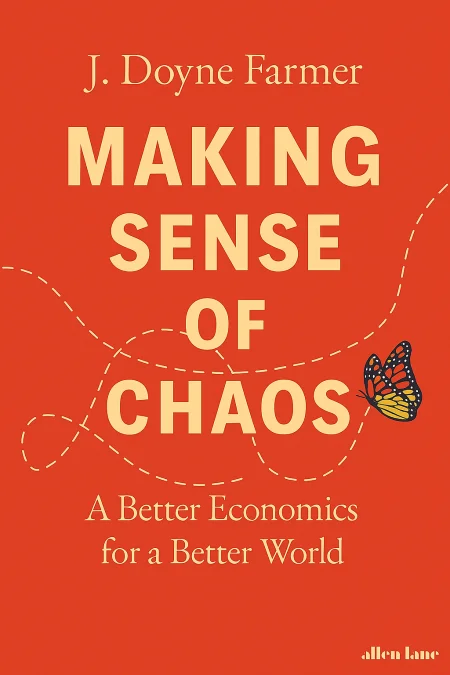
Making Sense of Chaos
A Better Economics for a Better World
Book Edition Details
Summary
Technological wizardry meets economic enlightenment in "Making Sense of Chaos," where Doyne Farmer, the maestro of complexity theory, unveils a paradigm-shifting narrative. In an era where digital intricacies weave through the tapestry of global economics, Farmer's insights illuminate the path from chaos to clarity. This book is a clarion call, urging us to harness the power of big data and computational might to navigate the economic maelstrom of climate challenges, inequality, and societal discord. Through a compelling blend of personal anecdotes and cutting-edge science, Farmer offers a visionary roadmap for constructing a resilient future. As you journey through this provocative exploration, you'll find the tools to transform economic predictions into a catalyst for a brighter, more sustainable tomorrow.
Introduction
Why do financial markets crash without warning, catching even the most sophisticated economists off guard? How can entire industries collapse while others flourish, seemingly overnight? Traditional economic models, built on assumptions of rational actors and stable equilibrium, consistently fail to capture the dynamic, interconnected reality of modern economies. This fundamental disconnect between theory and reality has led to policy failures, missed opportunities, and an inability to address our most pressing economic challenges. Complexity economics offers a revolutionary framework that treats economies as what they truly are: complex adaptive systems similar to ecosystems, weather patterns, or living organisms. Rather than viewing markets as mechanical systems that naturally return to balance, this approach recognizes that economic phenomena emerge from the interactions of millions of individual agents, each making decisions with limited information and bounded rationality. These interactions create patterns and behaviors that cannot be understood by studying individual components in isolation, much like how a flock of birds exhibits coordinated movement without any central coordinator. This perspective illuminates persistent economic puzzles including financial instability, technological disruption, inequality dynamics, and the transition to sustainable energy systems, providing practical tools for prediction and policy-making that could fundamentally transform how we navigate economic uncertainty.
From Equilibrium to Complex Adaptive Systems
Complex adaptive systems theory fundamentally reframes how we understand economic behavior by replacing the fiction of perfectly rational actors with realistic models of human decision-making. In this framework, economic agents operate with bounded rationality, using simple rules of thumb rather than solving complex optimization problems. A household might follow a rule like "save more when unemployment rises in my neighborhood" while a firm might decide "increase investment when competitors are expanding." These individual strategies, while reasonable at the micro level, interact to create emergent macroeconomic phenomena that no single agent intended or could have predicted. The power of this approach becomes evident through agent-based modeling, where researchers simulate thousands of diverse economic actors and observe what patterns emerge from their interactions. Unlike traditional models that assume a single representative agent, these simulations populate virtual economies with heterogeneous actors varying in their risk tolerance, information processing capabilities, and strategic approaches. Some households are cautious savers while others are optimistic spenders; some firms are innovative risk-takers while others follow conservative strategies. These models reveal how macroeconomic patterns arise spontaneously from microeconomic behavior, bridging a gap that has long plagued economics. Business cycles can emerge naturally when households adjust their spending based on their neighbors' economic success, creating waves of optimism and pessimism that ripple through the economy. Housing bubbles form when buyers, lenders, and real estate agents each follow individually rational strategies that collectively create unsustainable price spirals. The approach proves particularly valuable for understanding rare but consequential events like financial crises, which traditional equilibrium models dismiss as virtually impossible but which complexity models show to be natural outcomes of systemic interactions.
Financial Markets as Ecological Networks
Financial markets function as complex ecosystems where different trading strategies compete for profits like species competing for scarce resources. This ecological perspective reveals why markets are inherently unstable and prone to sudden regime shifts that appear to emerge from nowhere. Value investors, who buy underpriced assets and wait for corrections, play a stabilizing role similar to predators keeping prey populations in check. Trend followers, who buy rising assets and sell declining ones, act as destabilizing forces that can amplify price movements far beyond what fundamentals would justify. The relative populations of these different strategy types determine overall market behavior and stability. When trend followers dominate the ecosystem, markets become volatile and prone to bubbles and crashes, as seen during the dot-com boom or the 1987 Black Monday crash where automated portfolio insurance strategies created cascading sell-offs. When value investors dominate, markets remain closer to fundamental values but may respond slowly to new information. The constant evolution of these populations, driven by the success and failure of different approaches, creates the complex dynamics observed in real markets including volatility clustering and fat-tailed return distributions. Leverage cycles add another critical dimension to market ecology by creating feedback loops between asset prices and credit availability. During calm periods, investors borrow more to amplify returns, but this increased leverage makes the entire system more fragile. A small shock can trigger margin calls forcing leveraged players to sell assets, depressing prices further and triggering additional margin calls in a vicious cycle. The 2008 financial crisis exemplified this dynamic on a global scale, where interconnected webs of leveraged institutions created systemic risks that no individual institution anticipated. Understanding these ecological relationships allows regulators to monitor the balance of different strategies and intervene before destabilizing forces become too dominant, much like wildlife managers maintaining healthy predator-prey ratios in natural ecosystems.
Technology Transitions and Climate Economics
The transition to clean energy represents one of the most significant economic transformations in human history, and complexity science provides crucial insights into how this transition will unfold. Rather than treating technological progress as an external factor, complexity economics recognizes that innovation follows predictable patterns driven by learning curves, network effects, and increasing returns to scale. Technologies like solar panels and electric vehicles have followed Wright's Law remarkably well, with costs falling by consistent percentages for every doubling of cumulative production, making renewable energy increasingly cost-competitive with fossil fuels. These technological improvement patterns create nonlinear dynamics where emerging technologies can remain expensive and niche for years before suddenly becoming dominant. Solar photovoltaic costs have dropped over 90 percent since 2010, while battery costs have fallen by similar amounts, triggering cascading changes across multiple industries. Electric vehicles are approaching cost parity with gasoline cars, while renewable energy has become the cheapest form of new electricity generation in most markets. These transitions exhibit tipping point behavior where small policy interventions can accelerate adoption and trigger virtuous cycles of cost reduction and performance improvement. Agent-based models of energy transitions reveal how coordinated action across sectors and countries can accelerate decarbonization while reducing costs. Early movers in clean technology adoption create learning effects and economies of scale that benefit later adopters, suggesting that climate policy should focus not just on carbon pricing but on strategic investments in emerging technologies. The models also illuminate labor market transitions as coal miners and oil workers shift to renewable energy jobs, helping policymakers design retraining programs and social support systems. By understanding the complex dynamics of technological change and economic adaptation, we can navigate the energy transition more effectively, creating a sustainable future while minimizing disruption to fossil fuel-dependent communities and maximizing economic opportunities in clean energy industries.
Summary
The fundamental insight of complexity economics is that economies are not machines seeking equilibrium but living, evolving ecosystems where order emerges from the bottom-up interactions of countless individual agents making decisions with limited information and bounded rationality. This perspective transforms economics from a purely descriptive discipline into a practical toolkit for prediction, policy design, and crisis prevention that could revolutionize how we manage our economic future. As we face unprecedented challenges from financial instability to climate change, complexity economics offers hope by revealing the hidden patterns and feedback loops that drive economic change and showing us where targeted interventions might yield transformative results for building more resilient, sustainable, and prosperous societies.
Related Books
Download PDF & EPUB
To save this Black List summary for later, download the free PDF and EPUB. You can print it out, or read offline at your convenience.
By J. Doyne Farmer
