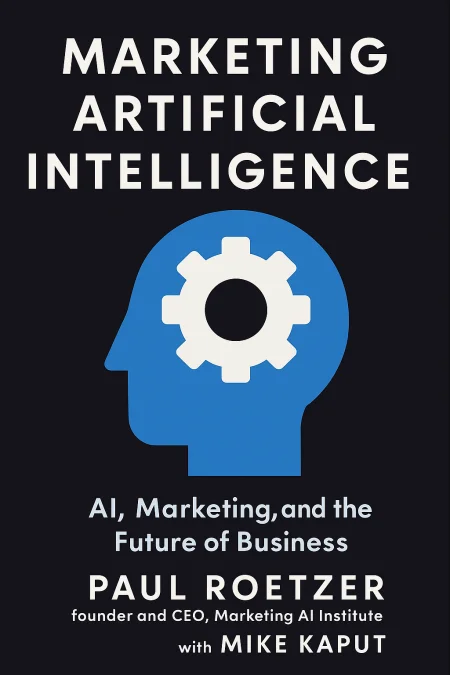
Marketing Artificial Intelligence
AI, Marketing, and the Future of Business
Book Edition Details
Summary
In the dynamic realm where algorithms meet artistry, "Marketing Artificial Intelligence" offers a riveting blueprint for the future of marketing. Authors Paul Roetzer and Mike Kaput illuminate the profound potential of AI, not as a distant fantasy but as a practical ally in revolutionizing how we connect with consumers. With a rich tapestry woven from extensive research and interviews, they unravel the mysteries of AI, showing marketers how to transform overwhelming data into powerful, actionable insights. This isn't just a guide—it's your invitation to harness the extraordinary synergy of human creativity and machine efficiency, making the impossible possible. Step into a world where AI is your competitive edge, poised to redefine your marketing strategy and amplify your success in the ever-evolving digital landscape.
Introduction
Imagine waking up to discover that your most successful marketing campaign was actually designed by a machine. While you slept, artificial intelligence analyzed millions of data points about your customers, predicted which messages would resonate most effectively, and automatically optimized your ad spending across dozens of platforms. This isn't science fiction—it's happening right now in marketing departments around the world. AI has quietly revolutionized how we understand customers, create content, and measure success, yet many marketers still view it as a mysterious technology reserved for tech giants. The reality is far more accessible and transformative. Throughout this exploration, you'll discover how AI can become your most valuable marketing assistant, capable of handling repetitive tasks while amplifying your creative potential. You'll also learn why the most successful marketers are those who embrace this human-machine partnership, using AI not to replace their judgment, but to make their insights more powerful and their strategies more precise than ever before.
Understanding AI: Language, Vision, and Prediction Capabilities
At its core, artificial intelligence in marketing operates through three fundamental capabilities that mirror human cognitive abilities, but with superhuman scale and precision. Language capabilities allow AI systems to read, write, and understand text just as naturally as having a conversation with a colleague. These systems can analyze thousands of customer emails, generate personalized responses, and even craft compelling ad copy that resonates with specific audiences. The technology has advanced to the point where AI can capture your brand's unique voice and maintain it consistently across all communications. Vision capabilities enable machines to see and interpret visual content with remarkable accuracy. AI can recognize your company's logo in social media posts, analyze the emotional expressions on faces in marketing videos, and even determine which colors and layouts will perform best in your next campaign. This visual intelligence extends beyond simple recognition to understanding context and meaning, helping marketers make data-driven decisions about their creative assets. Prediction represents perhaps the most valuable capability for marketers, transforming vast amounts of historical data into actionable insights about future behavior. AI systems excel at identifying patterns that human analysts might miss, predicting which customers are likely to make purchases, when they're most likely to engage with emails, and what products they'll want next. This predictive power extends to forecasting campaign performance, optimizing budget allocation, and even identifying potential customer churn before it happens. The magic happens when these three capabilities work together, creating marketing systems that can simultaneously understand customer communications, analyze visual content, and predict outcomes with increasing accuracy. This combination allows marketers to move beyond guesswork and intuition toward data-driven strategies that consistently deliver better results while requiring less manual effort.
Getting Started: Piloting AI Use Cases Across Marketing Functions
Beginning your AI journey requires a strategic approach that focuses on quick wins rather than revolutionary transformations. The most successful implementations start with identifying specific, repetitive tasks that consume significant time but don't require complex human judgment. Email subject line optimization serves as an excellent entry point because it's measurable, contained, and directly impacts key performance indicators that executives understand and value. The piloting process follows a systematic framework built around five core marketing areas: planning, production, personalization, promotion, and performance. Within planning, AI can assist with lead scoring and audience identification, essentially acting as a tireless research assistant that analyzes customer data patterns. Production applications include content creation and optimization, where AI tools can draft initial blog posts, generate social media captions, or suggest improvements to existing content based on performance data from similar pieces. When selecting initial pilot projects, prioritize use cases that are data-driven, repetitive, and predictive in nature. A successful pilot might involve using AI to personalize email send times for individual subscribers, automatically generate product descriptions for e-commerce sites, or optimize digital advertising budgets across multiple platforms in real-time. These projects deliver measurable results quickly while building internal confidence in AI capabilities. The key to successful piloting lies in setting realistic expectations and measuring the right metrics. Rather than expecting immediate perfection, focus on incremental improvements in efficiency and performance. A modest five percent increase in email open rates or a ten percent reduction in time spent on routine tasks can translate into significant value when scaled across your entire marketing operation, building the foundation for more ambitious AI implementations.
Scaling AI: Building Intelligent Marketing Organizations and Teams
Transforming from isolated AI experiments to organization-wide intelligent automation requires fundamental changes in how marketing teams operate, learn, and evolve. Successful scaling begins with creating a culture of continuous learning where both humans and machines improve together through systematic feedback loops. This means establishing processes where AI systems learn from marketing outcomes while human team members develop increasingly sophisticated ways to guide and interpret AI recommendations. The most effective approach involves reimagining traditional marketing roles rather than simply adding AI tools to existing workflows. Marketing professionals evolve into AI-augmented specialists who combine human creativity and strategic thinking with machine-powered analysis and execution. This transformation requires significant investment in education and training, moving beyond basic tool tutorials to develop deep understanding of how AI systems make decisions and how humans can most effectively collaborate with them. Organizational structure must also evolve to support AI integration across all marketing functions. Rather than creating isolated AI teams, successful companies embed AI capabilities throughout their marketing organization while establishing centers of excellence that provide guidance, standards, and support. This distributed model ensures that AI becomes integral to daily operations rather than remaining a separate, specialized function. The scaling process inevitably encounters challenges around data quality, system integration, and change management. Organizations must invest in robust data infrastructure that can support AI systems across multiple marketing channels while ensuring data privacy and security. Equally important is addressing the human side of transformation, helping team members understand how AI enhances rather than threatens their roles, and providing clear pathways for professional development in an AI-enabled marketing environment.
Human-Centered AI: Ethics, Bias, and Responsible Implementation
The power of AI in marketing comes with significant responsibilities that extend far beyond achieving better campaign performance. As AI systems become more sophisticated at predicting and influencing human behavior, marketers must grapple with fundamental questions about privacy, manipulation, and fairness. The technology that enables personalization at scale also creates unprecedented opportunities for exploitation, making ethical considerations not just moral imperatives but business necessities for long-term success. Bias represents one of the most serious challenges in marketing AI implementation. AI systems learn from historical data, which often contains embedded prejudices and inequalities that can perpetuate or amplify discriminatory practices. A recommendation engine might systematically exclude certain demographic groups from seeing high-value product advertisements, or a lead scoring system might unfairly penalize prospects based on characteristics that correlate with protected attributes. Addressing these issues requires proactive bias detection and mitigation throughout the AI development and deployment process. Responsible AI implementation demands transparency and accountability in how systems make decisions that affect customers and business outcomes. This means being able to explain why an AI system recommended a particular action, understanding the data sources and algorithms involved, and maintaining human oversight over critical decisions. Organizations must establish clear governance frameworks that define acceptable uses of AI, regular auditing processes to detect problems, and mechanisms for addressing issues when they arise. The ultimate goal of human-centered AI is to create marketing systems that enhance human capabilities while respecting human dignity and autonomy. This approach recognizes that the most powerful AI applications are those that amplify human creativity, empathy, and strategic thinking rather than replacing them. By maintaining focus on human values and outcomes, marketers can harness AI's transformative potential while building sustainable, ethical businesses that earn and maintain customer trust in an increasingly AI-driven world.
Summary
The future of marketing lies not in choosing between human intuition and machine intelligence, but in creating powerful partnerships that leverage the unique strengths of both. AI transforms marketing from a field dominated by guesswork and manual processes into a data-driven discipline capable of delivering personalized experiences at unprecedented scale while freeing marketers to focus on strategy, creativity, and authentic relationship building. As you consider implementing AI in your own marketing efforts, ask yourself: What repetitive tasks currently consume your time that could be handled by intelligent systems, and how might you redirect that energy toward the uniquely human skills that no machine can replicate? The marketers who thrive in this new landscape will be those who embrace AI not as a threat to their expertise, but as a tool that amplifies their capacity to understand, engage, and serve their audiences with greater precision and empathy than ever before.
Related Books
Download PDF & EPUB
To save this Black List summary for later, download the free PDF and EPUB. You can print it out, or read offline at your convenience.
By Paul Roetzer
