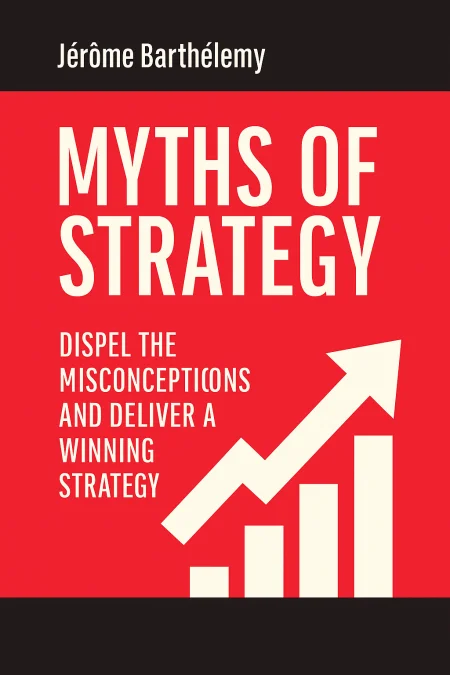
Myths of Strategy
Dispel the Misconceptions and Deliver a Winning Strategy
Book Edition Details
Summary
In a world where business wisdom often comes sugar-coated and oversimplified, "Myths of Strategy" emerges as a beacon of reality. This incisive tome dismantles thirty prevalent myths that clutter the corporate landscape, revealing the gritty truth behind strategic success. Instead of offering empty promises, it challenges the status quo by sifting through the noise of consultant jargon and guru mantras, delivering insights that are both practical and grounded in rigorous research. Part of the enlightening Business Myths series, this book is your antidote to clichéd corporate advice, providing a fresh lens to view the chaos of business strategy. Whether you're a seasoned executive or a curious entrepreneur, this read promises to sharpen your perspective and arm you with the unvarnished truths necessary for genuine success.
Introduction
Business strategy has long been dominated by compelling narratives and seemingly logical prescriptions that promise competitive advantage and sustained success. Yet beneath the surface of these widely accepted principles lies a troubling disconnect between what strategy experts preach and what rigorous research actually reveals. The conventional wisdom surrounding strategic decision-making, from the pursuit of best practices to the glorification of visionary leadership, often rests on flawed assumptions and incomplete evidence. This systematic examination challenges thirty-five pervasive myths that continue to shape corporate boardrooms and executive decisions worldwide. Rather than relying on anecdotal success stories or consultant frameworks, the analysis draws upon decades of peer-reviewed research, controlled studies, and empirical evidence to separate strategic fact from fiction. The approach reveals how cognitive biases, survivorship bias, and oversimplified causation have created a mythology around business strategy that frequently leads organizations astray. The evidence-based perspective demonstrates that many cherished strategic beliefs not only fail to deliver promised results but can actively harm organizational performance. By systematically deconstructing these myths through careful analysis of research findings, patterns emerge that illuminate more reliable paths to strategic success. The journey through this evidence reveals that effective strategy often contradicts intuition and challenges the comfortable certainties that have long guided business thinking.
The Fallacy of Best Practice Imitation
The seductive appeal of benchmarking against industry leaders represents one of the most persistent yet problematic approaches to strategy development. Organizations routinely study successful competitors, identify their common practices, and attempt to replicate these elements within their own operations. This imitation-based strategy appears logical on the surface, yet research consistently demonstrates its fundamental flaws and potential dangers. The core problem lies in the assumption that observable practices of successful companies necessarily caused their success. This correlation-causation confusion creates a false foundation for strategic decision-making. When researchers examine companies that have achieved exceptional performance, they often find common characteristics among these firms. However, without studying unsuccessful companies that may have employed identical practices, it becomes impossible to determine whether these practices actually drive success or simply represent coincidental similarities. The scientific method demands comparison groups to establish causation, yet most business analysis focuses exclusively on winners. This survivorship bias creates an incomplete picture that can mislead strategists into adopting practices that contributed nothing to the success they admire. More troubling still, some practices that appear successful in one context may prove actively harmful in another organizational environment. Benchmarking against successful competitors also inherently limits strategic potential. At best, imitation might help an organization catch up to current leaders, but it can never provide the differentiation necessary to surpass them. True competitive advantage requires unique combinations of resources, capabilities, and market positioning that cannot be simply copied from external examples. The most effective strategies often emerge from internal experimentation and adaptation rather than external imitation.
Innovation Through Experimentation Over Planning
Strategic success increasingly depends on an experimental mindset rather than comprehensive upfront planning. While traditional approaches emphasize detailed analysis and prediction before action, the most effective strategies often emerge through iterative testing and adaptation. This shift from planning to experimentation reflects the fundamental unpredictability of complex business environments and the limitations of forecasting in dynamic markets. The scientific method provides a powerful framework for strategic development that remains underutilized in business contexts. Just as researchers form hypotheses and test them through controlled experiments, organizations can develop strategic hypotheses and validate them through small-scale tests before committing significant resources. This approach reduces risk while generating valuable learning that informs strategic direction. Serendipity plays a crucial role in strategic innovation, but only for organizations actively engaged in exploration and experimentation. The most breakthrough innovations often arise from unexpected discoveries during the pursuit of other objectives. However, these fortunate accidents only benefit organizations with the mindset and infrastructure to recognize and capitalize on unexpected opportunities. Passive planning cannot capture these serendipitous moments. The experimental approach requires tolerance for failure and learning from unsuccessful attempts. Each experiment generates information that refines understanding and improves subsequent efforts, even when individual tests fail to achieve their immediate objectives. This iterative process of hypothesis formation, testing, and refinement creates a learning organization capable of adapting to changing conditions and discovering unexpected opportunities. Organizations that embrace experimentation as a core strategic capability position themselves to thrive in uncertain environments while those committed to rigid planning often struggle to adapt when their predictions prove incorrect.
People and Performance: Beyond Conventional Wisdom
The relationship between talent acquisition strategies and organizational performance reveals significant gaps between popular beliefs and empirical evidence. Many organizations invest heavily in hiring external stars, implementing elaborate recruitment processes, and following conventional wisdom about human capital, yet research suggests these approaches often fail to deliver expected results and may even harm performance. The phenomenon of external hiring presents a particularly striking example of misaligned expectations and outcomes. While organizations frequently pursue high-performing individuals from other companies, expecting them to replicate their success in new environments, research demonstrates that these star performers typically experience significant performance declines after changing organizations. The contextual factors that enabled their previous success, including organizational culture, support systems, and informal networks, rarely transfer with the individual. Moreover, the premium organizations pay for external talent often exceeds any performance benefits they receive. External hires command higher salaries than internal candidates for equivalent positions, yet they demonstrate higher turnover rates and require longer adaptation periods. The most effective approach involves developing internal talent while selectively recruiting external candidates who can contribute unique capabilities that complement existing strengths. Leadership impact, while real, is frequently overestimated relative to other performance drivers. Research indicates that CEO influence accounts for only 10-20 percent of organizational performance variance, with industry characteristics, firm-specific factors, and operational capabilities playing larger roles. This finding challenges the common practice of attributing organizational success or failure primarily to leadership decisions. The most effective leaders recognize these limitations and focus on creating systems and cultures that enable organizational success rather than attempting to control all strategic outcomes through personal intervention.
Strategic Adaptation in Complex Environments
Complex environments characterized by volatility, uncertainty, complexity, and ambiguity demand nuanced strategic responses rather than defensive retreat into familiar practices. While these conditions create genuine challenges for strategic planning, they do not eliminate the possibility of strategic thinking or effective decision-making. Instead, they require different approaches that embrace uncertainty while maintaining strategic direction. Each component of environmental complexity requires specific response strategies. Volatility calls for adaptive capacity and early response to changes before they become crises. Uncertainty benefits from scenario planning and decision frameworks that remain effective across multiple potential futures. Complexity requires systems thinking and recognition of interconnected relationships that influence outcomes. Ambiguity demands experimentation and learning approaches that reveal causal relationships through action rather than analysis. The most effective responses to complex environments often involve proactive rather than reactive strategies. Organizations that attempt to predict and respond to changes often lag behind those that actively shape their environments through innovation, partnership development, and strategic initiatives. This proactive stance requires resources and organizational capability but provides greater influence over outcomes than purely adaptive approaches. Platform strategies exemplify effective responses to complexity by creating ecosystems that benefit from network effects rather than traditional competitive dynamics. These approaches shift focus from controlling resources to orchestrating relationships and enabling value creation by multiple participants. The platform approach demonstrates how organizations can thrive in complex environments by embracing rather than fighting the interconnected nature of modern business ecosystems.
Summary
The systematic examination of strategic myths reveals a fundamental truth about business success that contradicts much conventional wisdom. Effective strategy emerges through evidence-based decision-making, experimental learning, and adaptive responses to environmental complexity rather than through imitation of apparent best practices or adherence to popular frameworks. The research consistently demonstrates that sustainable competitive advantage requires unique approaches tailored to specific organizational contexts rather than universal solutions copied from successful companies.
Related Books
Download PDF & EPUB
To save this Black List summary for later, download the free PDF and EPUB. You can print it out, or read offline at your convenience.
By Jerome Barthelemy
