
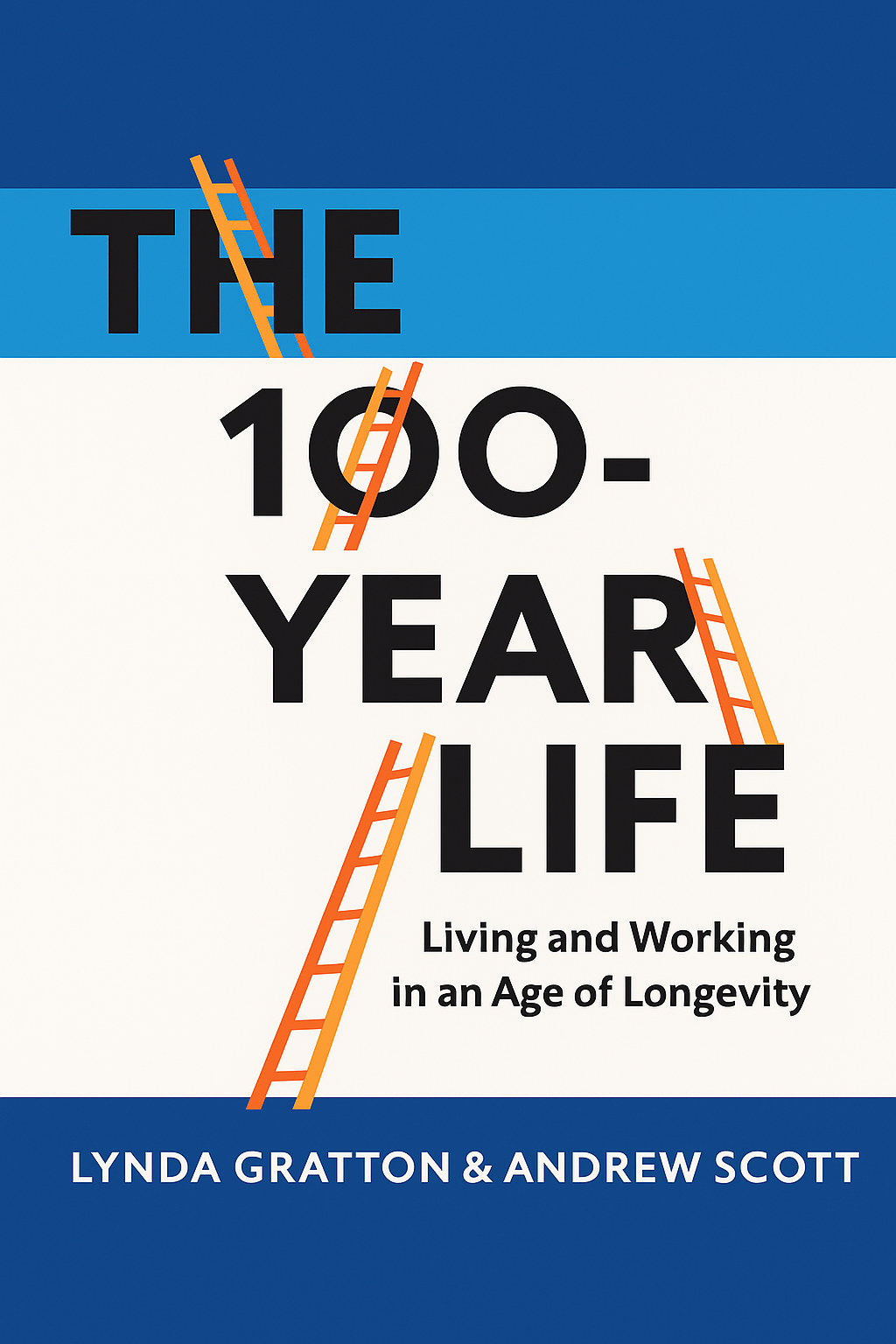
The 100-Year Life
Living and Working in an Age of Longevity
Book Edition Details
Summary
In a world where the sands of time stretch longer than ever, "The 100-Year Life" invites you to reinvent the way you think about your future. Gone are the days of the linear path from education to retirement; authors Lynda Gratton and Andrew Scott challenge you to embrace a dynamic, multi-stage journey that spans a century. As life expectancy soars and the safety nets of the past vanish, this groundbreaking work melds insights from psychology and economics to offer a blueprint for a life filled with vitality and purpose. Whether you're just starting out or contemplating your next move at midlife, this book serves as your compass, guiding you through financial reinvention, career pivots, and the nurturing of relationships. More than just a book, it's a call to action for individuals and society alike to craft a life that's as rich in experience as it is in years.
Introduction
Imagine celebrating your 100th birthday with four generations of your family, still mentally sharp and physically active. This scenario, once the stuff of fantasy, is rapidly becoming reality for millions of people born today. We're witnessing an extraordinary demographic revolution that will fundamentally reshape how we live, work, and relate to one another. While medical advances and improved living conditions have steadily extended human lifespans, we've barely begun to grasp the profound implications of this longevity boom. The traditional three-stage life model of education, career, and retirement was designed for lifespans of 70 years, not 100. This seismic shift demands we completely reimagine the architecture of human life itself. Throughout this exploration, you'll discover how extended lifespans will create entirely new life stages, transform the nature of careers and relationships, and challenge our most basic assumptions about aging, work, and what it means to live a fulfilling life. Most surprisingly, you'll learn why living longer isn't just about adding years to your life, but about fundamentally changing how those years are structured and experienced.
Living Longer: The Science of Extended Lifespans
The mathematics of longevity reveal a stunning trend that has persisted for over 160 years. Since 1840, life expectancy in developed nations has increased at the remarkably consistent rate of three months per year, or roughly 2.5 years per decade. This isn't a recent phenomenon or a temporary blip, but rather a steady, predictable pattern that shows no signs of slowing. A child born in Japan today has a 50 percent chance of living to 107, while their counterparts in Western countries can expect to reach 104. These aren't optimistic projections but conservative estimates based on current trends. This longevity revolution has unfolded in distinct waves. The first major gains came from conquering infant and childhood mortality through improved sanitation, nutrition, and the elimination of infectious diseases like smallpox and tuberculosis. The second wave focused on middle-aged killers, particularly heart disease and cancer, through better medical interventions and public health campaigns against smoking. We're now entering the third wave, targeting the diseases of old age itself, with billions of dollars flowing into research on cellular aging and age-related cognitive decline. What makes this transformation truly remarkable is its consistency across different societies and time periods. The steady progression suggests we're witnessing a fundamental shift in the human condition rather than temporary improvements. Countries starting with lower life expectancies follow the same trajectory as their wealthier predecessors, just delayed by a few decades. This means the 100-year life isn't just a privilege of the affluent nations but a global phenomenon that will eventually touch every corner of the world. The implications extend far beyond simply adding years to life. Medical research increasingly shows that people aren't just living longer but staying healthier for more of those years. The concept of compressed morbidity suggests that while lifespans extend, the period of serious illness and decline at life's end may actually shrink. This means that extra decades could be filled with vitality, creativity, and meaningful contribution rather than prolonged infirmity.
Working Later: Economics of Century-Long Careers
The financial mathematics of a 100-year life present both shocking challenges and hidden opportunities. Consider the stark reality facing different generations: someone born in 1945 needed to save just 4.3 percent of their income annually to fund a comfortable retirement, thanks to robust company pensions and shorter lifespans. Someone born in 1971 must save 17 percent annually to achieve the same standard of living in retirement. Most dramatically, someone born in 1998 would need to save 25 percent of their income every year to retire comfortably at 65, a rate so high it's virtually impossible for most people to achieve. These calculations assume a traditional three-stage life model where people study until their early twenties, work until 65, then retire. But this model breaks down catastrophically when stretched over a century. The alternative isn't necessarily grim, however, if we abandon the rigid retirement age concept. Working until 80 transforms the financial equation entirely, reducing required savings rates to manageable levels while providing decades of additional earning potential. The transformation goes beyond individual choices to reshape entire economic systems. The Pay-As-You-Go pension schemes that supported previous generations are crumbling under demographic pressure. When these systems were designed, there were ten workers supporting each retiree. In many developed countries, this ratio is falling toward two workers per retiree, making current pension promises mathematically impossible to fulfill. Corporate pension schemes are disappearing even faster, shifting the burden of retirement planning entirely onto individuals. Yet working later doesn't mean endless drudgery. The key insight is that careers themselves must evolve beyond the traditional single-profession model. Instead of forty years in one field, people might pursue multiple distinct careers, each lasting ten to fifteen years. This approach allows for reinvention, reduces the risk of technological obsolescence, and provides intellectual stimulation across the extended working life. Financial planning becomes more complex but also more flexible, with multiple income streams and varied saving patterns across different life phases. The transition is already beginning among knowledge workers who have both the skills and bargaining power to reshape their careers. We're seeing the emergence of portfolio careers, consulting arrangements, and gradual transitions rather than abrupt retirement. This trend will accelerate as organizations realize they cannot afford to lose the accumulated wisdom and experience of their senior workforce, while individuals recognize that extended careers can be energizing rather than exhausting when properly structured.
Multi-Stage Life: New Models Beyond Retirement
The rigid three-stage life model is giving way to a more flexible, multi-stage approach that recognizes the reality of century-long lifespans. Instead of the linear progression from education to work to retirement, we're witnessing the emergence of distinct new life stages that can be pursued at various ages and in different sequences. This transformation represents the most significant restructuring of human life patterns since the Industrial Revolution created our current age-segregated society. The Explorer stage represents a period of discovery and option-creation that extends far beyond traditional gap years. Explorers actively investigate different possibilities, travel purposefully, and build diverse networks while keeping their commitments light and their options open. This isn't about avoiding responsibility but about making informed choices when the consequences of those decisions will play out over many decades. Exploration can occur in one's twenties, but also during mid-life transitions or even later as people reinvent themselves for new chapters. The Independent Producer stage involves creating value through entrepreneurial activities, whether building startups, developing creative projects, or crafting new solutions to emerging problems. Unlike traditional entrepreneurs focused on building large enterprises, independent producers often pursue shorter-term, project-based ventures that provide learning experiences and creative fulfillment alongside income generation. This stage allows people to develop skills, build reputations, and create networks outside traditional corporate structures. The Portfolio stage combines multiple activities simultaneously, perhaps mixing paid work, creative pursuits, family responsibilities, and community service. Rather than the single-minded career focus of traditional working life, portfolio stages allow people to diversify their time and energy across different domains. This approach provides both financial security and personal satisfaction while reducing the risks associated with depending entirely on one employer or industry. What makes these stages revolutionary is their age-agnostic nature. Unlike traditional life phases tied to specific ages, these new stages can be entered and re-entered throughout life as circumstances and interests evolve. A 25-year-old might be building a portfolio career while a 65-year-old embarks on an exploration phase. This flexibility allows people to optimize their lives for changing priorities, market conditions, and personal growth opportunities rather than following predetermined paths based solely on their birth year.
Summary
The advent of 100-year lifespans represents the most profound transformation of human existence in centuries, demanding nothing less than a complete reimagining of how we structure our lives, careers, and relationships. The key insight is that longevity isn't simply about adding more years to the end of life, but about fundamentally restructuring those years to create multiple phases of growth, contribution, and renewal throughout the century-long journey. As we move beyond the industrial-age model of education, career, and retirement toward flexible, multi-stage lives, we unlock unprecedented opportunities for personal development, creative expression, and meaningful contribution across multiple decades and domains. This shift challenges us to think differently about aging itself, viewing it not as inevitable decline but as continued evolution and possibility. How will you design your own 100-year life to maximize not just its length but its depth and richness? What new skills, relationships, and experiences will you cultivate across the multiple chapters that await you? For readers fascinated by the intersection of demographics, economics, and human potential, this transformation offers a compelling glimpse into a future where longevity becomes humanity's greatest gift rather than its greatest challenge.
Related Books
Download PDF & EPUB
To save this Black List summary for later, download the free PDF and EPUB. You can print it out, or read offline at your convenience.
By Lynda Gratton
