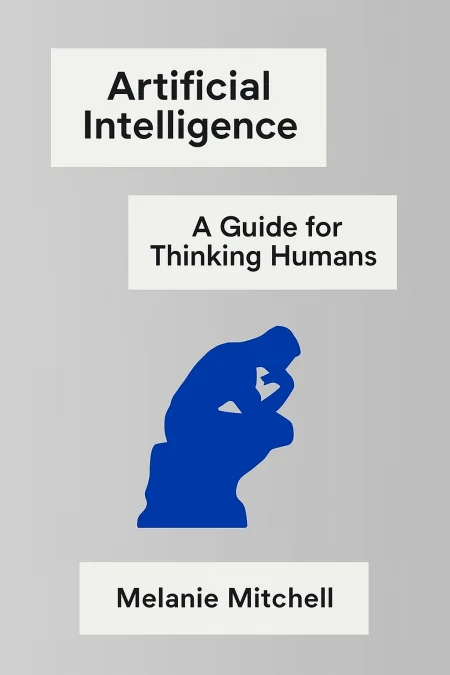
Artificial Intelligence
A Guide for Thinking Humans
Book Edition Details
Summary
In a realm where tomorrow's possibilities are being sculpted by code, Melanie Mitchell's "Artificial Intelligence" offers a spellbinding odyssey into the heart of machine minds and human aspirations. This isn't just a book—it's a conversation with the past, present, and future of AI, as seen through the eyes of one of its most insightful explorers. Mitchell peels back the layers of hype to reveal the true pulse of AI's advances, while deftly illuminating the stark contrast between technological triumphs and the daunting shadows they cast. With wit and wisdom, she introduces us to the pioneers and prophets of AI, including the likes of Douglas Hofstadter, whose candid fears about AI's trajectory add a human touch to this high-stakes narrative. Through tales that are as enlightening as they are entertaining, Mitchell crafts an indispensable guide to understanding the potential and pitfalls of a world increasingly defined by artificial intelligence.
Introduction
Contemporary artificial intelligence presents a fascinating paradox that challenges our fundamental assumptions about machine cognition and intelligence itself. While AI systems demonstrate remarkable capabilities in specific domains - from defeating world champions in complex games to achieving superhuman accuracy in image recognition - a deeper examination reveals that these impressive performances mask a profound absence of genuine understanding. The core argument advanced here centers on the critical distinction between statistical pattern recognition and true comprehension, demonstrating that current AI systems operate through fundamentally different mechanisms than human intelligence. This investigation employs a systematic analysis of deep learning's actual operational principles, revealing how these systems excel at identifying correlations in vast datasets while remaining entirely divorced from conceptual understanding or meaning. The exploration traces the implications of this gap between performance and comprehension, examining why AI systems exhibit such brittleness when confronted with novel situations or adversarial inputs. Through rigorous examination of specific failures and limitations, readers encounter a framework for understanding why the path to genuine machine intelligence requires far more than scaling up current approaches. The analysis challenges both uncritical enthusiasm about AI capabilities and dystopian fears about machine consciousness, offering instead a grounded assessment of what separates sophisticated computation from authentic understanding.
Performance Without Understanding: Deep Learning's Statistical Nature
Deep learning systems achieve their impressive results through a process fundamentally different from human cognition, relying on statistical optimization rather than conceptual understanding. When a convolutional neural network correctly identifies thousands of images in the ImageNet dataset, it has learned to associate specific pixel patterns with particular labels through exposure to millions of training examples. The system adjusts millions of parameters through gradient descent, optimizing mathematical functions to minimize prediction errors across the training data. This process, while computationally sophisticated, bears no resemblance to how humans develop understanding of visual concepts. The statistical nature of this learning becomes apparent when examining what these systems actually encode. A network trained to recognize cats has no understanding of what a cat is - its biological nature, behavior, or relationship to other animals. Instead, the system has learned to detect statistical regularities in pixel arrangements that correlate with the label "cat" in its training data. This distinction explains why such systems can achieve superhuman accuracy on benchmark datasets while simultaneously failing in ways that would never confuse a human observer. The dependency on massive datasets further illustrates this limitation. Deep learning systems require exposure to hundreds of thousands or millions of examples to achieve competent performance, contrasting sharply with human learning where children can recognize new categories from just a few examples. This difference reflects the fundamental gap between statistical pattern matching and genuine concept formation. Humans develop rich, interconnected understanding that allows them to generalize from limited experience, while AI systems remain trapped within the statistical boundaries of their training distributions. The implications extend far beyond academic curiosity when these systems are deployed in critical applications. Medical diagnosis systems that achieve high accuracy on test datasets may fail catastrophically when encountering patient presentations that differ subtly from their training data. The absence of genuine understanding means these systems cannot reason about their decisions, adapt to new contexts, or recognize when they are operating outside their competence boundaries.
The Brittleness Problem: When Pattern Recognition Fails
The brittleness of current AI systems manifests most dramatically in their vulnerability to adversarial examples - inputs that appear unchanged to humans but cause networks to fail spectacularly. Researchers have demonstrated that imperceptible modifications to images can cause state-of-the-art vision systems to misclassify a school bus as an ostrich or a stop sign as a speed limit sign. These vulnerabilities reveal that AI systems have learned to exploit superficial statistical patterns rather than developing robust representations of the concepts they appear to recognize. This brittleness extends beyond adversarial attacks to encompass the broader challenge of handling real-world variability. AI systems trained on carefully curated datasets often fail when confronted with the messy complexity of actual environments. Autonomous vehicle systems that perform well in controlled testing scenarios struggle with construction zones, unusual weather conditions, or unexpected human behavior precisely because these situations fall outside their training experience. The systems lack the contextual understanding that allows humans to adapt flexibly to novel circumstances. The long-tail problem represents another dimension of AI brittleness, occurring when systems encounter the countless edge cases that characterize real-world environments. While individual unusual events may be rare, the sheer number of possible scenarios means that deployed AI systems will inevitably face situations they have never seen before. Unlike humans, who can draw upon rich background knowledge to make reasonable inferences about unfamiliar situations, AI systems have no framework for reasoning beyond their training data. These failures are not merely technical inconveniences but fundamental indicators of missing cognitive architectures. The brittleness stems from the absence of causal understanding, common-sense knowledge, and the ability to form meaningful abstractions. Without these capabilities, AI systems remain sophisticated but ultimately limited pattern-matching engines that cannot achieve the robust, flexible intelligence that characterizes human cognition.
Missing Foundations: Human Intelligence Beyond Pattern Matching
Human intelligence encompasses sophisticated capabilities that current AI systems entirely lack, beginning with the capacity for abstract reasoning that allows people to identify underlying principles applicable across diverse domains. When humans encounter a new problem, they naturally search for analogous situations from their experience, recognizing structural similarities that transcend surface features. This analogical reasoning enables flexible thinking that can adapt general principles to novel situations, a capability that remains entirely absent from current AI architectures. Equally fundamental is human understanding of causality - the ability to reason about cause-and-effect relationships and predict consequences of actions. Humans naturally understand that events have causes and can engage in counterfactual reasoning, considering what would happen if circumstances were different. This causal understanding underlies human capacity for planning, learning from limited examples, and adapting to new situations. Current AI systems, trained on correlational patterns in data, lack any framework for causal inference and consequently struggle when encountering scenarios that require understanding of underlying mechanisms rather than surface patterns. The embodied nature of human intelligence provides another crucial foundation missing from current AI systems. From infancy, humans develop intuitive understanding of physics, biology, and psychology through direct interaction with their environment. This embodied experience creates rich background knowledge about how objects behave, how people think and feel, and how social interactions unfold. Such knowledge forms the foundation for all higher-level reasoning, enabling humans to navigate complex situations with flexibility and insight. Common-sense knowledge represents perhaps the most significant gap between human and artificial intelligence. Humans effortlessly understand that objects fall when dropped, that people have goals and emotions, and that actions have consequences. This vast repository of implicit knowledge about how the world works allows humans to make reasonable inferences in novel situations and avoid the kinds of catastrophic failures that plague AI systems. Current approaches to artificial intelligence have made little progress in capturing this foundational knowledge, leaving AI systems without the conceptual framework necessary for genuine understanding.
Barriers to True Machine Intelligence: Beyond Technical Limitations
The development of genuinely intelligent machines faces challenges that extend far beyond current technical limitations, requiring fundamental advances in knowledge representation, reasoning, and learning that may demand entirely new approaches to artificial intelligence. The problem is not simply one of building larger neural networks or collecting more training data, but of creating systems capable of forming meaningful concepts and reasoning about them with the flexibility that characterizes human thought. Creating AI systems that can acquire and utilize common-sense knowledge represents one of the most formidable challenges facing the field. Decades of research have failed to develop effective methods for encoding the vast body of implicit knowledge that humans take for granted. This knowledge is not merely factual but involves complex understanding of how different concepts relate to each other and how they apply across various contexts. The challenge lies not just in representing this knowledge but in enabling systems to use it flexibly and appropriately in novel situations. The learning problem presents another fundamental barrier to achieving genuine machine intelligence. Current AI systems require massive amounts of training data to achieve competent performance, yet they often fail when confronted with even minor variations from their training experience. Human learning, by contrast, is remarkably efficient and generalizable, allowing people to acquire new concepts from limited examples and immediately apply them in novel contexts. This suggests that human learning involves sophisticated mechanisms for abstraction and generalization that current AI approaches fail to capture. Perhaps most fundamentally, the path to genuine machine intelligence may require abandoning core assumptions that have guided AI research for decades. Rather than treating intelligence as primarily a problem of statistical pattern recognition, future approaches may need to incorporate insights from cognitive science about how humans actually think and learn. This could involve developing hybrid architectures that combine symbolic reasoning with neural processing, creating systems capable of both recognizing patterns and manipulating abstract concepts. The ultimate goal of creating machines that truly understand rather than merely process information remains distant, but recognizing current limitations provides essential guidance for future research directions.
Summary
The comprehensive examination of artificial intelligence's current capabilities reveals a technology that excels at statistical pattern recognition while remaining fundamentally limited in its capacity for genuine understanding. Despite remarkable achievements in narrow domains, AI systems lack the flexible, contextual comprehension that characterizes human intelligence, operating through mechanisms that are fundamentally different from human cognition. This analysis demonstrates that the gap between impressive performance metrics and true understanding represents not merely a technical hurdle but a profound conceptual barrier that separates sophisticated computation from authentic intelligence. The path forward requires not just incremental improvements to existing approaches but fundamental advances in how machines represent knowledge, reason about causality, and learn from experience - challenges that illuminate the extraordinary complexity of intelligence itself and suggest that genuine machine understanding may require entirely new paradigms in artificial intelligence research.
Related Books
Download PDF & EPUB
To save this Black List summary for later, download the free PDF and EPUB. You can print it out, or read offline at your convenience.
By Melanie Mitchell
