
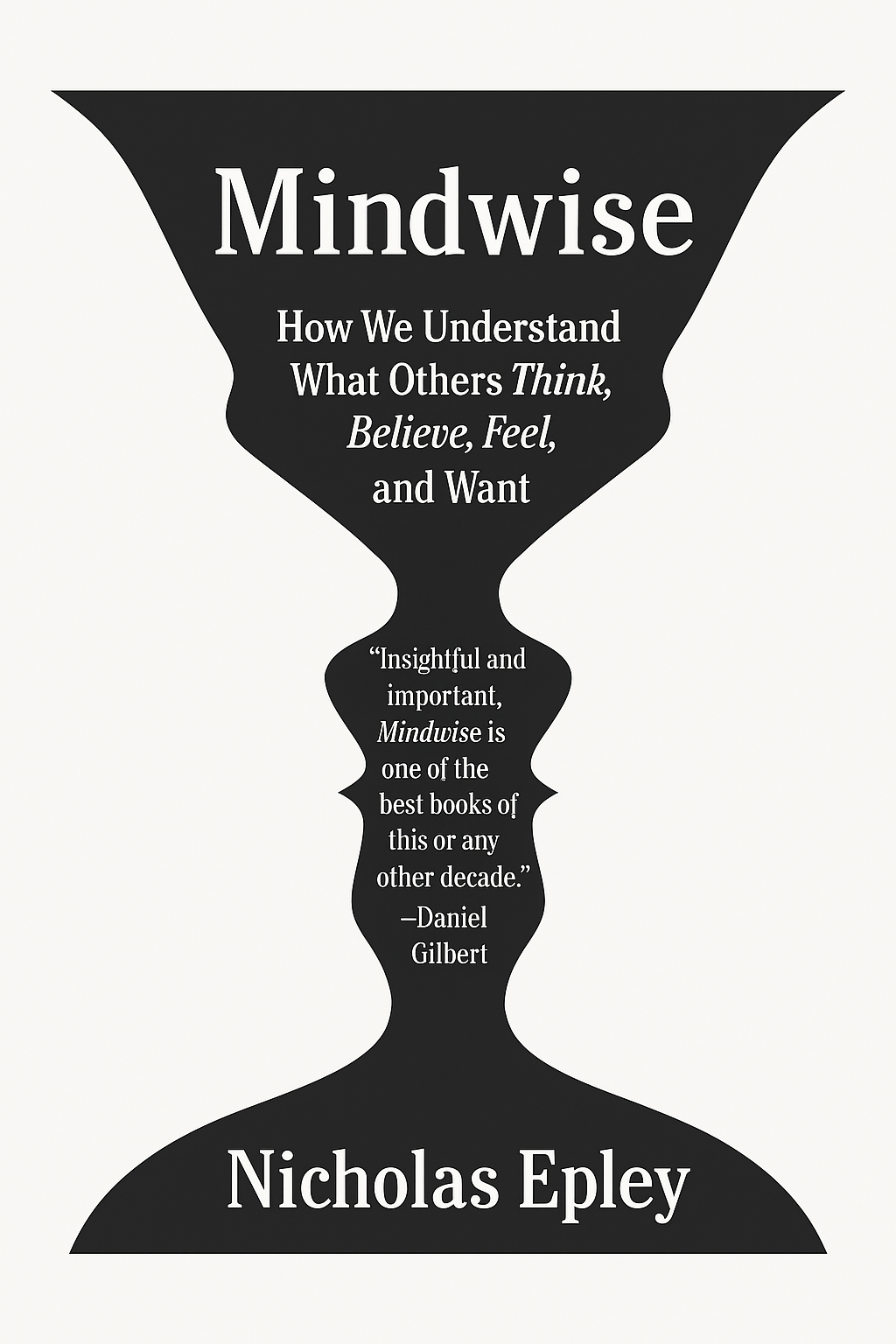
Mindwise
How We Understand What Others Think, Believe, Feel and Want
Book Edition Details
Summary
What if the key to understanding others was as elusive as a shadow, dancing just out of reach? In "Mindwise," Nicholas Epley, a renowned psychologist, peels back the layers of our everyday interactions to reveal the startling truth about our perceived mind-reading abilities. We often wander through life believing we can intuit the thoughts and feelings of those around us, yet Epley unveils the common missteps that cloud our perceptions. Why do we attribute human traits to inanimate objects or assume our loved ones share our viewpoints? This insightful exploration challenges your assumptions and equips you with the wisdom to navigate the rich tapestry of human connection with clarity and empathy, inviting you to rethink how you perceive others—and yourself.
Introduction
Human beings possess what appears to be a remarkable sixth sense: the ability to peer into the minds of others and discern their thoughts, feelings, and intentions. This capacity for mental telepathy operates so seamlessly in daily life that we rarely question its accuracy or consider its limitations. Yet beneath our confident assessments of what others think lies a systematic pattern of overestimation that creates profound consequences across every domain of human interaction. The central challenge is not that we lack mind-reading abilities entirely, but that our confidence in these abilities dramatically exceeds their actual precision. We routinely misjudge how well we understand our spouses, colleagues, and even ourselves, creating a dangerous gap between perceived insight and reality. This overconfidence manifests in contexts ranging from intimate relationships to international diplomacy, where the stakes of misunderstanding extend far beyond personal embarrassment. Through rigorous examination of psychological research and real-world examples, a compelling pattern emerges revealing the systematic ways our social intuitions mislead us. These errors stem from predictable cognitive shortcuts that prioritize efficiency over accuracy, leading us to rely on flawed tools for understanding others. By identifying these patterns and developing more humble approaches to social perception, we can bridge the gap between confidence and competence in reading minds.
The Illusion of Insight: Our Systematic Overconfidence Problem
The most fundamental flaw in human social perception lies not in complete blindness to others' mental states, but in our dramatic overestimation of our accuracy in reading them. Controlled psychological experiments consistently reveal that people's confidence in their mind-reading abilities shows virtually no correlation with their actual performance. This creates what researchers term an illusion of insight, where subjective certainty masks objective uncertainty. The overconfidence manifests across diverse relationships and contexts. Married couples, despite years of intimate knowledge, achieve accuracy rates of only 35 percent when predicting their partner's moment-to-moment thoughts and feelings, compared to 20 percent for complete strangers. Yet their confidence remains stubbornly high, creating the false impression of deep mutual understanding. Similarly, professional negotiators consistently overestimate their ability to detect deception and understand their counterpart's true priorities, leading to suboptimal outcomes despite their expertise. This systematic bias extends to high-stakes professional contexts where accurate social perception carries enormous consequences. Emergency room physicians assess patient pain levels from facial expressions, judges evaluate witness credibility from courtroom demeanor, and military leaders make strategic decisions based on their perceived ability to read foreign counterparts. The persistent overconfidence in these assessments can lead to medical misdiagnosis, wrongful legal judgments, and international miscalculations that affect millions of lives. The illusion persists because our subjective experience of understanding others feels immediate and authoritative, much like our confidence in our own thoughts and emotions. This phenomenological similarity creates the false impression that we have direct access to others' mental states, when in reality we are making educated guesses based on limited and often misleading information. Recognizing this fundamental limitation represents the first step toward developing more calibrated social perception.
Three Cognitive Tools That Mislead: Egocentrism, Stereotypes, and Attribution
When attempting to understand others, human cognition relies on three primary mental shortcuts that provide genuine insight while simultaneously introducing systematic errors. Egocentrism leads us to use our own minds as the default template for understanding others, assuming they share our knowledge, preferences, and perspectives more than they actually do. This projection occurs because our own mental states are most accessible to us, serving as an anchor point that proves difficult to adjust sufficiently when considering different viewpoints. The egocentric bias manifests in numerous predictable ways, from overestimating how obvious our emotions are to others, to assuming our moral judgments reflect universal truths rather than personal values. Parents consistently overestimate their children's knowledge of information the parents consider basic, while experts struggle to imagine the genuine confusion of novices in their field. This curse of knowledge creates communication breakdowns when people fail to adjust their explanations to match their audience's actual level of understanding rather than their assumed comprehension. Stereotypes represent our second major tool for social understanding, automatically activated when we categorize someone as belonging to a particular group. While stereotypes often contain statistical truths about group differences, they systematically exaggerate the magnitude of these differences while minimizing the substantial variation within groups. Research demonstrates that people's stereotypes about gender, age, race, and political affiliation typically capture the correct direction of real differences but overestimate their size by factors of three to ten, creating distorted impressions of how different groups actually are from one another. The correspondence bias constitutes our third flawed cognitive tool, leading us to infer people's character and intentions directly from their observed actions while underestimating the power of situational forces. When someone behaves rudely, we assume they possess a rude personality rather than considering they might be responding to unusual pressures or circumstances. This attribution error proves particularly problematic because the situational influences on behavior often remain invisible to observers, leading to fundamental misunderstandings about others' true personalities, motivations, and capabilities.
Why Intuitive Mind-Reading Techniques Fail Us
Popular approaches to enhancing mind-reading accuracy consistently fail to deliver on their promises, often increasing confidence without improving actual performance. Body language interpretation, despite widespread belief in its effectiveness, provides surprisingly unreliable information about others' thoughts and emotions. Controlled studies reveal that people who can only hear someone speaking achieve greater accuracy in detecting emotions than those who rely solely on visual cues like facial expressions and gestures, contradicting the common assumption that nonverbal communication carries the most important information. The myth of microexpressions as reliable indicators of deception has been thoroughly debunked through rigorous empirical research. These supposedly telltale facial movements lasting less than one-fifth of a second appear in only about two percent of emotional expressions and occur equally often when people tell the truth as when they lie. Professional training programs based on microexpression detection, including those used in airport security screening, have proven ineffective at identifying actual threats while generating high rates of false positives that waste resources and create unnecessary anxiety. Perspective-taking, the deliberate attempt to imagine oneself in another person's situation, also fails to improve understanding and can sometimes make accuracy worse. When people try to adopt another's viewpoint, they often access their own stereotypes about that person's group or circumstances, potentially amplifying rather than correcting their existing biases. Negotiation experiments demonstrate that participants instructed to consider their counterpart's perspective often become more suspicious and competitive rather than more understanding, as the exercise activates concerns about being exploited rather than genuine empathy. The fundamental limitation of these intuitive techniques lies in their reliance on the same flawed cognitive mechanisms that create mind-reading errors in the first place. Attempting to read body language more carefully or imagine another's perspective more vividly cannot overcome the basic constraint of having access only to our own subjective experience. These approaches may increase confidence in our social judgments without improving their accuracy, creating an even more dangerous combination of certainty and error that leads to poor decisions in both personal and professional contexts.
Beyond Guesswork: The Case for Direct Communication
The most effective strategy for understanding others involves abandoning attempts to read minds telepathically and instead creating conditions that encourage people to reveal their thoughts directly. This fundamental shift from perspective-taking to perspective-getting requires developing skills in asking better questions, listening more carefully to responses, and reducing psychological barriers that prevent honest communication. Research consistently demonstrates that this direct approach yields dramatically superior results compared to intuitive inference. Studies examining romantic relationships reveal that partners who interview each other about relevant topics before making predictions cut their error rates in half compared to those who rely on existing knowledge and imagination alone. Similarly, military and business organizations achieve significantly better outcomes when they systematically survey personnel about morale and satisfaction rather than having leaders guess at these crucial factors based on casual observations and assumptions about employee attitudes. Effective perspective-getting requires creating psychological safety that encourages honest responses rather than socially desirable ones. People withhold information or provide misleading answers primarily to avoid negative consequences, so reducing these fears through confidentiality guarantees, immunity from punishment, or demonstrated openness to criticism dramatically improves the quality of information obtained. Professional interrogators have discovered that rapport-building and threat reduction prove far more effective than intimidation for eliciting truthful responses, even from hostile subjects. The approach also demands formulating questions that people can actually answer accurately based on their genuine self-knowledge. Individuals understand their current feelings and preferences better than their reasons for having them, and they know their present mental state more reliably than their future reactions to hypothetical situations. Successful perspective-getting focuses on concrete present experiences rather than abstract explanations or speculative projections, mirroring techniques developed by professional pollsters who have learned to predict complex social phenomena by asking the right questions in precisely the right way.
Summary
True understanding of others requires abandoning the seductive fantasy of telepathic insight in favor of the patient work of genuine communication and systematic humility about our own perceptions. The path forward lies not in sharpening our intuitive mind-reading abilities, which are fundamentally limited by the opacity of consciousness itself, but in recognizing these limitations and developing more direct methods for accessing others' perspectives. The most profound insight emerges from accepting that minds remain largely hidden from external observation, making honest dialogue rather than confident inference the foundation of authentic human understanding.
Related Books
Download PDF & EPUB
To save this Black List summary for later, download the free PDF and EPUB. You can print it out, or read offline at your convenience.
By Nicholas Epley
