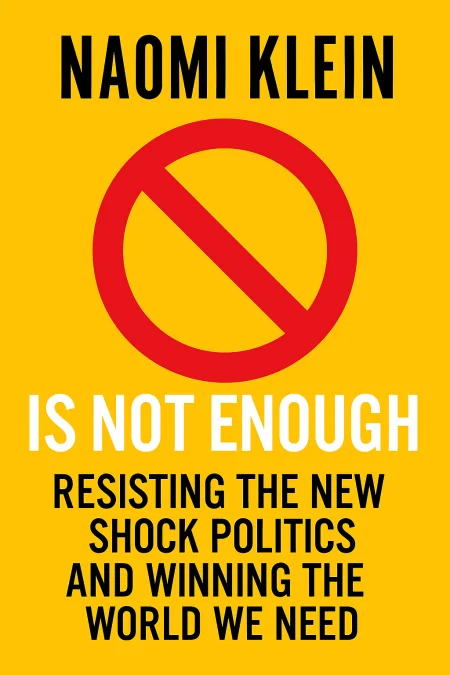
No Is Not Enough
Resisting the New Shock Politics and Winning the World We Need
Book Edition Details
Summary
In a time when reality itself feels stranger than fiction, Naomi Klein dissects the phenomenon of Donald Trump with a sharp, unflinching lens. "No Is Not Enough" navigates the intricate tapestry of cultural obsessions and corporate maneuvers that sculpted this larger-than-life figure into a political reality. Klein pulls back the curtain on the unsettling theater of shock politics—where facts are fluid and crises are currency—urging us not to succumb to despair but to harness our collective power. With wit and urgency, she unveils a roadmap for resistance and renewal, challenging us to envision a future unbound from the chaos of the present. This is not just a critique; it's a clarion call to reclaim our world.
Introduction
The ascension of Donald Trump to the American presidency represents far more than an electoral anomaly or populist backlash against established politics. It embodies the culmination of a systematic transformation in how corporate power operates within democratic societies, revealing the emergence of what can be understood as "disaster capitalism" in its most refined form. This phenomenon demonstrates how moments of social disruption and crisis become opportunities for implementing radical economic policies that would face insurmountable resistance under normal circumstances. The analysis employs a framework that connects seemingly disparate elements: the rise of brand-based political identity, the strategic exploitation of social and environmental crises, and the systematic capture of democratic institutions by concentrated wealth. This approach reveals patterns that extend far beyond American borders, showing how similar dynamics have reshaped societies from Chile to Eastern Europe, always following predictable sequences of shock, disorientation, and radical restructuring in favor of corporate interests. Understanding these patterns becomes crucial for developing effective resistance strategies that go beyond merely opposing individual policies to address the underlying mechanisms that generate authoritarian populism and ecological destruction. The investigation demonstrates how movements can anticipate and counter shock doctrine tactics by preparing comprehensive alternatives that address the root causes of social and environmental crisis rather than merely responding to their symptoms.
Corporate Coup: Trump's Brand Capitalism and Governmental Capture
The Trump presidency represents the apotheosis of brand-based capitalism, where the traditional boundaries between corporate identity, celebrity culture, and political authority have completely dissolved. Trump's business model exemplifies the hollow brand phenomenon that emerged in the 1980s, where companies shifted from manufacturing products to manufacturing meaning, outsourcing production while capturing value through brand licensing and image creation. The Trump Organization operates as a licensing empire rather than a traditional business, extracting profits by attaching the Trump name to properties owned and operated by others while bearing minimal financial risk. This model created perfect synergy between business interests and political persona, where the presidency serves as the ultimate brand extension. Every policy decision and public appearance increases the value of the Trump name globally, transforming governance into a continuous revenue-generating activity. The conversion of Mar-a-Lago into a for-profit "Winter White House" exemplifies this dynamic, where paying customers can literally purchase access to presidential power, normalizing the direct monetization of democratic institutions. The administration's composition reveals the extent of corporate capture, with cabinet appointments collectively worth over fourteen billion dollars representing industries from fossil fuels to private military contractors. This represents not merely corruption but a structural transformation where governmental functions are directly subordinated to private profit motives. Key figures like Rex Tillerson from ExxonMobil and Steve Mnuchin from foreclosure operations brought expertise in extracting value from crisis situations, suggesting systematic preparation for exploiting future disasters. The implications extend beyond individual enrichment to a fundamental redefinition of democratic governance itself. When political power becomes indistinguishable from brand management and profit generation, the concept of public service loses all meaning. This model threatens to normalize the idea that democratic institutions exist primarily to serve the financial interests of those who control them, rather than the broader population whose consent theoretically legitimizes governmental authority.
Shock Doctrine Politics: Crisis Exploitation for Radical Transformation
The Trump administration's governance strategy follows the classic shock doctrine playbook: create or exploit moments of crisis to implement radical policies that would be impossible under normal democratic conditions. This approach relies on overwhelming the public with rapid-fire changes while maintaining constant atmospheric chaos that prevents effective opposition from organizing. The administration's early months demonstrated this technique through relentless executive orders, policy reversals, and inflammatory statements designed to keep opponents constantly reactive rather than proactive. Shock doctrine politics exploit the psychological impact of trauma and disorientation on democratic decision-making processes. When populations experience overwhelming change and conflicting information, they become more susceptible to authoritarian solutions and less capable of sustained resistance. The Trump team's background in reality television and professional wrestling provided expertise in manufacturing drama and manipulating public attention, skills that translate directly into political shock tactics that disorient and exhaust opposition movements. Historical precedents from Chile under Pinochet to Iraq under American occupation demonstrate how shock tactics can permanently restructure societies in favor of corporate interests. The pattern remains consistent: moments of crisis create opportunities to implement unpopular policies like privatization of public services, elimination of labor protections, and deregulation of financial markets. The Trump administration's wish list included many policies requiring crisis conditions: Social Security privatization, environmental deregulation, and expanded surveillance capabilities. The strategy becomes particularly dangerous when combined with the administration's extensive ties to disaster capitalism industries. Key appointees built careers profiting from crisis situations, whether through military conflicts that drive up oil prices or financial deregulation that creates new bubble economies. Their presence in government suggests willingness to create or exploit future shocks for economic gain, making the administration both beneficiary and potential architect of the crises it claims to address.
Climate Emergency: Democratic Failure Under Corporate Authoritarianism
The climate crisis represents a unique form of shock that operates on geological rather than political timescales, creating urgent deadlines for systemic transformation that cannot be postponed through electoral cycles or policy negotiations. Unlike economic or security crises that can be managed through incremental adjustments, climate change demands complete restructuring of energy systems, transportation networks, and consumption patterns within a rapidly closing window of opportunity. The Trump administration's aggressive climate denial and fossil fuel promotion directly conflicts with this timeline, creating collision between political expediency and physical reality. Trump's cabinet represented the most direct merger of fossil fuel interests with governmental power in American history, featuring executives from ExxonMobil, coal companies, and oil pipeline firms in key environmental positions. This constituted not merely regulatory capture but complete inversion of environmental governance, where agencies tasked with protecting public health and natural systems were administered by individuals whose careers were built on degrading them. The systematic dismantling of climate research and environmental monitoring represented attempts to make the crisis invisible rather than address its causes. The economic implications of serious climate action explain the fierce resistance from fossil fuel interests. Meaningful climate policy would require keeping trillions of dollars worth of proven oil, gas, and coal reserves permanently underground, effectively stranding the assets that underpin these companies' stock valuations and debt structures. The Trump administration's energy policies can be understood as desperate attempts to extract maximum value from these assets before global climate action renders them worthless, regardless of environmental consequences. Climate change functions as a "threat multiplier" that exacerbates existing inequalities while creating new opportunities for disaster capitalism to profit from reconstruction and adaptation efforts. Rising sea levels, extreme weather events, and resource scarcity disproportionately impact vulnerable populations while generating crises that justify further corporate consolidation and authoritarian measures. This creates vicious cycles where climate impacts generate emergencies that enable the very policies that accelerate ecological breakdown.
Beyond Resistance: Building Systemic Alternatives to Disaster Capitalism
Effective opposition to Trump-style authoritarianism requires more than defensive resistance; it demands compelling alternative visions capable of addressing the underlying conditions that made his rise possible. The failures of neoliberal centrism to provide economic security, social cohesion, or environmental sustainability created the vacuum that Trump filled with nationalist populism and corporate authoritarianism. Progressive movements must offer concrete policies that deliver material improvements in people's lives while building social solidarity necessary to resist divide-and-conquer tactics. Historical examples of successful resistance to shock doctrine politics demonstrate the importance of having alternative policies prepared for implementation when crises create openings for change. The New Deal emerged from years of organizing and policy development by labor unions, civil rights groups, and progressive intellectuals who were ready when the Great Depression created space for systemic reform. Contemporary movements must engage in similar preparatory work, developing detailed proposals for economic transformation, democratic reform, and ecological transition that can be rapidly implemented when political opportunities arise. The interconnected nature of contemporary crises demands intersectional approaches that recognize how racial oppression, economic inequality, gender violence, and environmental destruction reinforce each other within existing power structures. Trump's coalition relies on maintaining artificial divisions between groups that share common interests in democratic governance, economic justice, and ecological sustainability. Breaking down these divisions requires demonstrating through policy and practice how liberation movements strengthen rather than compete with each other. The transition from fossil fuel dependence to renewable energy systems provides opportunities for restructuring economic relationships more broadly. Community-controlled energy projects can generate local employment, keep profits within communities, and create models of democratic ownership that challenge corporate concentration. Similarly, massive infrastructure investments required for climate adaptation could prioritize public goods and worker cooperatives over private profit maximization, demonstrating how ecological necessity can become the foundation for economic democracy.
Summary
The Trump phenomenon reveals the logical endpoint of decades-long processes that have concentrated wealth, weakened democratic institutions, and exploited social divisions for economic gain, demonstrating that effective resistance requires understanding these systemic roots rather than treating authoritarianism as an isolated aberration. The administration's shock doctrine tactics, brand-based governance model, and climate denial represent different facets of a coherent project to restructure society in favor of oligarchic interests, making clear that defensive resistance alone cannot address the scale of transformation required. The climate crisis adds particular urgency to this political moment, as the window for avoiding catastrophic warming continues narrowing while fossil fuel interests use their political power to accelerate extraction and consumption. Only by building alternative visions that address the interconnected crises of democracy, inequality, and environmental destruction can progressive movements create lasting change rather than merely slowing the pace of deterioration, proving that another world remains possible even in the darkest of times.
Related Books
Download PDF & EPUB
To save this Black List summary for later, download the free PDF and EPUB. You can print it out, or read offline at your convenience.
By Naomi Klein
