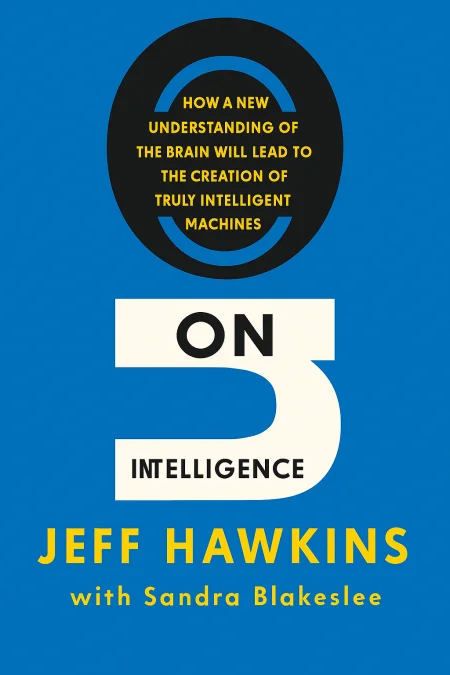
On Intelligence
How a New Understanding of the Brain Will Lead to the Creation of Truly Intelligent Machines
byJeff Hawkins, Sandra Blakeslee
Book Edition Details
Summary
In a world dominated by binary logic, Jeff Hawkins invites us to rethink the very essence of intelligence. Known for pioneering the PalmPilot and shaping modern technology, Hawkins now turns his visionary mind toward the human brain, offering a groundbreaking perspective that challenges our most basic assumptions. Contrary to the mechanical precision of computers, our brains function as complex memory systems, weaving past experiences into intricate tapestries of prediction and perception. With the narrative flair of science writer Sandra Blakeslee, Hawkins dissects the enigma of consciousness, promising not only a deeper understanding of our minds but also the dawn of machines that could one day surpass human capabilities. "On Intelligence" is a compelling manifesto for the future, where neuroscience and artificial intelligence converge to redefine what it means to be truly intelligent.
Introduction
Why have decades of artificial intelligence research failed to produce truly intelligent machines, while a three-year-old child can effortlessly recognize faces, understand language, and navigate complex environments? This fundamental question exposes a critical gap in our understanding of intelligence itself. Rather than focusing on behavior as the hallmark of intelligence, this work presents a revolutionary framework that positions memory and prediction as the core mechanisms underlying human cognition. The memory-prediction framework challenges conventional approaches to both neuroscience and artificial intelligence by proposing that intelligence emerges from the brain's ability to store sequences of patterns and use them to predict future events. This theory suggests that the neocortex operates as a hierarchical memory system, constantly making predictions about sensory input and updating its model of the world based on experience. Understanding this mechanism opens new pathways for comprehending consciousness, creativity, and human behavior while providing a blueprint for building genuinely intelligent machines that could revolutionize technology and expand our knowledge of the universe.
The Memory-Prediction Framework of Intelligence
Intelligence fundamentally differs from the computational processes found in traditional computers or artificial intelligence systems. The memory-prediction framework reveals that intelligence stems from the brain's capacity to store experiences as sequences of patterns and use these memories to continuously predict future events. This predictive ability forms the essence of understanding, learning, and conscious experience. The framework operates through three interconnected mechanisms that work together to create intelligent behavior. First, the brain stores sequences of sensory patterns rather than isolated snapshots, allowing it to capture the temporal relationships between events. Second, it employs auto-associative memory recall, where partial or distorted inputs can trigger complete memory patterns, enabling recognition even under changing conditions. Third, it creates invariant representations that capture the essential relationships between objects and events independent of specific sensory details, allowing knowledge to transfer across different contexts and situations. Consider how you recognize a familiar song played in a different key or on a different instrument. Your brain doesn't store every possible version of the melody but rather learns the invariant relationships between notes—the intervals and rhythmic patterns that remain constant regardless of the specific pitch or timbre. When you hear the song in a new context, your memory-prediction system recognizes these invariant patterns and predicts what should come next, allowing you to follow along effortlessly. This same principle applies to recognizing faces from different angles, understanding speech with various accents, or navigating familiar environments under different lighting conditions. The memory-prediction framework thus provides a unified explanation for the remarkable flexibility and adaptability that characterizes human intelligence.
How the Neocortex Works: Hierarchical Structure
The neocortex, the brain region responsible for intelligence, operates as a hierarchical memory system with a remarkably uniform structure throughout its various regions. This six-layered neural tissue processes information through multiple levels of abstraction, with lower levels handling basic sensory features and higher levels forming increasingly complex and invariant representations of objects, concepts, and relationships. Information flows both upward and downward through this cortical hierarchy in a continuous cycle of prediction and verification. Sensory data enters at the bottom levels, where it gets processed and passed upward to regions that recognize increasingly complex patterns. Simultaneously, higher regions send predictions downward about what the lower regions should expect to experience next. When predictions match incoming sensory data, the system operates smoothly and efficiently. However, when unexpected patterns arise that cannot be predicted by lower levels, this information cascades upward until some region can make sense of it and generate new predictions. The hierarchical structure mirrors the nested organization of the real world itself. Just as words are composed of letters, sentences of words, and stories of sentences, the brain's memory system reflects these natural hierarchies. Consider how you recognize your home: lower cortical regions might detect edges and textures, intermediate regions identify doors and windows, while higher regions recognize rooms and ultimately the complete house. Each level contributes to your understanding, but the highest levels maintain stable representations even as you move through different rooms or view the house from various angles. This hierarchical organization allows the brain to understand both the fine details and the broader context simultaneously, enabling the rich and flexible intelligence that emerges from this elegant neural architecture.
Consciousness, Creativity, and Human Intelligence
Consciousness emerges naturally from the memory-prediction framework as the subjective experience of having a hierarchical memory system that constantly models the world and predicts future events. Rather than being a mysterious property that requires special explanation, consciousness represents the brain's ongoing process of comparing predictions with sensory input and maintaining a coherent model of reality through memory. Creativity operates as an inherent feature of the prediction system, manifesting whenever the brain applies stored patterns to novel situations through analogical thinking. Every act of prediction involves creativity because the brain must match current circumstances with past experiences that are never exactly identical. This process ranges from simple everyday acts like recognizing a familiar face in new lighting conditions to profound insights where distant analogies illuminate complex problems. The mathematician who sees similarity between a current equation and one solved years ago, or the artist who connects seemingly unrelated concepts through metaphor, both engage the same fundamental mechanism of pattern matching across different domains. Human intelligence distinguishes itself from other mammals through two primary factors: the dramatically larger size of our neocortex and our development of language. The expanded cortical area allows us to perceive deeper patterns, form more complex analogies, and maintain sophisticated models of abstract concepts like mathematics, science, and social relationships. Language amplifies this capacity by enabling us to share our internal models with others, creating a cumulative knowledge base that transcends individual lifetimes. Through language, we can invoke specific memories and create new combinations of ideas in other minds, allowing human knowledge to build progressively across generations. This combination of expanded neural capacity and linguistic communication has enabled humans to become the most adaptable species on Earth, capable of thriving in virtually any environment through our collective ability to learn, predict, and share understanding of the world's complex patterns.
Building Intelligent Machines: Future Applications
Intelligent machines built on the memory-prediction framework will differ fundamentally from both traditional computers and the humanoid robots of science fiction. These systems will operate by learning hierarchical models of their environments through experience, much like human children develop understanding through exposure and practice. Rather than being programmed with explicit rules, they will observe patterns in their sensory input and build predictive models that enable them to understand and anticipate events in their domain. The technical challenges of building such machines center on creating large-capacity hierarchical memory systems with sufficient connectivity to support the complex pattern relationships found in real-world environments. Silicon-based implementations will likely exceed biological brains in several key dimensions: processing speed potentially millions of times faster than neurons, memory capacity expandable far beyond human limits, perfect replicability allowing trained systems to be copied and shared, and exotic sensory capabilities that could perceive patterns invisible to human senses such as global weather systems, power grid fluctuations, or molecular-level interactions. Rather than replacing humans, these intelligent machines will excel in domains where human senses and cognitive capabilities are limited. Imagine a weather prediction system that experiences global atmospheric patterns directly through distributed sensors, building predictive models with the same intuitive understanding that humans have of familiar objects moving through space. Or consider medical research systems that perceive molecular interactions and protein folding patterns with the same immediacy that humans experience visual scenes. Such machines could accelerate scientific discovery, enhance our understanding of complex systems, and solve problems that remain intractable to traditional computational approaches. The revolutionary applications will likely emerge from areas we cannot yet imagine, just as the internet and mobile communications arose from the basic development of computer chips and telecommunications, ultimately transforming society in ways their inventors never anticipated.
Summary
Intelligence emerges from the brain's fundamental capacity to store sequences of patterns in hierarchical memory and use these stored experiences to predict future events, with prediction rather than behavior serving as the true measure of understanding. This memory-prediction framework not only explains the remarkable flexibility and creativity of human cognition but also provides a roadmap for building genuinely intelligent machines that could extend human knowledge into realms currently beyond our sensory and cognitive reach. By recognizing that intelligence operates through pattern recognition, hierarchical memory, and predictive modeling, we gain both deeper insight into our own minds and practical guidance for creating technologies that could accelerate scientific discovery, solve complex global challenges, and ultimately expand the boundaries of human understanding in ways that will reshape our relationship with knowledge itself.
Related Books
Download PDF & EPUB
To save this Black List summary for later, download the free PDF and EPUB. You can print it out, or read offline at your convenience.
By Jeff Hawkins
