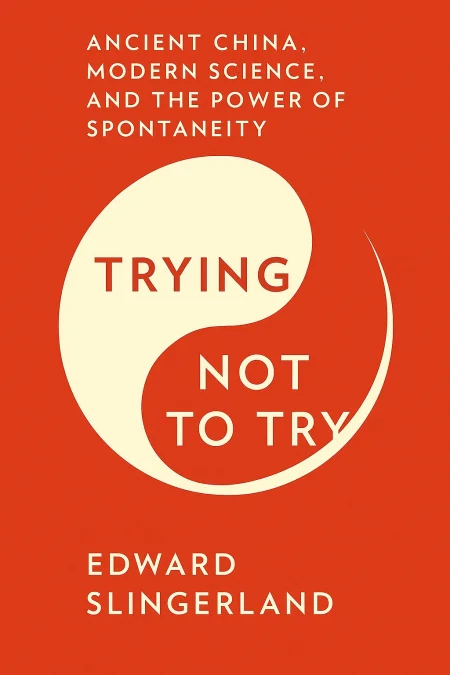
Trying Not to Try
Ancient China, Modern Science, and the Power of Spontaneity
Book Edition Details
Summary
In a world where effort often betrays intention, "Trying Not to Try" by Edward Slingerland unlocks the art of effortless living through the wisdom of ancient Chinese philosophy. Why do we falter when striving for perfection? What secret magic allows a butcher’s blade to dance through an ox or a sculptor’s chisel to reveal hidden beauty? This book invites you to rediscover the power of spontaneity — the elusive wu-wei — that the ancients revered and cognitive scientists now explore. Slingerland marries Eastern insights with modern science, unveiling how embracing a natural flow can lead to happiness, authenticity, and success. Whether you're wooing on a first date or seeking calm in chaos, find harmony in the paradox of trying not to try. This is not just philosophy; it’s a transformative journey to a more fulfilling life, set against the backdrop of stories that dance like a symphony of the human spirit.
Introduction
Human experience reveals a maddening contradiction that cuts across cultures and centuries: the very qualities we most desire—spontaneity, charisma, peak performance, authentic happiness—become increasingly elusive the harder we pursue them. This fundamental tension between conscious effort and effortless achievement represents more than a philosophical curiosity; it illuminates the deepest structures of human psychology, social cooperation, and the evolutionary challenges that shaped our species. Ancient Chinese philosophers during the Warring States period identified this paradox through their concept of wu-wei, literally "non-action" or effortless action. Their insights, remarkably prescient, align with contemporary neuroscience discoveries about dual-system cognition and the neurological basis of expertise. The paradox emerges because genuine mastery, authentic virtue, and natural charisma all require a kind of strategic surrender of conscious control—yet this surrender cannot itself be consciously orchestrated without contaminating the very spontaneity it seeks to achieve. This exploration traces four distinct ancient strategies for cultivating effortless action, revealing how each approach grapples with the same unsolvable tension between trying and not trying. The analysis demonstrates that this paradox serves essential evolutionary functions in human societies, acting as a reliable signal of genuine commitment that cannot be easily faked. Understanding why effortless action defies direct pursuit offers practical wisdom for navigating contemporary challenges where excessive self-consciousness and optimization often undermine the outcomes we most desperately seek.
The Fundamental Paradox: When Conscious Effort Destroys Desired Outcomes
Wu-wei represents a state of optimal functioning where complex actions unfold with supernatural ease while the conscious mind steps aside. Athletes describe this as "being in the zone," musicians experience it during inspired improvisation, and craftspeople achieve it when their tools seem to move with their own intelligence. The defining characteristic of wu-wei is not the absence of effort, but rather the absence of self-conscious striving that typically accompanies difficult tasks. This effortless mastery comes paired with de—a natural charismatic power that others instinctively recognize and trust. Unlike manufactured charm or calculated persuasion, de emerges spontaneously from genuine wu-wei states and cannot be consciously produced. Those possessing de do not try to influence others; their authentic presence naturally draws people into harmony around them, creating the foundation for genuine leadership and social cooperation. The paradox crystallizes because wu-wei, by its very definition, cannot be achieved through direct pursuit. The moment we consciously try to be spontaneous, we introduce the self-awareness that destroys spontaneity. This creates a catch-22 that has frustrated seekers across cultures: we need wu-wei to be truly effective and attractive, yet any conscious effort to attain it becomes self-defeating. Every attempt to force relaxation increases tension; every strategy to appear natural produces artificiality. Modern neuroscience reveals why this contradiction is built into human cognition itself. Our brains operate through two fundamentally different systems—fast, unconscious processing that handles skilled behavior, and slow, deliberate cognition that monitors and controls. Wu-wei occurs when these systems integrate seamlessly, but conscious efforts to achieve this integration paradoxically disrupt it, creating the very self-consciousness that blocks effortless flow.
Ancient Strategies and Their Inherent Limitations: Four Paths to Effortlessness
The Confucian approach treats wu-wei as the culmination of intensive cultural training and moral cultivation. Through rigorous study of classical texts, mastery of ritual forms, and immersion in traditional practices, students gradually internalize civilized patterns until proper behavior becomes second nature. This "carving and polishing" strategy acknowledges that humans require extensive reshaping to achieve genuine spontaneity within cultural frameworks, operating on the principle that sustained conscious effort can eventually produce unconscious mastery. Confucian cultivation works by downloading conscious learning into automatic habit, similar to how driving a car transitions from effortful concentration to unconscious skill. The ultimate goal mirrors Confucius's own achievement at age seventy, when he could "follow his heart's desires without transgressing propriety"—complete spontaneity operating within perfect cultural form. This approach assumes that artificial becomes natural through sufficient repetition and internalization. Daoist thinkers like Laozi rejected this strategy as fundamentally misguided, arguing that cultural conditioning corrupts our natural goodness and that wu-wei emerges only by stripping away artificial desires and social programming. The Daoist sage embraces the "uncarved block" of original nature, returning to childlike simplicity through practices that quiet analytical thinking and reconnect with intuitive wisdom. Rather than adding layers of cultivation, this approach removes obstacles to our inherent spontaneity. Zhuangzi developed the most sophisticated Daoist technique through "fasting of the mind"—methods for transferring control from conscious cognition to what he termed spiritual energy or qi. His exemplars achieve wu-wei by forgetting conventional categories and responding directly to situations as they unfold, remaining empty and receptive so appropriate action can emerge naturally from embodied wisdom. Each strategy contains profound insights yet ultimately fails to fully resolve the paradox, as intensive training can produce mechanical compliance, abandoning effort often leads to passivity, and even perfect flexibility can become another form of attachment.
Evolutionary Logic: Why Authenticity Cannot Be Faked in Cooperative Societies
The persistence of the wu-wei paradox across cultures reveals its function in solving humanity's greatest evolutionary challenge: enabling cooperation among genetically unrelated strangers in large-scale societies. Traditional mechanisms for ensuring trustworthiness—kinship bonds, personal relationships, rational contracts—prove insufficient for the complex, ongoing interactions that civilization requires. Instead, humans evolved sophisticated systems for detecting authentic commitment to shared values through signals that bypass conscious control. Genuine emotions like moral outrage, loyalty, and righteous indignation serve as "commitment devices" that make cooperative intentions credible to others. These feelings work precisely because they lead to seemingly irrational behavior—sacrificing immediate gains to punish unfairness or maintain principles. However, this emotional commitment must be authentic; any conscious calculation undermines the very trust it attempts to establish, creating the fundamental tension between genuine virtue and its social rewards. Wu-wei functions as a particularly reliable signal because it cannot be easily manufactured on demand. Someone displaying effortless absorption in valued activities, natural grace under pressure, or spontaneous concern for others demonstrates internalized commitment that conscious performance cannot replicate. The very difficulty of achieving wu-wei makes it a trustworthy indicator of genuine character, distinguishing those with deeply held values from skilled manipulators. Archaeological evidence from ancient China shows this paradox emerging alongside the transition from tribal societies to complex civilizations. Oracle bone inscriptions reveal rulers already grappling with the tension between authentic virtue and its benefits. The paradox serves an essential evolutionary function: wu-wei must remain elusive to maintain its signaling value, acting as a natural filter that ensures only those with genuinely internalized values can consistently display markers of trustworthiness, enabling the complex social structures that define human civilization.
Navigating Paradox: Strategic Approaches to an Unsolvable Human Dilemma
Rather than seeking definitive solutions to an inherently unsolvable paradox, wisdom lies in understanding how different approaches serve various personalities, situations, and life stages. The tension between effort and effortlessness cannot be eliminated because it performs essential functions in human social life, but it can be navigated more skillfully through strategic application of cultivation methods that acknowledge the paradox rather than attempting to resolve it. Individual temperament significantly determines which approaches prove most effective. Conservative personalities may find structured Confucian discipline more natural, while liberal temperaments might gravitate toward Daoist spontaneity. Age and experience also matter—intensive training suits those building foundational skills, while letting go becomes appropriate when excessive effort has become counterproductive. The key is matching strategy to circumstance rather than seeking universal solutions. Context determines approach as much as personality. Learning new skills requires conscious attention and deliberate practice to build foundations that later enable effortless performance. Social situations where authenticity matters most make trying too hard inevitably backfire, favoring Daoist approaches. Complex problems resisting direct assault often yield better to stepping back and allowing unconscious processing rather than continued analytical effort. The highest insight recognizes that wu-wei cannot be achieved through any single method but emerges from dynamic interplay between effort and surrender, structure and spontaneity, conscious intention and unconscious wisdom. Like jazz musicians who master scales through disciplined practice only to transcend them in improvisation, peak human achievements require both rigorous preparation and courage to let go when moments demand it. Success comes not from resolving the paradox but from dancing skillfully within its tensions.
Summary
The wu-wei paradox reveals that humanity's deepest excellences—authentic virtue, genuine charisma, peak performance—cannot be directly pursued without undermining themselves, yet somehow must be cultivated to emerge at all. This contradiction forms the practical foundation of human cooperation, trust, and civilization itself, as the impossibility of faking effortless authenticity makes it a reliable signal of genuine commitment to shared values. While no single strategy resolves this paradox, understanding its evolutionary logic and learning to navigate between effort and surrender offers wisdom for skillful living in a world where trying too hard often defeats itself, yet not trying leads nowhere. The paradox endures because it serves essential functions in human social evolution, filtering for trustworthiness while enabling the complex relationships that distinguish our species.
Related Books
Download PDF & EPUB
To save this Black List summary for later, download the free PDF and EPUB. You can print it out, or read offline at your convenience.
By Edward Slingerland
