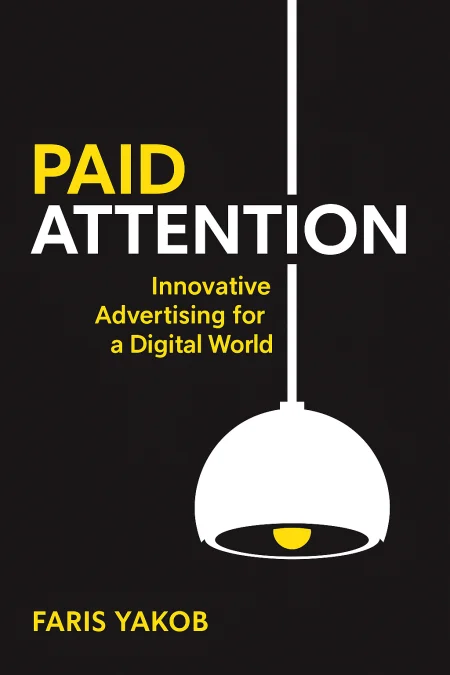
Paid Attention
Innovative Advertising for a Digital World
Book Edition Details
Summary
In an age where the digital din drowns out the voices of many, "Paid Attention" offers a lifeline to brands grappling with the chaos of modern media. As communication channels evolve from famine to feast, the battle for consumer awareness intensifies. This insightful exploration dives into the mechanics of influence, weaving together threads from neuroscience, creativity, and cultural shifts. It dissects the blurred lines between content and advertisement and challenges the antiquated methods of market research. As ad-blockers and fleeting focus span the horizon, the book crafts a roadmap for brands to captivate audiences in innovative ways, urging a pivot from traditional tactics to a more dynamic, idea-driven approach. Prepare to rethink advertising in a world where grabbing attention is not just an art, but a necessity for survival.
Introduction
In an era where human attention has become the scarcest commodity, how do brands compete in an infinitely cluttered digital landscape? The traditional advertising playbook, built for a world of limited media channels and captive audiences, now faces obsolescence in the face of empowered consumers who can skip, block, and ignore commercial messages at will. This transformation demands nothing less than a fundamental reimagining of how communication works. This work presents a comprehensive theoretical framework for understanding attention as an economic resource and brands as complex cultural constructs that must earn rather than buy their way into consumer consciousness. The analysis draws from behavioral economics, cognitive psychology, and media theory to construct a new paradigm for marketing effectiveness. At its core lies the recognition that we have shifted from a media environment defined by scarcity to one characterized by abundance, where the rules of engagement have fundamentally changed. The framework addresses how brands can navigate this transition by understanding attention markets, leveraging recombinant cultural processes, and adopting integrative strategic approaches that treat all brand actions as forms of communication.
From Brands as Myths to Attention Economics
The evolution of brands from simple product identifiers to complex cultural phenomena represents one of the most significant shifts in modern commerce. This transformation can be understood through the lens of mythological replacement theory, which suggests that brands have stepped into the cultural void left by declining traditional mythologies in Western society. Just as ancient myths provided meaning and resolved contradictions in human experience, modern brands serve similar functions by offering coherent narratives that help consumers navigate an increasingly complex world. The mythological framework reveals why brands are inherently complex and resist simple definition. Like myths, brands are composed of multiple interconnected elements, or brandemes, that work together to create meaning. Coca-Cola, for instance, is not merely about refreshment but encompasses redness, youth, sharing, tradition, and countless other associative elements that combine to form a rich cultural construct. This complexity allows brands to remain relevant across different contexts and consumer interpretations while maintaining coherent identity. This mythological function explains why brands have become so culturally pervasive and economically valuable. They provide the meaning-making frameworks that help individuals construct identity and navigate social relationships. When someone chooses a particular brand, they are not simply selecting a product but participating in a larger cultural narrative. This participation creates the psychological and social value that drives premium pricing, loyalty, and the brand equity that appears on corporate balance sheets. The transition from myth to brand also illuminates why authenticity has become such a crucial concern in marketing. Authentic brands, like enduring myths, must demonstrate consistency between their stated values and their actions. They must embrace both their positive attributes and their shadow elements, creating more complex and believable narratives that resonate with human experience in all its contradictions.
The Failure of Traditional Advertising Models
The fundamental assumptions underlying traditional advertising have been systematically undermined by advances in behavioral science and changes in media consumption patterns. The rational actor model that dominated advertising thinking for decades assumed that consumers make decisions through conscious evaluation of product benefits and advertising messages. However, research in behavioral economics and cognitive psychology demonstrates that most purchasing decisions occur through unconscious, emotional processes that operate below the threshold of conscious attention. The traditional messaging paradigm faces a more profound challenge in the form of attention fragmentation. In a world where consumers can access infinite content and have unprecedented control over their media consumption, the interruption-based advertising model begins to resemble spam. The military vocabulary of traditional media planning, with its emphasis on targeting, campaigns, and executions, reveals an adversarial relationship with consumers that is no longer sustainable when those consumers possess the technological means to fight back. Market research, the foundation upon which traditional advertising strategy has been built, suffers from fundamental epistemological flaws. Asking people about their preferences and intentions provides unreliable data because individuals do not have conscious access to their decision-making processes. The gulf between claimed attitudes and actual behavior renders most survey-based research ineffective for predicting real-world outcomes. When people are forced to rationalize their choices in research settings, they create post-hoc explanations that may bear little resemblance to the unconscious factors that actually drive their behavior. This breakdown of traditional models is accelerated by the emergence of digital technologies that make previously private consumption behaviors observable and measurable. Real-time data about search behavior, social sharing, and purchase patterns provides more accurate indicators of consumer sentiment than survey responses. The shift toward data-driven creativity represents an attempt to ground advertising decisions in observable behavior rather than claimed preferences.
Recombinant Culture and Creative Combination
The digital age has ushered in an era of recombinant culture, where creativity is increasingly understood as the art of combining existing elements in novel ways rather than creating entirely original content. This theoretical framework, rooted in cognitive science and cultural studies, suggests that all ideas are fundamentally new combinations of pre-existing elements. The creative process involves exposing oneself to diverse influences and finding non-obvious connections between seemingly disparate concepts. The recombinant approach challenges romantic notions of originality and genius, instead positioning creativity as a learnable process of intelligent borrowing and transformation. This shift is particularly relevant in advertising, where the democratization of content creation tools means that brands can no longer rely solely on production values or technical sophistication to capture attention. The key lies in developing superior combinatorial skills that allow for the creation of unexpected and meaningful connections. The framework distinguishes between copying and stealing in creative work. Copying reproduces surface elements without transformation, while stealing takes inspiration from diverse sources and transforms them into something genuinely new. The most effective creative work steals from sources that are remote in time, culture, or category, creating dynamic tension between familiar and unfamiliar elements. This approach requires practitioners to maintain broad cultural awareness and resist the tendency toward narrow specialization. Digital technologies have accelerated recombinant processes by making vast libraries of cultural content instantly accessible and manipulable. The remix has become the dominant cultural form of the digital age, with consumers routinely creating their own versions and variations of brand content. This shift requires marketers to design campaigns that invite participation and transformation rather than passive consumption. The most successful advertising ideas in the digital environment are those that provide platforms for creative expression rather than finished messages.
Integrative Strategy for Social Brand Behavior
The fragmentation of media and the socialization of communication require a fundamental shift from campaign-based thinking to platform-based strategy that treats brands as behavioral systems rather than communication entities. This integrative approach recognizes that every brand action communicates and that traditional boundaries between advertising, product development, customer service, and corporate behavior have dissolved in an environment where information flows freely and instantaneously. The social media environment operates according to different behavioral grammar than traditional commercial communication. Success requires brands to adopt the reciprocal and generous behaviors that characterize healthy social relationships rather than the transactional approaches of traditional advertising. This means solving consumer problems, providing value, and engaging in genuine dialogue rather than simply broadcasting messages. The shift from push to pull marketing requires brands to earn attention through useful actions rather than purchasing it through media placements. Strategic integration demands that all brand touchpoints work together as an interoperating system rather than merely coordinated campaigns. This systems approach considers how different elements can amplify each other and create cumulative effects greater than the sum of their parts. Digital technologies enable real-time responsiveness that allows brands to adapt their behavior based on immediate feedback from social media and other direct communication channels. The emergence of branded content, social media marketing, and experiential campaigns represents tactical responses to this strategic shift, but success requires deeper organizational changes. Brands must develop capabilities for rapid response, authentic voice development, and community management while maintaining strategic coherence across all activities. This evolution transforms marketing from a communication function to a business strategy function that guides organizational behavior at the highest levels.
Summary
The fundamental insight that emerges from this comprehensive analysis is that we have entered an era where brands must earn attention through valuable behavior rather than purchase it through traditional media placements. The theoretical framework presented here provides the intellectual foundation for understanding this transition and developing effective responses to it. By recognizing brands as complex cultural constructs, embracing recombinant creative processes, and adopting integrative strategic approaches, organizations can navigate the challenges of the digital attention economy while building stronger relationships with their audiences. This paradigm shift represents more than a tactical adjustment to new media channels; it constitutes a fundamental reimagining of the relationship between organizations and the people they serve. The implications extend beyond marketing to encompass organizational design, corporate behavior, and business strategy. Those who master these new principles will find themselves better positioned not only to capture attention but to create meaningful value in an increasingly connected and transparent world.
Related Books
Download PDF & EPUB
To save this Black List summary for later, download the free PDF and EPUB. You can print it out, or read offline at your convenience.
By Faris Yakob
