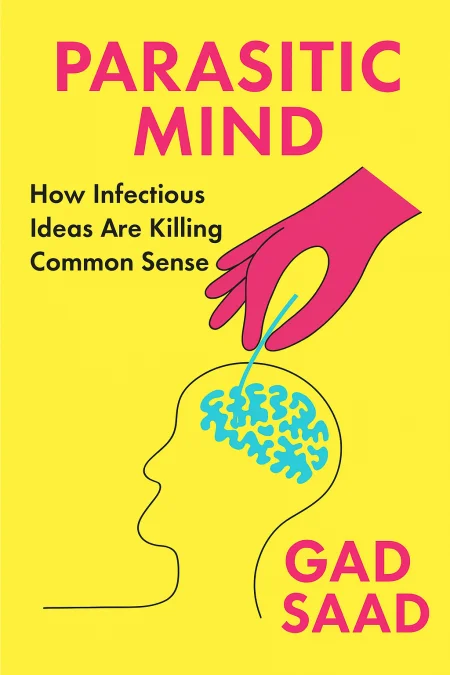
Parasitic Mind
How Infectious Ideas Are Killing Common Sense
byGad Saad
Book Edition Details
Summary
In the battle for the soul of Western civilization, Dr. Gad Saad stands as a torchbearer against the creeping shadows of intellectual conformity. His book, "The Parasitic Mind," serves as a rallying cry for those who refuse to let reason drown in the sea of political correctness. With the precision of a surgeon, Saad dissects the "idea pathogens" germinated in academia, now infecting politics, business, and culture. These corrosive ideologies threaten to smother free thought and spirited debate, but Saad empowers us with the tools to fight back. This provocative manifesto urges a return to critical thinking and fearless expression, challenging readers to reclaim their intellectual sovereignty in an age of emotional tumult and manufactured consensus.
Introduction
Western civilization faces an unprecedented intellectual crisis. Universities, once bastions of rigorous inquiry and open debate, have transformed into breeding grounds for anti-rational ideologies that reject fundamental principles of science, logic, and evidence-based reasoning. These destructive thought patterns operate like parasites of the human mind, systematically dismantling our capacity for critical thinking while promoting emotional reactions over factual analysis. The symptoms are everywhere: safe spaces replacing intellectual challenges, trigger warnings substituting for academic rigor, and identity politics overriding merit-based evaluation. The assault on reason manifests through multiple interconnected movements—postmodernism's rejection of objective truth, radical feminism's denial of biological realities, social justice activism's embrace of perpetual victimhood, and cultural relativism's refusal to make moral distinctions. These ideological viruses share a common characteristic: they immunize themselves against criticism by labeling any opposition as bigotry, racism, or hatred. This creates an intellectual ecosystem where feelings trump facts, where personal narratives override empirical evidence, and where ideological purity matters more than truth-seeking. Understanding how these mind viruses operate, spread, and maintain their grip on institutions becomes essential for anyone committed to preserving rational discourse. The battle for Western civilization's intellectual foundations requires recognizing these patterns, developing immunity against their influence, and actively defending the principles that made scientific and social progress possible.
The War Against Reason: Universities as Breeding Grounds for Anti-Science
Modern universities have abandoned their foundational mission of pursuing truth through rigorous inquiry. Instead, they have become laboratories for cultivating ideological conformity under the banner of diversity, inclusion, and equity. This transformation represents a fundamental betrayal of academic principles, where questioning certain narratives can result in professional destruction rather than scholarly advancement. The evidence of this intellectual corruption appears across disciplines. Postmodern theories reject the existence of objective reality, claiming that all knowledge is merely social construction serving power structures. Gender studies departments deny biological differences between men and women, insisting that all observed disparities result from societal oppression. Climate science becomes weaponized to advance political agendas rather than pursue empirical understanding. Mathematical reasoning itself gets labeled as a tool of white supremacy. Faculty hiring practices demonstrate systematic discrimination against conservative viewpoints, creating echo chambers where progressive orthodoxy goes unchallenged. Students arrive at universities expecting intellectual growth but instead receive indoctrination into victimhood narratives and grievance-based thinking. The result is a generation of graduates who cannot engage in rational debate because they have never encountered genuine intellectual opposition. This institutional capture of higher education has downstream effects throughout society. Graduates carry these anti-rational mindsets into government, media, corporate leadership, and cultural institutions. What begins as campus lunacy eventually shapes policy decisions, journalistic standards, and social norms across Western civilization.
Feeling Over Facts: How Emotions Trump Truth in Modern Academia
Contemporary academic culture has inverted the traditional relationship between emotion and reason, elevating subjective feelings above objective analysis. This emotional primacy manifests through concepts like "lived experience" being treated as superior to empirical data, "microaggressions" being classified as violence, and hurt feelings being considered grounds for suppressing speech. The trigger warning phenomenon exemplifies this emotional fragility. Students demand advance notice of potentially upsetting content, creating an expectation that education should never cause psychological discomfort. This represents a fundamental misunderstanding of learning, which necessarily involves confronting uncomfortable truths and challenging preexisting beliefs. Safe spaces further institutionalize this fragility by providing refuges from opposing viewpoints rather than developing intellectual resilience. Universities have restructured their operations around protecting feelings rather than pursuing truth. Administrators craft policies to minimize offense rather than maximize learning. Professors self-censor to avoid student complaints rather than challenge misconceptions. Research topics become off-limits if they might produce findings that conflict with progressive sensibilities. The entire academic enterprise subordinates itself to emotional management rather than intellectual advancement. This emotional prioritization extends beyond campus boundaries into broader cultural debates. Scientific findings get dismissed if they threaten preferred narratives about gender, race, or sexuality. Historical analysis becomes impossible when certain conclusions are predetermined to be unacceptable. Political discourse degenerates into emotional manipulation rather than rational argumentation. The cumulative effect is a society increasingly incapable of making decisions based on evidence and reason.
The Pathology of Progressivism: Deconstructing Social Justice Ideology
Progressive ideology operates as a comprehensive worldview that reframes every social phenomenon through the lens of oppression and victimhood. This framework divides humanity into rigid categories of oppressors and oppressed, with moral virtue determined by one's position in this hierarchy rather than individual actions or character. Identity politics serves as the organizational principle for this ideology, reducing complex human beings to simple demographic categories. Intersectionality multiplies these categories, creating elaborate systems for measuring relative victimhood. The result is a competitive environment where individuals vie for victim status rather than pursuing achievement or contribution. This dynamic incentivizes grievance-mongering while discouraging personal responsibility or resilience. Social justice activism promotes concepts that actively undermine rational discourse. Cultural appropriation restricts artistic expression and cross-cultural exchange. Microaggression theory pathologizes normal social interaction. Privilege checking silences dissent by attributing disagreement to demographic characteristics rather than addressing substantive arguments. These mechanisms function as thought-stopping techniques that prevent genuine intellectual engagement. The movement's approach to solving social problems reveals its fundamental irrationality. Rather than addressing specific injustices through targeted reforms, it demands comprehensive transformation of society based on untested theories. Rather than measuring success through objective outcomes, it focuses on symbolic gestures and ideological purity. This approach guarantees perpetual failure while providing endless justification for expanding activist power and influence.
Fighting Back: Restoring Scientific Method and Intellectual Courage
Defending rational discourse requires understanding how anti-rational ideologies operate and developing systematic approaches to counter their influence. The scientific method provides the most reliable framework for distinguishing truth from falsehood, but it must be actively defended against ideological corruption and emotional manipulation. Intellectual courage becomes essential for anyone committed to truth-seeking. This involves willingness to investigate uncomfortable questions, present unpopular findings, and resist social pressure to conform to ideological expectations. Such courage requires accepting that pursuit of truth may result in professional costs, social ostracism, or personal attacks. The alternative—surrendering intellectual integrity to avoid conflict—ultimately destroys the foundations of rational inquiry. Institutions must be reformed to protect and reward truth-seeking rather than ideological conformity. This means eliminating diversity bureaucracies that police thought, ending speech codes that restrict debate, and restoring merit-based evaluation criteria. Faculty hiring should prioritize intellectual quality over demographic characteristics. Curriculum should emphasize critical thinking skills rather than activist indoctrination. Individual resistance plays a crucial role in this restoration effort. People must refuse to participate in ideological rituals, challenge false narratives when encountered, and support those who demonstrate intellectual courage. This requires developing immunity to social pressure tactics while maintaining commitment to rational principles. The cumulative effect of individual resistance can create cultural change that makes institutional reform possible.
Summary
The fundamental insight here concerns how sophisticated societies can lose their capacity for rational thought through the systematic cultivation of intellectual parasites that hijack normal reasoning processes. These ideological viruses succeed by exploiting human psychological tendencies toward conformity, emotional reasoning, and tribal loyalty while immunizing themselves against criticism through moral manipulation. The restoration of rational discourse requires not just defending truth in the abstract, but actively cultivating intellectual virtues like curiosity, courage, and humility while building institutions that reward rather than punish genuine inquiry. This work will resonate with readers who recognize that the stakes extend far beyond academic disputes to encompass the very survival of enlightenment values and scientific progress.
Related Books
Download PDF & EPUB
To save this Black List summary for later, download the free PDF and EPUB. You can print it out, or read offline at your convenience.
By Gad Saad
