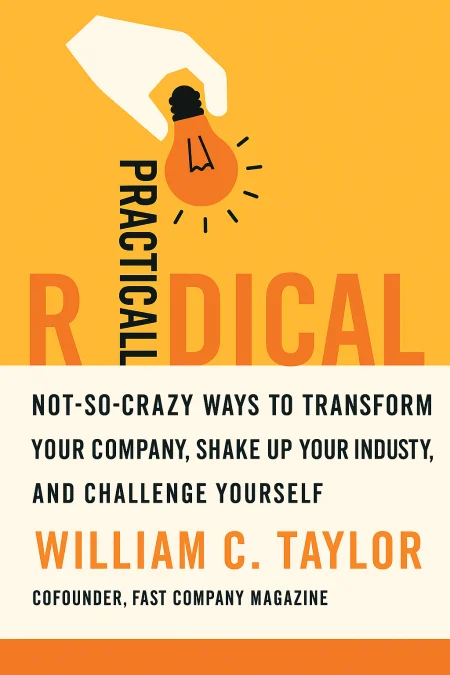
Practically Radical
Not-So-Crazy Ways to Transform Your Company, Shake Up Your Industry and Challenge Yourself
Book Edition Details
Summary
Amidst the chaos of modern business, William C. Taylor's "Practically Radical" stands as a beacon for those daring enough to redefine the norm. With a keen eye, Taylor delves into the stories of twenty-five trailblazing organizations—from the dynamic pulse of Zappos to the global reach of Interpol—showcasing their extraordinary transformations in the face of adversity. This isn’t your run-of-the-mill business manual; it’s a revolutionary manifesto for leaders hungry for change. Here lies the blueprint for unleashing innovation, challenging the status quo, and embracing the bold questions that can catapult you to success. Whether you’re a CEO or an entrepreneur at heart, this is the ultimate guide to making waves and rewriting the rules in your favor.
Introduction
In today's hypercompetitive landscape, organizations face an unprecedented paradox: the very strategies that brought success yesterday may become tomorrow's limitations. Leaders across industries grapple with a fundamental question that keeps them awake at night—how do you spark meaningful transformation without abandoning the core strengths that define your identity? The answer lies in mastering a delicate balance between bold innovation and practical wisdom, between challenging every assumption and honoring proven principles. This journey requires developing the courage to see familiar challenges through completely new eyes while building upon the foundation of what genuinely works. Whether you're steering a nimble startup or guiding an established enterprise through turbulent waters, the path forward demands both the vision to imagine radical possibilities and the discipline to execute them with precision and heart.
See with Fresh Eyes: The Vuja Dé Advantage
The concept of vuja dé represents the powerful opposite of déjà vu—instead of looking at new situations and feeling you've encountered them before, it's about examining the most familiar circumstances as if seeing them for the very first time. This mental revolution becomes the cornerstone of breakthrough thinking and transformational leadership. Dean Esserman exemplified this approach when he took command of the Providence Police Department in 2003. The department was drowning in corruption, inefficiency, and complete alienation from the community it was meant to protect. Rather than implementing standard reform protocols, Esserman applied vuja dé thinking to completely reimagine what community policing could become. He made the radical decision to open his weekly command meetings to civilians, social workers, ministers, and college students, creating unprecedented transparency and collaboration between law enforcement and community members. The transformation proved extraordinary. Crime plummeted by 30 percent during Esserman's first five years, with murders dropping 39 percent and rapes declining 64 percent. His "Beyond 911" strategy reconnected officers with their neighborhoods in ways unseen since the era of the beat cop. Officers began carrying business cards with personal cell phone numbers, encouraging direct community engagement rather than anonymous emergency responses. To cultivate your own vuja dé perspective, begin by questioning the fundamental assumptions everyone in your field accepts as unchangeable truth. What practices does your entire industry consider essential that might actually create obstacles? Challenge yourself to spend meaningful time with people from completely different sectors who might view your challenges through entirely fresh lenses. The goal isn't rejecting everything from the past, but rediscovering timeless principles that can be applied in revolutionary new ways.
Become the Most of Something: Building Distinctive Organizations
In an overcrowded marketplace where mediocrity masquerades as competence, being reasonably good at everything guarantees invisibility. The organizations that capture hearts, minds, and market share are those bold enough to become the absolute most of something meaningful—the most convenient, most innovative, most customer-obsessed, or most values-driven option in their space. Tony Hsieh transformed Zappos from an online shoe retailer into a customer service legend by becoming the most service-obsessed company in their industry. Hsieh made the counterintuitive decision to encourage customers to call rather than avoid phone contact, staffing call centers with extensively trained representatives who operated without scripts or time limits. The company's longest customer service call lasted over five hours, focusing not just on footwear but on the caller's personal life and genuine concerns. Zappos even offers new employees $2,000 to quit during training, ensuring only truly committed team members join their culture. This extreme commitment to service generated remarkable business results. Within a decade, Zappos evolved from startup to billion-dollar enterprise, ultimately attracting Amazon's $1.2 billion acquisition offer. More significantly, they achieved customer loyalty that most companies only dream of achieving—75 percent of daily shipments go to repeat customers, and their average order values significantly exceed industry standards. To build your own distinctive organization, first identify what you want to become the absolute most of in your market. This requires making difficult strategic choices about what you won't pursue in order to excel at what matters most. Create systems and processes that reinforce your chosen distinction, even when it appears inefficient or costly short-term. Most importantly, ensure every team member understands and embodies your extreme positioning, because half-hearted execution of an extreme strategy delivers worse results than no strategy at all.
Lead with Humbition: Unleashing Hidden Genius Everywhere
The most effective leaders combine genuine humility about what they don't know with ambitious determination about what their organizations can achieve. This approach, called "humbition," recognizes that breakthrough innovations often emerge from unexpected sources throughout the organization, not just from executive suites or formal research departments. Kent Thiry demonstrated this leadership philosophy when transforming DaVita from a struggling dialysis company facing bankruptcy into an industry leader. Operating in healthcare's most challenging environment, where patients require life-sustaining treatments three times weekly indefinitely, Thiry created what he describes as "a community first and a company second." The organization embraces rituals, symbols, and traditions that seem unconventional in corporate settings—company songs, Musketeer uniforms for leadership, and graduation ceremonies rivaling college commencements. This emotional engagement produced extraordinary business transformation. Under Thiry's leadership, DaVita's market capitalization grew from $200 million to over $5 billion while achieving the industry's best clinical outcomes and dramatically improving employee retention. The company's "Reality 101" program requires all senior executives to spend full weeks working in dialysis centers, ensuring leadership maintains deep empathy for both patients and frontline staff. To unleash hidden genius throughout your organization, create formal mechanisms for collecting and evaluating ideas from every level and department. Establish regular forums where people can share insights regardless of position or seniority. Invest in programs that build empathy and connection across organizational boundaries. Most importantly, celebrate and reward contributions from unexpected sources to encourage ongoing participation. Remember that your role as leader isn't having all the answers—it's creating conditions where the best answers can emerge and flourish.
Summary
The journey from conventional thinking to transformational leadership requires what visionary leaders call "reminiscing about the future"—the remarkable ability to envision possibilities so compelling they pull organizations toward better versions of themselves. As we've witnessed through countless examples, the most successful transformations combine courage to break from limiting assumptions with wisdom to build upon enduring strengths. True innovation happens when leaders dare to see familiar challenges through fresh eyes, become distinctively excellent at something meaningful, and create environments where genius can emerge from anywhere. Begin your transformation today by asking one fundamental question that can reshape everything: "If we were designing our organization from scratch right now, knowing what we know, what would we do differently?" Then take the first deliberate step toward that vision, understanding that sustainable change happens one purposeful action at a time.
Related Books
Download PDF & EPUB
To save this Black List summary for later, download the free PDF and EPUB. You can print it out, or read offline at your convenience.
By William C. Taylor
