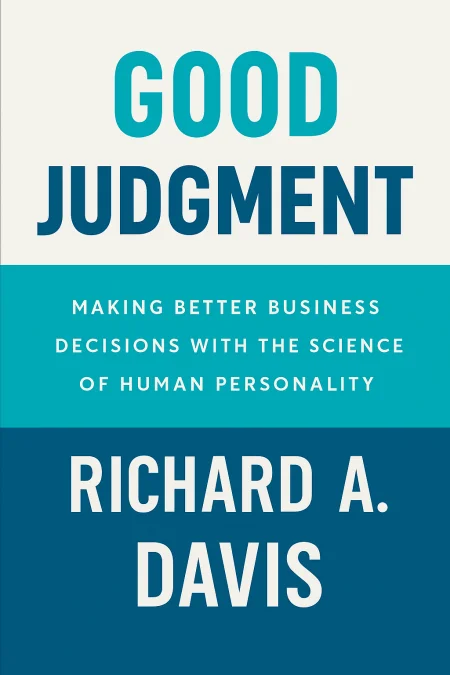
Good Judgment
Better Business Decisions with Human Personality Science
Book Edition Details
Summary
Unlock the secret to mastering human dynamics in any business setting with the profound insights of Dr. Richard Davis, a leading organizational psychologist. In "Good Judgment," Dr. Davis unravels the mysteries of personality science, guiding you to make razor-sharp decisions that can transform your professional life. Imagine having the power to discern the ideal CEO or the visionary startup founder, not through guesswork, but through a deep understanding of intellect, emotionality, and more. With decades of experience advising giants like Amazon and Nike, Dr. Davis delivers a blueprint for recognizing the personality traits that define successful leaders. Whether you're building a team or navigating corporate politics, this indispensable toolkit equips you with the skills to forge stronger relationships and elevate your career. Embrace the art of good judgment and become the architect of your own success story.
Introduction
Why do some people consistently make excellent decisions about whom to hire, marry, or partner with, while others repeatedly choose poorly? The answer lies not in intuition or luck, but in a learnable skill called perceptivity—the ability to accurately assess human personality and predict behavior based on character traits. This book presents a scientifically grounded framework that transforms how we evaluate people, moving beyond superficial impressions and popular but flawed concepts like emotional intelligence. Drawing from decades of personality psychology research, it offers practical tools for reading character quickly and accurately. The core questions addressed include: What are the fundamental dimensions of human personality that predict behavior? How can we systematically gather and interpret personality data in real-world situations? What specific techniques allow us to build stronger relationships, improve our own performance, and influence others more effectively? Rather than relying on gut feelings or pseudoscientific assessments, this approach provides a reliable methodology for understanding the deeper patterns that drive human behavior, enabling better judgment in both professional and personal contexts.
The Personality Blueprint: Five-Box Framework for Character Assessment
The foundation of accurate people assessment rests on understanding that human personality can be systematically organized into five core dimensions, each capturing essential aspects of how individuals think, feel, and behave. This framework, known as the Personality Blueprint, transforms the overwhelming complexity of human character into manageable categories that reveal predictable patterns of behavior. The five boxes of personality encompass distinct but interconnected domains. Box One, Intellect, captures how people process information and make decisions—whether they think analytically or intuitively, embrace complexity or prefer simplicity, and approach problems with creativity or convention. Box Two, Emotionality, reveals how individuals express and manage their emotional life, from those who wear their hearts on their sleeves to those who maintain stoic composure under pressure. Box Three, Sociability, describes interpersonal style and communication patterns, distinguishing natural extroverts who energize in social settings from thoughtful introverts who prefer deeper, quieter connections. Box Four, Drive, illuminates the underlying motivations that fuel behavior—whether someone is primarily motivated by achievement, money, recognition, creative expression, or service to others. Box Five, Diligence, captures work style and organizational habits, from meticulous planners who thrive on structure to spontaneous individuals who prefer flexibility and improvisation. These dimensions interact dynamically, creating unique personality profiles that explain why people behave consistently across different situations. Consider how this framework reveals character in action. A startup CEO might score high on Intellect and Drive, showing strategic thinking and fierce ambition, but low on Diligence, leading to brilliant vision paired with poor execution. Understanding these patterns allows for more nuanced evaluation than simple good-or-bad judgments, revealing both strengths to leverage and potential weaknesses to manage. This systematic approach to personality assessment provides the foundation for all subsequent people decisions.
Deep-Dive Interviews and Revealing Conversations for Selection
The most powerful tool for assessing personality lies not in standardized tests but in skillfully conducted conversations that reveal character through personal narrative and behavioral patterns. The deep-dive interview technique transforms ordinary dialogue into a scientific instrument for understanding who people truly are beneath their professional facades. This approach begins with creating psychological safety through genuine rapport-building, allowing subjects to lower their defenses and speak authentically about their experiences. The methodology then guides individuals through their personal chronology, from childhood influences and family dynamics through educational choices and career transitions. Each element of their story provides data points that illuminate personality patterns—how they handle adversity, make decisions under pressure, form relationships, and define success. Four power questions prove particularly revelatory in uncovering character. First, exploring how individuals resemble or differ from their parents reveals inherited traits and conscious reactions to early influences. Second, examining their friendship patterns exposes values and social preferences that predict compatibility. Third, asking them to characterize their own life story as an outside observer encourages self-reflection and reveals their level of personal insight. Fourth, inquiring what former bosses or colleagues would say about them tests their self-awareness and comfort with feedback. The conversation structure includes strategic breaks that allow for psychological processing and often prompt deeper revelations. People use these pauses to reflect on what they have shared, frequently returning with more honest or complete accounts of their experiences. This technique recognizes that personality assessment is not about extracting information through interrogation but about creating space for authentic self-expression. The resulting insights far exceed what any standardized assessment could provide, revealing not just what traits people possess but how those traits manifest in their unique life context and behavioral patterns.
User's Manuals and Partnership Road Maps for Relationships
Once personality patterns are understood, this knowledge must be translated into practical strategies for building and maintaining successful relationships. User's manuals for people provide personalized guides for optimal interaction, while partnership road maps establish frameworks for navigating inevitable conflicts and challenges. A user's manual captures the specific behavioral needs and triggers of an individual based on their personality profile. For someone high in Emotionality and low in Diligence, the manual might recommend providing emotional support during stressful periods while implementing external structure to compensate for their organizational challenges. For a highly analytical, introverted leader, it might suggest presenting ideas with detailed logic and data while allowing processing time before expecting decisions. These manuals address critical relationship dynamics: what motivates and demotivates the person, how they prefer to receive feedback, what their stress signals look like, and how their personality strengths might become liabilities under pressure. They also include guidance on managing one's own reactions to personality traits that might clash with your own preferences. Someone who values efficiency might need strategies for patiently working with a colleague who processes decisions more slowly but more thoroughly. Partnership road maps take this concept further by establishing mutual understanding and agreed-upon interaction protocols between two people. These collaborative agreements acknowledge each person's personality patterns and create explicit guidelines for communication, conflict resolution, and mutual support. They might specify that a highly competitive individual will receive direct, challenging feedback as engagement rather than aggression, while their conflict-averse partner will interpret pauses and questions as respectful consideration rather than resistance. The power of these tools lies in their proactive approach to relationship management. Rather than waiting for personality differences to create friction, they create conscious awareness and predetermined strategies for leveraging differences as complementary strengths while minimizing potential conflicts through mutual understanding and adaptation.
Character Quick Takes for In-the-Moment Influence
The ability to rapidly assess personality and adjust behavioral strategies in real-time represents the dynamic application of character insight for immediate influence and connection. Character Quick Takes provide a systematic approach to gathering personality data within minutes and using that information to enhance communication effectiveness. This technique begins with heightened observational awareness, scanning for verbal and nonverbal cues that reveal dominant personality traits. Language sophistication and logical structure might indicate high Intellect, while emotional expressiveness and people-focused conversation suggests strong Emotionality. Confident eye contact and animated gestures often signal high Sociability, while references to achievement, competition, or material success reveal particular Drive motivations. Attention to detail in appearance and punctuality typically indicates strong Diligence. The strategy involves forming rapid hypotheses about which personality dimension someone leads with, then adjusting your own communication style to create resonance and rapport. When encountering someone who appears analytically minded, presenting logical arguments with supporting data proves more persuasive than emotional appeals. With someone who seems relationship-focused, building personal connection before addressing business matters increases receptivity to your message. Calibration remains essential, as initial impressions require testing and refinement through continued interaction. Context also matters significantly—someone's behavior in a stressful interview might not reflect their typical personality expression. The most skilled practitioners use brief rapport-building exchanges to gather additional data while simultaneously demonstrating their own positive traits. The power of Character Quick Takes lies in their ability to transcend surface-level social interaction and quickly establish meaningful connection based on genuine understanding. Rather than manipulative tactics, this approach represents authentic adaptation to others' communication preferences and psychological needs. When applied ethically, it creates more satisfying interactions for both parties while dramatically improving the likelihood of achieving desired outcomes in negotiations, interviews, sales situations, and everyday social encounters.
Summary
True wisdom in human relationships emerges not from intuition alone but from the systematic application of personality science to understand, predict, and positively influence behavior. This approach transforms people decisions from guesswork into informed judgment, creating better outcomes in hiring, partnering, and daily interactions. The methodology provides lasting value because personality traits remain remarkably stable over time, making character assessment a reliable foundation for long-term relationship success. Beyond its practical applications, developing perceptivity as a skill enhances empathy, reduces bias, and creates deeper understanding of both others and ourselves. In an increasingly complex social world, the ability to accurately read character represents not just a professional advantage but an essential life skill for building meaningful connections and making wise choices about the people who shape our personal and professional destinies.
Related Books
Download PDF & EPUB
To save this Black List summary for later, download the free PDF and EPUB. You can print it out, or read offline at your convenience.
By Richard A. Davis
