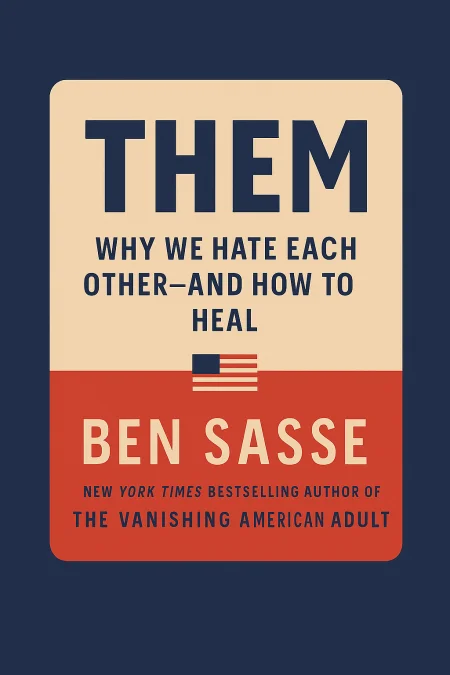
Them
Why We Hate Each Other – and How to Heal
Book Edition Details
Summary
In a nation teetering on the brink of disconnection, Ben Sasse delivers a potent wake-up call in "Them." As life expectancy wanes and birth rates plummet, America finds itself drowning in division, not just politically but at the very core of human connection. Sasse, a New York Times bestselling author and U.S. Senator, shatters the illusion that our crisis is merely a political one. Instead, he uncovers a deeper loneliness that has crept into the fabric of our lives, eroding the community bonds that once held us together. While technology amplifies our estrangement, Sasse argues for a revolutionary return to genuine human relationships and local engagement. With a keen eye for societal patterns, he urges readers to reclaim the roots of trust and neighborly love, positing that the revival of our communities could very well be the antidote to the nation's pervasive despair. This book is not just an analysis but a rallying cry to mend the fractures in America's soul by nurturing the connections right outside our front doors.
Introduction
American society confronts an unprecedented crisis of social fragmentation that threatens the very foundations of democratic life. This crisis manifests not merely as political polarization, but as the systematic erosion of the bonds that once held communities together—the decline of civic institutions, the collapse of social trust, and the substitution of authentic relationships with digital simulacra. The phenomenon extends beyond partisan divisions to encompass a fundamental transformation in how Americans relate to one another, their communities, and their shared democratic project. The analysis reveals how economic disruption, technological mediation, and geographic mobility have converged to undermine traditional sources of meaning and belonging. When genuine community disappears, humans inevitably seek substitutes in tribal affiliations that provide identity through opposition rather than shared purpose. This substitution proves ultimately destructive, creating cycles of antagonism that further erode the possibility of authentic connection. The examination employs both empirical evidence and philosophical reflection to demonstrate that democratic renewal requires more than political reform—it demands the patient reconstruction of social infrastructure through intentional choices about place, presence, and civic engagement. The path forward involves understanding how the collapse occurred and taking concrete steps to rebuild the relationships and institutions that make both individual flourishing and collective self-governance possible.
The Collapse of Authentic Community and Rise of Anti-Tribal Substitutes
The dissolution of American social capital represents one of the most significant transformations in modern democratic life. Traditional institutions that once provided Americans with identity, purpose, and mutual support have experienced dramatic decline over several decades. Bowling leagues, religious congregations, labor unions, and neighborhood associations have lost millions of members, leaving individuals increasingly isolated despite unprecedented technological connectivity. This institutional collapse has created what sociologists term "relationship inequality"—a growing divide between those with robust social networks and those without access to meaningful community connections. The economic dimension of this collapse reveals itself most starkly in the divergent experiences of college-educated Americans versus those without higher education. While the former maintain relatively stable family structures and community ties, working-class Americans face rising rates of family breakdown, social isolation, and economic displacement. This bifurcation extends beyond income inequality to encompass differential access to the social relationships that provide resilience, opportunity, and meaning in life. The vacuum left by declining authentic community has been filled by what can be characterized as anti-tribal formations—groups defined primarily by shared enemies rather than constructive common purpose. These substitutes provide the psychological benefits of belonging while requiring minimal actual relationship or mutual obligation. Political movements, cultural factions, and ideological communities offer identity and emotional satisfaction through antagonism rather than through the vulnerable work of building something together with others. This tribal substitution proves ultimately unsatisfying because it lacks the depth and reciprocity that characterize genuine community. Anti-tribal membership requires only shared grievances and common opponents, not the sustained commitment and mutual dependence that create lasting bonds. The result is a society of increasingly isolated individuals seeking connection through conflict rather than cooperation, perpetuating cycles of division that further undermine the possibility of authentic community formation and democratic deliberation.
How Digital Media Systematically Undermines Genuine Human Connection
Digital technology has fundamentally altered the landscape of human attention and social interaction in ways that systematically undermine community formation. The transformation from shared media experiences to individualized content consumption has eliminated common reference points for public discourse, creating what might be termed "reality silos" where different groups operate from entirely different sets of facts and assumptions. This fragmentation makes democratic deliberation increasingly difficult as citizens lose the shared foundation necessary for productive disagreement and compromise. Social media platforms, despite promises of enhanced connectivity, have proven particularly destructive to genuine relationship. Their business models depend on capturing and monetizing human attention through design features that prioritize engagement over truth and emotional reaction over thoughtful reflection. The resulting environment rewards the most provocative and divisive content while marginalizing nuanced discussion and authentic dialogue. Users become products to be sold to advertisers, with algorithms optimized to maximize screen time rather than foster meaningful human connection. The psychological effects of constant digital stimulation extend beyond mere distraction to fundamental changes in how humans process information and relate to one another. Research demonstrates correlations between excessive screen time and increased rates of anxiety, depression, and social isolation, particularly among young people. The dopamine-driven feedback loops of social media create addictive patterns that substitute for but cannot replicate the deeper satisfaction of face-to-face interaction and shared physical presence. Perhaps most significantly, digital mediation has altered the temporal and spatial dimensions of human experience in ways that conflict with community formation. Authentic relationships require sustained presence in particular places with specific people over extended time periods. Digital connectivity promises the opposite: instant access to anyone, anywhere, at any time. This apparent freedom actually constrains genuine relationship by making it difficult to commit fully to any particular set of people or places, since seemingly better options remain perpetually available in the digital realm.
Rebuilding Local Democracy Through Place-Based Civic Engagement
The renewal of democratic community must begin with intentional choices about place and presence that resist the centrifugal forces of digital culture. This involves what might be characterized as strategic rootedness—the deliberate decision to invest deeply in particular geographic locations and specific groups of people rather than maintaining superficial connections across vast networks. Such rootedness does not require rejecting all technology, but rather subordinating technological tools to human purposes rather than allowing them to dictate the terms of relationship and civic engagement. Local institutions provide the most promising foundation for democratic renewal because they operate at human scale and require face-to-face interaction among people who share common interests in their immediate environment. Schools, religious congregations, neighborhood associations, and local businesses create natural opportunities for repeated encounters that build trust and mutual understanding over time. These institutions succeed when they prioritize relationship-building over efficiency and create space for the informal interactions that transform collections of individuals into genuine communities capable of democratic self-governance. The challenge lies in adapting traditional forms of local engagement to contemporary realities of economic mobility and technological saturation. This requires creative approaches that honor the need for geographic flexibility while maintaining commitment to particular communities. Successful examples include seasonal residents who invest deeply in local institutions during their time in a place, or professionals who use technology strategically to maintain involvement in hometown communities despite career-related relocations. Authentic community renewal also demands recognition that genuine relationships require shared work toward common goals rather than mere social interaction. Communities cohere around projects that matter to their members—whether maintaining local infrastructure, caring for vulnerable neighbors, or preserving shared cultural traditions. These activities create bonds that transcend individual preferences and provide the sense of mutual dependence that transforms groups of people into genuine communities capable of weathering disagreement while maintaining fundamental solidarity necessary for democratic life.
Practical Strategies for Restoring Community in the Digital Age
The restoration of American community requires individual and collective choices that prioritize depth over breadth in relationships while resisting cultural pressures toward constant mobility and digital distraction. This begins with what might be termed technological sabbath—regular periods of disconnection from digital devices that create space for sustained attention to immediate surroundings and present company. Such practices need not involve complete rejection of technology but rather its conscious subordination to human flourishing rather than corporate profit maximization. Geographic commitment represents another essential element of community renewal, though this need not mean permanent immobility. The crucial insight involves choosing particular places for sustained investment rather than treating all locations as interchangeable. This might involve purchasing property, joining local institutions, or simply committing to remain in a place long enough to develop genuine relationships with neighbors and contribute meaningfully to local civic life. Even temporary residents can invest deeply in local communities if they approach their time with intentionality rather than treating locations as mere way stations. Civic engagement provides concrete opportunities to practice the skills of democratic citizenship while building relationships across lines of difference. Local politics, volunteer organizations, and community institutions offer venues for working alongside people with whom one might disagree on national issues but share common concerns about immediate surroundings. These experiences teach the arts of compromise, collaboration, and constructive disagreement that democracy requires while creating personal relationships that humanize political differences and make productive conflict possible. The ultimate goal involves recovering what Alexis de Tocqueville observed as the distinctly American genius for voluntary association—the ability to identify common problems and organize collective responses without waiting for government direction or permission. This capacity depends on social trust, civic skills, and shared commitment to particular places and people. Rebuilding these foundations requires patient work at the local level, person by person and relationship by relationship, creating the social infrastructure that makes democratic self-governance both possible and meaningful for future generations.
Summary
The crisis facing American democracy stems not from political disagreement but from the deeper erosion of the relationships and institutions that make democratic life possible. Economic transformation, geographic mobility, and digital mediation have created unprecedented individual freedom while simultaneously undermining the social bonds that provide meaning, support, and civic capacity. The solution requires intentional choices about place, presence, and priority that resist cultural pressures toward mobility, distraction, and superficial connection. Rebuilding authentic community demands sustained commitment to particular people and places, engagement with local institutions, and the patient work of democratic citizenship at human scale. This represents not nostalgic retreat but rather the essential foundation for addressing contemporary challenges through the distinctly American tradition of voluntary association, mutual aid, and democratic self-governance rooted in genuine human relationship and shared commitment to the common good.
Related Books
Download PDF & EPUB
To save this Black List summary for later, download the free PDF and EPUB. You can print it out, or read offline at your convenience.
By Ben Sasse
